



30W vs 45W vs 65W Chargers: Which One Should You Choose?
 18 May,2026
In the rapidly evolving landscape of consumer electronics, the distinction between power delivery tiers is often oversimplified by marketing teams. For a 30w usb charger, a 45 watt usb c charger, or a 65W charger, the wattage rating is merely the peak output capability, not a comprehensive metric of performance. For B2B buyers and product managers, understanding the underlying circuit topology and thermal behavior is critical for reducing RMA rates and ensuring long-term reliability.
While the market trends heavily toward "higher is better," deploying a 65W adapter for a device that draws a maximum of 25W is an inefficient allocation of budget and engineering resources. The core challenge lies in matching the Switching Frequency Optimization and transformer design to the specific load profile of the end device. A mismatched power supply not only inflates BOM costs but can also operate outside its peak efficiency curve, generating unnecessary heat.
Technical Fundamentals: PD Architecture and GaN Integration
The transition from silicon-based MOSFETs to Gallium Nitride (GaN) has revolutionized power density, particularly in the 30w usb charger segment. However, the architecture changes significantly as power increases.
Topology Shifts: A standard 30W unit typically utilizes a Quasi-Resonant (QR) Flyback topology. This is cost-effective and reliable for lower power. As we move to a 45 watt usb c charger or 65W, engineers often shift to Active Clamp Flyback (ACF) or LLC Resonant topologies to minimize switching losses at higher frequencies.
Protocol Handshakes: Modern chargers rely on the USB-PD (Power Delivery) protocol. This involves a complex negotiation between the Source (charger) and Sink (device). The inclusion of PPS (Programmable Power Supply) allows for dynamic voltage adjustment in 20mV steps, which is crucial for reducing thermal throttling in the connected smartphone or laptop.
Thermal Management: In compact designs, heat dissipation is the limiting factor. High-frequency switching reduces transformer size but increases the thermal stress on the controller and switching nodes.

Engineering Trade-off Analysis: Efficiency Curves vs. BOM Cost
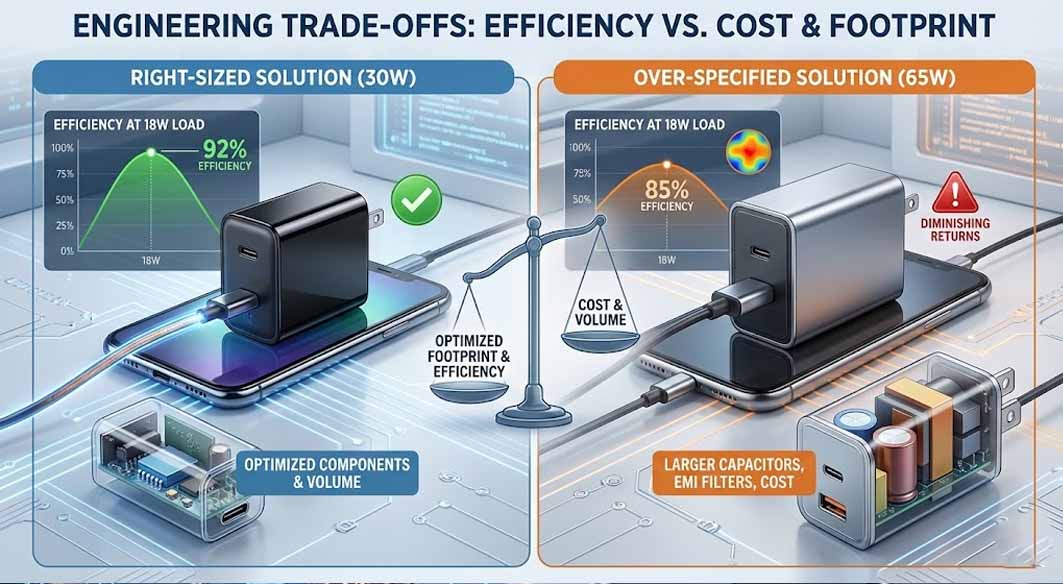
In meaningful engineering, there are no perfect solutions, only trade-offs. A common misconception in procurement is that a 65W charger is universally superior because it covers the lower ranges of 30W and 45W. From a design perspective, this logic is flawed regarding Efficiency at light loads.
A power supply is typically designed to hit peak efficiency at 50% to 100% load. When a 65W charger is used to charge a phone drawing only 18W, the charger operates at a lower point on its efficiency curve. This results in a higher percentage of energy being lost as heat relative to the power delivered.
Furthermore, the passive components required for 65W—such as larger bulk capacitors and EMI filters—add volume and cost. By specifying a 30w usb charger for mobile-first accessories, you optimize the physical footprint and maintain higher efficiency during the actual charging cycle of the device. Over-specifying power leads to "diminishing returns" where the added cost of the 45 watt usb c charger or 65W unit does not translate to faster charging speeds for devices capped at lower wattages.
Industry Pain Points in Power Supply Selection
When sourcing power adapters, OEM/ODM clients frequently encounter specific failure modes that are not apparent on a datasheet.
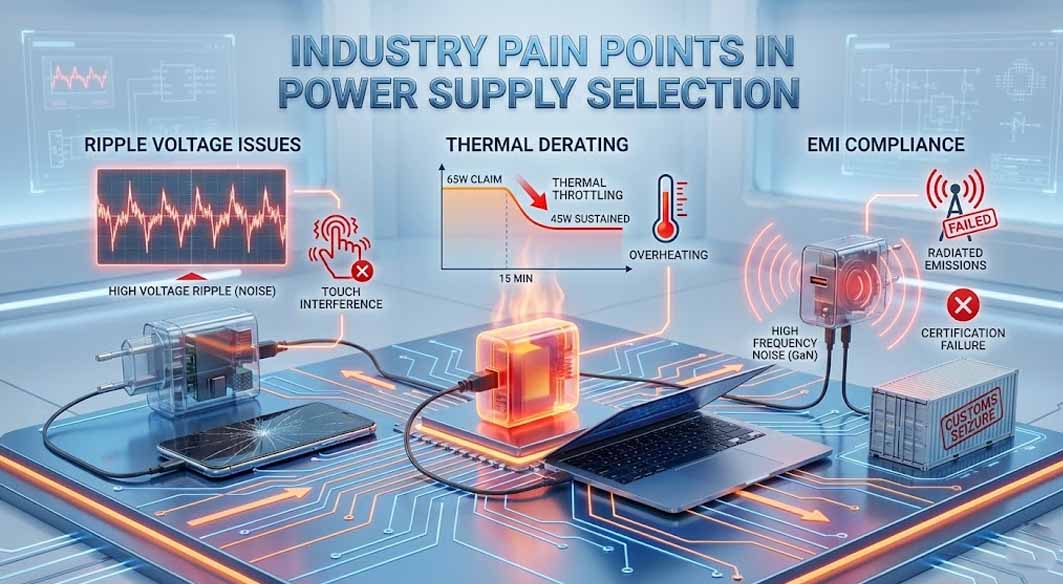
Ripple Voltage Issues: Poorly designed output filters can lead to high voltage ripple. This noise interferes with the touch sensitivity of tablets and smartphones, a common complaint in user reviews.
Thermal Derating: Many chargers claim 65W but cannot sustain it. After 15 minutes, thermal protection kicks in, dropping the output to 45W or lower. This makes the "65W" label misleading for continuous load applications like laptops.
EMI Compliance: As switching frequencies rise to reduce size (enabled by GaNFast technology or similar), Electromagnetic Interference (EMI) becomes harder to contain. Cheaply made chargers often fail radiated emissions tests, leading to customs seizures or certification failures.
Implementation Strategies in High-Density Designs
Achieving a balance between compact size and thermal stability requires rigorous component selection. In a reference engineering case involving a high-density 30w usb charger, the Tommox design team identified that standard potting compounds were trapping heat around the primary MOSFET. By switching to a vertical PCBA layout and selecting a transformer with a lower leakage inductance, the design achieved better airflow and reduced voltage spikes on the drain, effectively mitigating the need for excessive snubber circuits. This approach highlights how structural engineering is just as vital as electrical engineering in preventing Failure Mode Analysis triggers.
Comparison: 30W vs. 45W vs. 65W Charger
To assist in correct SKU planning, the following comparison breaks down the technical suitability for different applications.
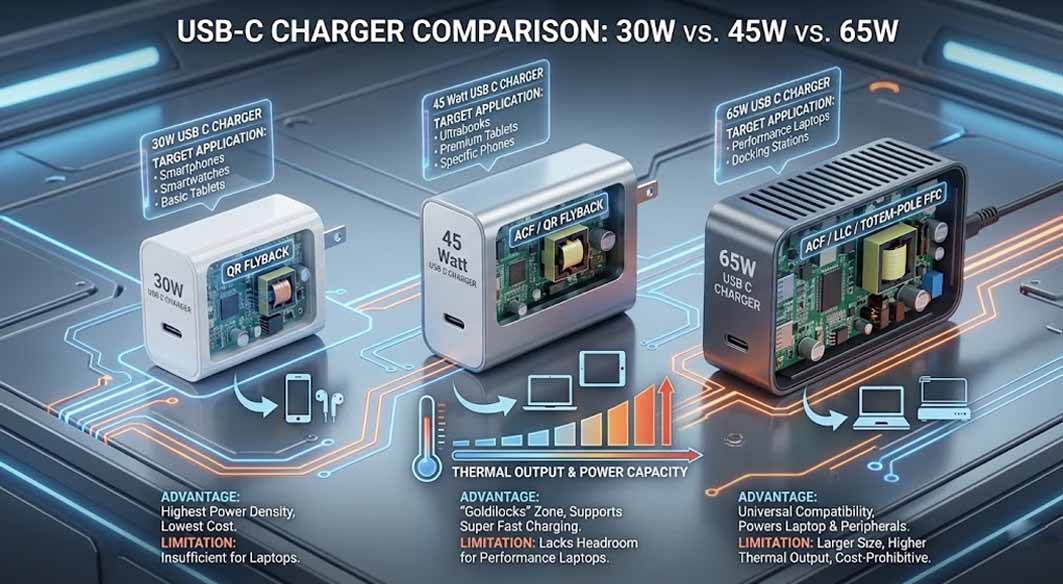
The 30W USB C Charger
Target Application: Smartphones (iPhone/Android), Earbuds, Smartwatches, Basic Tablets (iPad Air).
Topology: Typically QR Flyback.
Advantage: Highest power density for mobile devices; lowest cost; excellent light-load efficiency.
Limitation: Insufficient for most laptops; slow charging for large tablets.
The 45 Watt USB C Charger
Target Application: Ultrabooks (MacBook Air), Premium Tablets (iPad Pro), Samsung Phones (requiring specific PPS profiles).
Topology: QR Flyback or ACF.
Advantage: The "Goldilocks" zone for modern mobile computing; supports Super Fast Charging protocols effectively.
Limitation: Often lacks the headroom for performance laptops under heavy load.
The 65W USB C Charger
Target Application: Performance Laptops (MacBook Pro 13/14), Docking Stations, Universal Travel Adapters.
Topology: ACF, LLC, or Totem-Pole PFC (for higher efficiency).
Advantage: Universal compatibility; can power a laptop while charging peripherals.
Limitation: Larger physical size; higher thermal output; cost-prohibitive for "in-box" mobile bundles.
FAQ for Procurement Managers
Q: Is PPS mandatory for a 30W USB charger?
A: For basic PD compatibility, no. However, for modern Android flagships (Samsung/Pixel), PPS is required to achieve advertised charging speeds and manage device thermals.
Q: How does ripple control affect the end-user experience?
A: High ripple causes "ghost touches" on screens and can degrade the battery life of the connected device over time. Sourcing adapters with strict Ripple Control (<100mV) is essential for brand reputation.
Q: Can a 45 watt usb c charger replace a 65W laptop charger?
A: It can charge the laptop, but usually at a slower rate. If the laptop is under heavy CPU load, the battery may still slowly drain even when plugged in.
Future Trends & Design Direction
The future of power electronics is moving toward total integration. We are seeing the rise of "All-in-One" controller ICs that combine the primary driver, secondary synchronous rectifier, and protocol controller into a single package.
Higher Power Density: Pushing beyond 1.5W/cc allows for a 30w usb charger to shrink to the size of typical 5W cube.
Dynamic Load Balancing: Multi-port chargers will become smarter, allocating power based on real-time device negotiation rather than fixed ratios.
Sustainability: Focus on standby power consumption (less than 30mW) and the use of PCR (Post-Consumer Recycled) plastics in casings.
For sourcing managers, the key is to look past the wattage number and evaluate the custom power solution based on thermal capability and topology suitability.
 Is a High-Power Charger Safe for Daily Use?