



Why USB-C Chargers Are Becoming the New Standard?
 05 Feb,2026
The Inevitable Shift to Unified Power Architecture
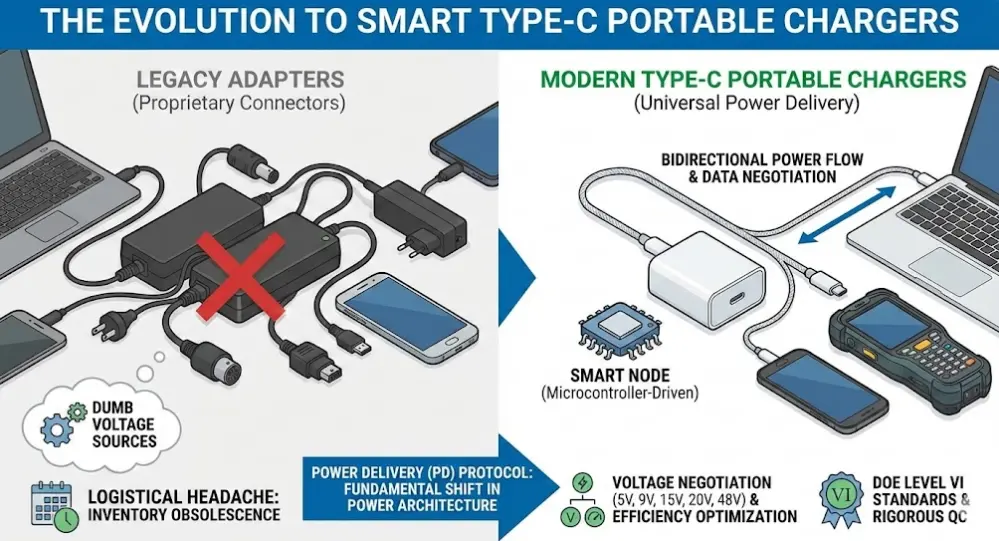
The era of proprietary connectors is effectively over. The ubiquity of the type c portable charger across laptops, smartphones, and industrial handhelds represents a fundamental shift in power delivery architecture, not just a change in cable shape. For procurement managers and electronics distributors, understanding the engineering beneath this transition is vital for avoiding inventory obsolescence.
The migration is driven by the Power Delivery (PD) protocol, which allows for bidirectional power flow and complex data negotiation on a single wire. Unlike legacy adapters that acted as "dumb" voltage sources, a modern type c portable charger acts as a smart node in a power network. It negotiates voltage levels (5V, 9V, 15V, 20V, and now up to 48V) based on the device's immediate requirements and thermal state.
This standardization solves a massive logistical headache for B2B buyers, but it introduces new complexities in quality control. A charger is no longer just a transformer and a rectifier; it is a microcontroller-driven system requiring rigorous firmware stability and Efficiency optimization to meet DOE Level VI standards.
Technical Fundamentals: Inside the PD Protocol
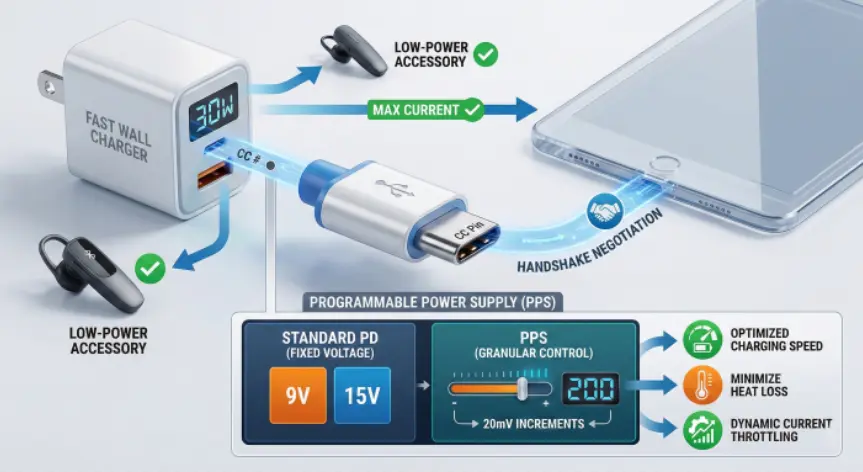
To understand why USB-C is dominant, we must look at the handshake mechanism. When a user connects a fast wall charger to a device, a distinct negotiation sequence occurs via the Configuration Channel (CC) pins.
This process ensures that a 30 watt charger does not accidentally fry a low-power accessory like a Bluetooth headset, while still delivering maximum current to a tablet.
The Role of Programmable Power Supply (PPS)
One of the most critical advancements in recent years is PPS. In standard PD, voltage is fixed (e.g., 9V or 15V). However, with PPS, the type c portable charger can adjust voltage in 20mV increments. This granular control allows the receiving device (the sink) to:
Optimize charging speed by keeping the battery charging pump in its most efficient range.
Minimize conversion loss on the device side, reducing phone/laptop heating.
Dynamically throttle current based on real-time thermal feedback.
Engineering Trade-off Analysis: Density vs. Thermal Reliability
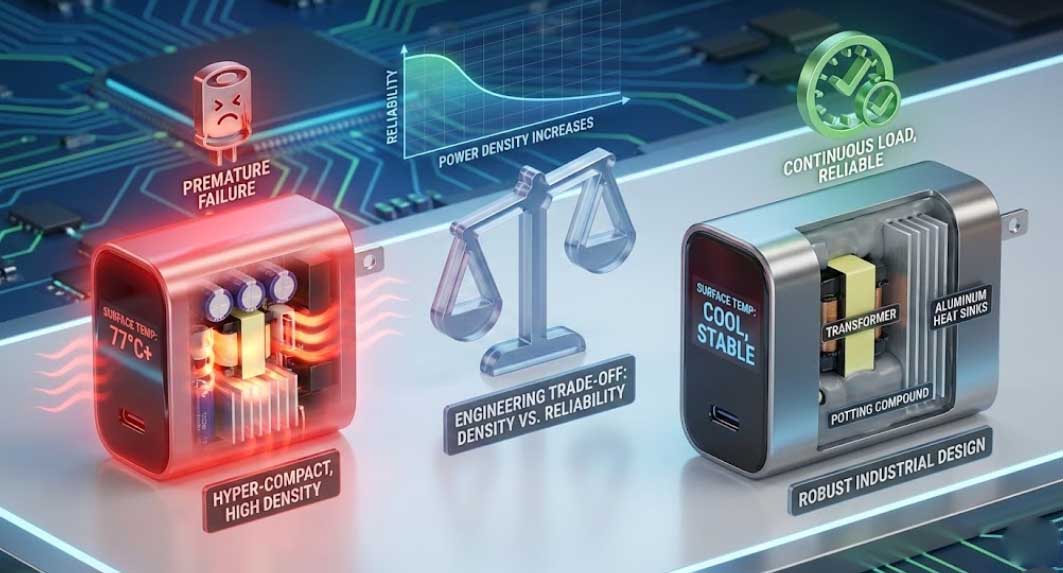
In the race to manufacture the smallest type c portable charger, many designs compromise reliability for distinctiveness. As an engineer, it is crucial to clarify a common misconception: Smaller is not always better for B2B applications.
High power density creates a concentrated heat source. If a 65W charger is compressed into the volume of a standard 30 watt charger without adequate thermal mass, the internal components—specifically the electrolytic capacitors—suffer.
The Thermal Conundrum
Switching Frequency Optimization: To shrink magnetics (transformers), engineers increase the switching frequency. However, higher frequency increases switching losses (heat).
The Trade-off: A hyper-compact charger often requires aggressive active cooling or runs at surface temperatures near regulatory limits (often 77°C or higher). For a consumer carrying a charger for an hour, this is acceptable. For an enterprise deploying chargers in a fleet or industrial setting where they are plugged in 24/7, this thermal stress leads to premature Failure Mode Analysis triggers, such as capacitor dry-out.
Therefore, a robust industrial design often deliberately sacrifices a few cubic centimeters of volume to incorporate better heat sinking or potting compounds, ensuring the device survives the warranty period under continuous load.
Tommox Design Implementation: Engineering for Stability
In the development of the Tommox 30 watt charger series, the engineering team faced a decision regarding topology selection. The choice lay between a standard Flyback topology and a Quasi-Resonant (QR) approach.
While a standard Flyback is cost-effective, it suffers from higher switching losses. The engineering team opted for a QR topology coupled with GaNFast technology components. This decision was not made to chase marketing specs but to address Thermal Management at the source.
Implementation specifics included:
Full Potting: The PCBA is encased in a thermal compound. This conducts heat away from the GaN FETs to the outer shell evenly, eliminating hot spots.
EMI Shielding: High-frequency switching generates noise. The design incorporated dedicated shielding to ensure the fast wall charger does not interfere with sensitive touchscreens or medical equipment powered nearby.
Conservative De-rating: Components were selected with higher voltage ratings than strictly necessary, providing a safety margin against grid surges.
This approach demonstrates that the utility of a type c portable charger in a B2B context relies on consistent performance rather than peak theoretical output.
Comparison: Silicon vs. GaN in Fast Wall Chargers
For sourcing managers, distinguishing between legacy Silicon (Si) and Gallium Nitride (GaN) is essential for portfolio segmentation.
| Feature | Legacy Silicon Charger | GaN-Based Fast Wall Charger |
| Material Bandgap | 1.1 eV (Narrow) | 3.4 eV (Wide) |
| Switching Speed | Slow (<100 kHz typical) | Fast (>200 kHz typical) |
| Thermal Efficiency | Moderate (Significant heat loss) | High (95%+ Efficiency possible) |
| Size Factor | Bulky, requires large heatsinks | Compact, high power density |
| Application | Low-cost, low-power adapters | High-performance laptops, type c portable charger |
FeatureLegacy Silicon ChargerGaN-Based Fast Wall Charger
Material Bandgap1.1 eV (Narrow)3.4 eV (Wide)
Switching SpeedSlow (<100 kHz typical)Fast (>200 kHz typical)
Thermal EfficiencyModerate (Significant heat loss)High (95%+ Efficiency possible)
Size FactorBulky, requires large heatsinksCompact, high power density
ApplicationLow-cost, low-power adaptersHigh-performance laptops, type c portable charger
While Silicon remains viable for cost-sensitive, low-power applications (under 20W), GaN is the requisite standard for any modern 30 watt charger or higher intended for travel or multi-port use.
Why Ripple Control Matters
Beyond the material, Ripple Control is a defining quality metric. Poor quality chargers output "dirty" DC power with high voltage ripple. Over time, this ripples causes stress on the battery management system (BMS) of the connected device. High-grade engineering focuses on smoothing this output to prolong the lifespan of the end-device—a critical selling point for B2B contracts.
Industry Pain Points for Distributors
When sourcing a type c portable charger line, buyers frequently encounter specific failure modes that damage brand reputation.
Incompatible Handshakes: Some low-quality controllers fail to properly negotiate with Apple or Samsung proprietary protocols, defaulting to slow charging (5W) despite being advertised as a fast wall charger.
Coil Whine: Due to poor varnishing of the transformer or lack of acoustic damping, chargers can emit an audible high-pitched noise, leading to high return rates in office environments.
Connector Durability: The USB-C port is a mechanical wear point. Inferior metallurgy in the receptacle leads to loose connections after a few hundred cycles.
<a href="/oem-power-supply-solutions">Explore OEM Power Supply Solutions</a> that address these specific mechanical and electrical failure points.
Future Trends: Beyond 100W
The definition of a type c portable charger is expanding. The USB PD 3.1 standard now enables power delivery up to 240W.
GaN Integration: Future designs will see the driver and FET integrated into a single package to further reduce parasitic inductance.
Smart Load Balancing: Multi-port chargers will utilize AI-driven algorithms to predict device usage patterns and allocate power more intelligently than static logic allows.
Universal DC Microgrids: We are moving toward buildings wired with DC Type-C outlets directly, reducing the need for the AC-to-DC fast wall charger entirely, though this transition will take decades.
FAQ: Procurement & Engineering Perspectives
Q1: Is a 30 watt charger sufficient for modern laptops?
A: For Ultrabooks (like MacBook Air) and Chromebooks, a 30 watt charger is sufficient for charging while working. However, for performance laptops or workstations, it will likely only slow down the battery drain or charge very slowly while in sleep mode. It is the ideal sweet spot for tablets and smartphones.
Q2: How does a type c portable charger handle voltage surges?
A: Industrial-grade units utilize Metal Oxide Varistors (MOVs) and fuses on the input stage. However, the robustness depends on the clamping voltage selected during design. Cheaper units often omit the MOV to save space, leaving the charger vulnerable to "dirty" grid power.
Q3: Why do some chargers get hot even when not charging?
A: This is due to high standby power consumption ("vampire draw"). Efficient designs disable the main switching circuit when no load is detected, dropping consumption to <30mW. If a unit stays warm, it indicates poor standby efficiency topology.
Q4: What certifications are non-negotiable for B2B imports?
A: Depending on the region, UL/ETL (North America), CE/LVD (Europe), and PSE (Japan) are mandatory. Beyond safety, EMC compatibility (FCC/CISPR) is critical to ensure the fast wall charger does not interfere with wireless communications.
Conclusion
The transition to USB-C is a transition to intelligent power. For distributors, success lies in looking beyond the wattage rating and understanding the thermal architecture, protocol compliance, and component quality that define a reliable product.
 How to Choose a Reliable Charger Manufacturer for Your Brand