



How to Choose a Reliable Charger Manufacturer for Your Brand
 05 Feb,2026
In the current consumer electronics market, the 30 watt charger has become the baseline standard for smartphones and tablets. It sits at the critical intersection of portability and power density. However, for sourcing managers and brand owners, the commoditization of this product category presents a hidden danger. Visually identical chargers can exhibit vastly different performance characteristics once they leave the lab and enter the hands of the end-user.
Selecting a manufacturing partner is not merely about comparing price sheets; it is about understanding the engineering DNA of the supplier. Whether you are sourcing a standard phone wall charger or a custom 30w fast charger design, the difference between a product that builds brand loyalty and one that causes a recall lies in the invisible details: thermal management, component derating strategies, and EMI (Electromagnetic Interference) control.
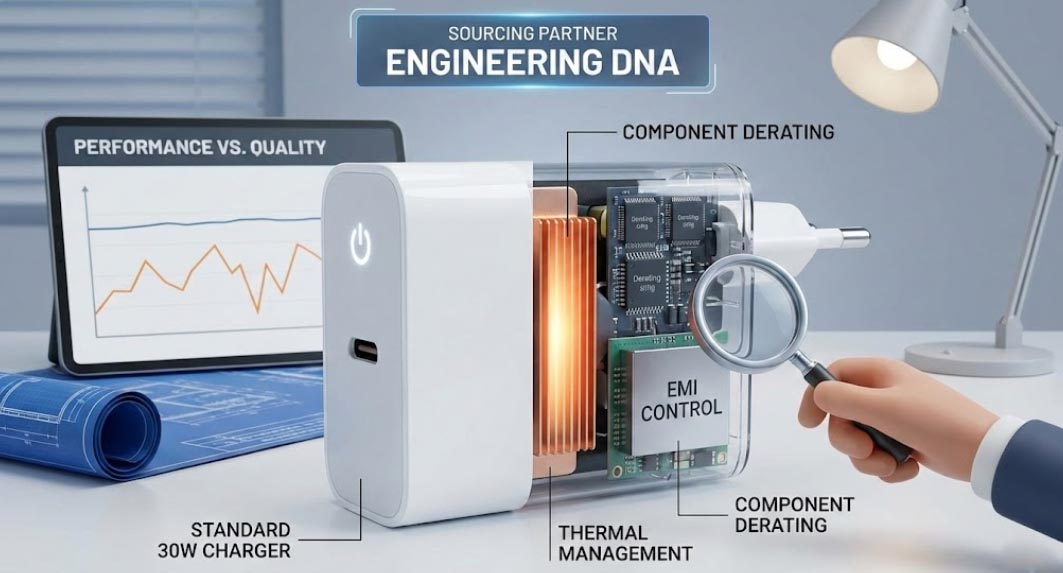
Technical Fundamentals: Inside a High-Performance 30 Watt Charger
To procure a reliable product, one must understand the architecture. A modern 30 watt charger typically utilizes a Quasi-Resonant (QR) Flyback topology, often enhanced with Gallium Nitride (GaN) semiconductors.
Unlike legacy silicon-based designs, GaNFast technology allows for higher switching frequencies. This enables the use of smaller transformers and capacitors, increasing power density. However, simply shrinking the PCBA brings engineering challenges that a manufacturer must address:
Switching Frequency Optimization: Higher frequency reduces size but increases switching losses and EMI. A competent engineering team tunes the frequency to find the "sweet spot" between compactness and thermal efficiency.
Ripple & Noise Control: Poorly designed output filters result in high voltage ripple. This can cause "ghost touches" on capacitive touchscreens and degrade the battery health of the connected device.
Protocol Handshake: The controller must flawlessly execute USB-PD and PPS (Programmable Power Supply) negotiations to ensure the 30w fast charger delivers the correct voltage/current curve without resetting.
Industry Pain Points: Why Generic Phone Wall Chargers Fail
In my decade of analyzing field returns, the failure modes of budget-tier chargers are remarkably consistent. The pressure to reduce BOM (Bill of Materials) cost often leads to cutting corners in areas that are not immediately visible on a spec sheet.
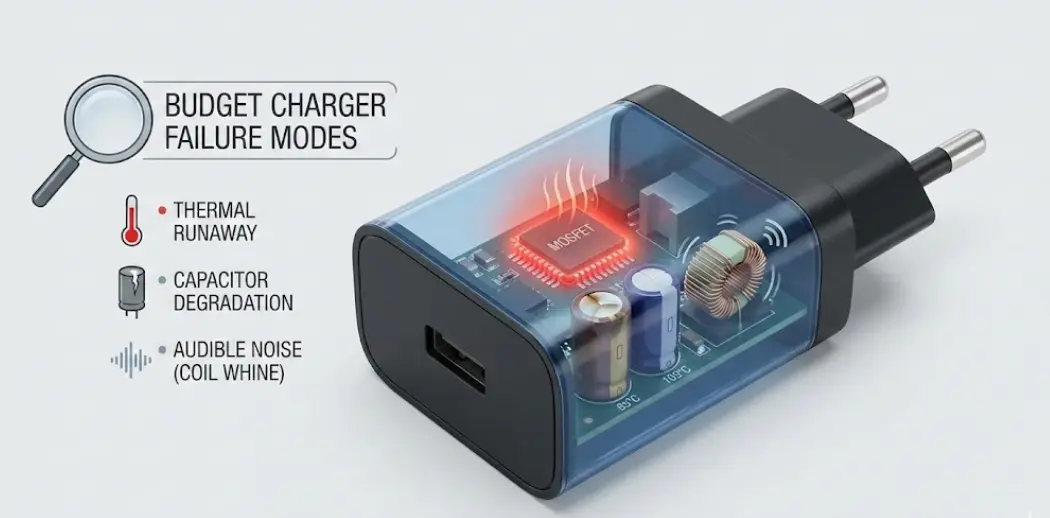
Common issues in mass-produced units include:
Thermal Runaway: Manufacturers often underestimate the thermal accumulation in sealed plastic enclosures. A charger might pass a 10-minute test but fail during a 2-hour full-load cycle because the heat cannot dissipate from the MOSFETs to the casing.
Capacitor Degradation: Using 85°C rated electrolytic capacitors instead of 105°C rated ones in the secondary side filter drastically reduces the product's lifespan (MTBF), especially in fast-charging scenarios where internal temperatures rise quickly.
Audible Noise (Coil Whine): Low-quality varnishing on the transformer or loose ferrite cores causes audible vibration at specific loads, damaging the user experience.
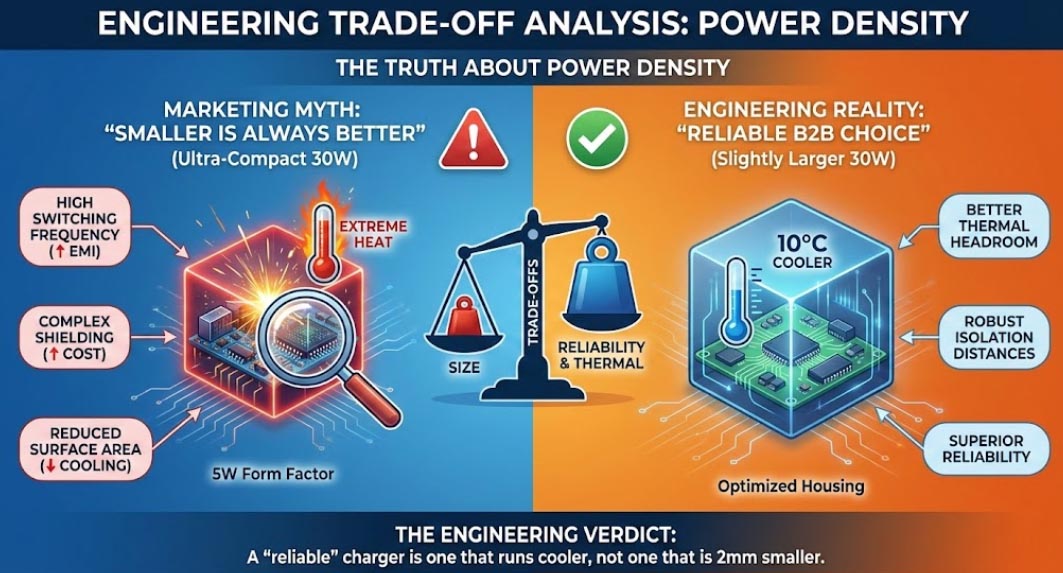
Engineering Trade-off Analysis: The Truth About Power Density
This section addresses the critical engineering reality often ignored in marketing brochures.
There is a persistent myth in the industry that "smaller is always better." As an engineer, I must clarify that ultra-compact designs inevitably involve strict trade-offs. When we push the power density of a 30 watt charger to the extreme (e.g., trying to fit it into a 5W cube form factor), we hit the limits of physics.
To achieve an ultra-small footprint, engineers must increase the switching frequency significantly. While this shrinks the transformer, it drastically increases EMI generation. To suppress this EMI, we must add complex shielding and filtering, which drives up cost and assembly complexity. Furthermore, reduced surface area means less natural convection cooling.
The Engineering Verdict: For a B2B application where reliability is paramount, a slightly larger housing (allowing for better thermal headroom and robust isolation distances) is often the superior engineering choice over the absolute smallest design. A "reliable" charger is one that runs 10°C cooler, not one that is 2mm smaller.
Tommox Design Philosophy: A Case Study in 30W Fast Charger Engineering
In the development of the Tommox 30 watt charger series, the engineering team encountered the specific challenge of maintaining stability across varying global grid voltages (90V–264V).
Rather than relying on theoretical simulations alone, the design process focused on worst-case scenario testing. The decision was made to utilize a multi-stage thermal potting technique. While this added step increased the manufacturing cycle time, it achieved two critical engineering goals:
Thermal Spread: It created a uniform thermal bridge, transferring heat from hot spots (Main Switch/Transformer) to the outer shell more efficiently.
Mechanical Rigidity: It secured heavy components against drop-shock vibration, a common failure mode in portable electronics.
Additionally, the input stage was designed with an oversized X-capacitor margin to ensure EMI compliance was not just "passing" but robust enough to handle production variances. This approach reflects a philosophy where long-term consistency takes precedence over minimizing individual unit BOM cost.
Specification & Approach Comparison
When evaluating a supplier for your phone wall charger, comparing the datasheet parameters is essential. Below is a breakdown of how generic sourcing differs from an engineered approach.
FeatureGeneric Market StandardProfessional Engineering Standard
TopologyBasic Flyback (Silicon)QR Flyback or GaN-based
CapacitorsLiquid Electrolytic (Standard Life)Solid State or High-Temp (105°C) Electrolytic
ProtectionsBasic OVP, OCPOVP, OCP, SCP, plus OTP (Over Temperature Protection) with Auto-Recovery
Ripple Voltage< 150mV p-p< 80mV p-p (Better for device battery health)
Burn-in TestRandom sampling / 15 mins100% Full Load / 2-4 Hours
OVP (Over Voltage Protection): Critical for preventing damage to the load if the feedback loop fails.
Efficiency: Look for DoE Level VI compliance as a minimum baseline.
FAQ: Sourcing a 30 Watt Charger for Mass Production
Q: What is the most critical certification for a B2B buyer to check?
A: Beyond standard safety (UL/ETL/CE), ensure the manufacturer has valid USB-IF certification. This guarantees the 30w fast charger correctly handles PD protocols. Non-certified chargers often fail handshake negotiations with newer devices.
Q: How does the "30 watt" rating affect thermal design compared to 20W?
A: The jump from 20W to 30W represents a 50% increase in power. If the manufacturer uses the exact same enclosure size without upgrading the thermal interface materials or efficiency (via GaN), the case temperature will likely exceed safety standards (typically touch temp limits of 77°C for plastics).
Q: Can I use a generic housing for my brand's charger?
A: Yes, using a supplier's "public mold" reduces tooling costs. However, verify that the housing material is flame-retardant PC (Polycarbonate) V0 grade. Never accept ABS blends for power electronics due to poor thermal resistance.
Future Trends & Design Direction
The evolution of the 30 watt charger is moving toward intelligent power distribution and sustainability.
PPS (Programmable Power Supply): Future designs will heavily rely on PPS, allowing the phone to communicate with the charger to adjust voltage in 20mV increments. This reduces conversion loss inside the phone, keeping the device cooler.
Bio-based Materials: We are seeing a shift toward PCR (Post-Consumer Recycled) plastics for charger housings to meet global sustainability goals.
Hybrid Architectures: The integration of control ICs and GaN switches into single packages (GaN ICs) will further improve reliability by reducing the component count on the PCB.
If you are currently evaluating suppliers for your next product line, consider reviewing the detailed technical schematics of our [High-Efficiency Charging Solutions] to understand the component-level differences that define quality.
 What Is a PD Charger and Why It Matters for Fast Charging