



What is the Lifespan of a Nitride Gallium Charger? Real-World Engineering Analysis of Fast Charger Durability
 04 Feb,2026
When sourcing a high-performance usb fast charger for B2B distribution or enterprise deployment, the datasheet’s "efficiency" metric often overshadows the most critical factor for long-term ROI: lifespan. As an engineer who has spent over a decade analyzing failure modes in power topologies, I can tell you that the longevity of a Gallium Nitride (GaN) charger is not magic—it is a calculated result of thermal management and component derating.
A well-engineered GaN usb fast charger should not merely survive its warranty period; it should operate reliably for 50,000 to 100,000 hours under standard load. However, the market is flooded with devices that sacrifice durability for ultra-compact aesthetics. Understanding the engineering variables that dictate the lifespan of a pd fast charger is essential for procurement managers looking to minimize RMA (Return Merchandise Authorization) rates.
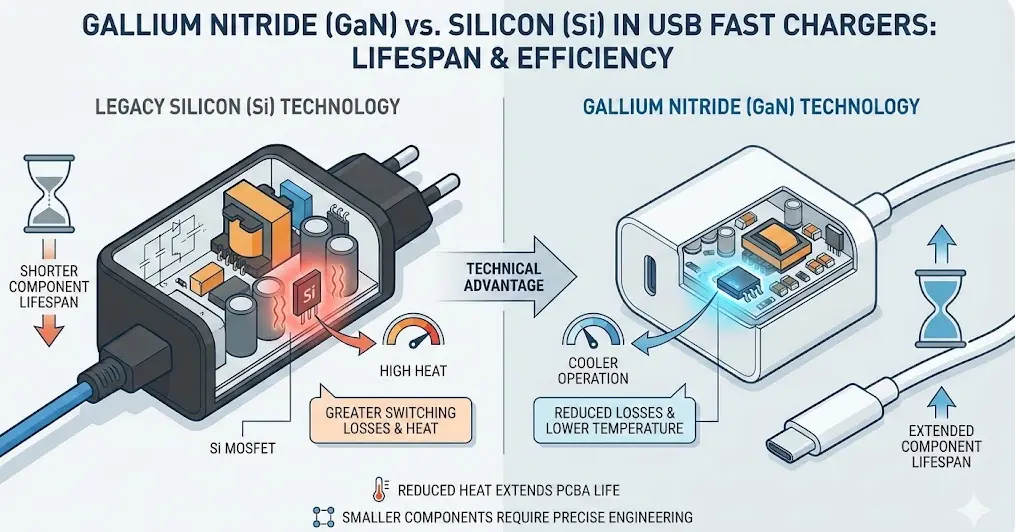
Technical Fundamentals: Why GaN Outlasts Silicon in a USB Fast Charger
To understand lifespan, we must first look at the material science. Gallium Nitride (GaN) is a wide-bandgap semiconductor. In the context of a usb fast charger, this allows the switching transistors to operate at significantly higher frequencies and voltages than legacy Silicon (Si) MOSFETs, while maintaining lower on-resistance
From a longevity perspective, this technical advantage translates into two key factors:
Reduced Switching Losses: GaN minimizes the energy lost as heat during the switching cycle. Since heat is the primary enemy of electronic components, cooler operation directly extends the life of the entire PCBA.
Passive Component Reduction: Higher switching frequencies allow us to use smaller magnetics (transformers) and capacitors. While this reduces size, it requires precise engineering to ensure these smaller components are not stressed beyond their ripple current ratings.
Industry Pain Points: The Silent Killers of Charger Longevity
In the mass market, particularly with generic usb fast charger imports, we observe a high failure rate within the first 12 to 18 months. These failures are rarely due to the GaN chip itself. Instead, they stem from systemic design flaws driven by aggressive cost-cutting.
The most common failure vectors include:
Electrolytic Capacitor Dry-Out: The liquid electrolyte inside aluminum capacitors evaporates over time. This process accelerates exponentially with heat (Arrhenius Law). A poorly ventilated charger housing will cook the capacitors, leading to increased ESR (Equivalent Series Resistance) and eventual failure.
Thermal Cycling Fatigue: Repeatedly heating up and cooling down causes solder joints to expand and contract. In a pd fast charger without proper underfill or potting compound, this mechanical stress can crack the solder joints connecting the heavy transformer to the PCB.
Voltage Spikes & EMI: Inadequate input filtering can allow grid surges to damage the primary switching stage, rendering the charger useless.
Engineering Trade-off Analysis: Density vs. Reliability
This is the section where most datasheets stay silent, but where engineering decisions define the product.
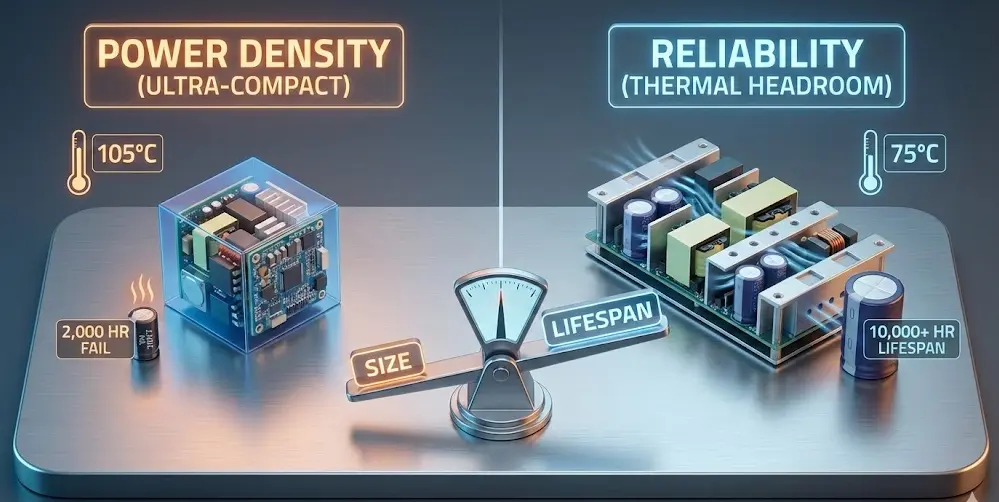
There is a massive conflict in modern power electronics between Power Density (Watts per cubic inch) and Reliability. The current market trend pushes for the "smallest possible" 35 watt charger or 65W adapter. As an engineer, I often push back against this "ultra-compact" obsession for B2B applications.
Here is the trade-off: To make a usb fast charger incredibly small, we have to cram components together, eliminating airflow channels. We rely solely on conduction to move heat to the plastic shell.
The Problem: If the internal ambient temperature rises to 105°C, a standard capacitor rated for 2,000 hours at 105°C will fail exactly then.
The Engineering Stance: We prefer a slightly larger form factor—perhaps 10-15% larger than the smallest competitor. This extra volume allows us to insert thermal pads, use larger capacitors with higher ripple current ratings, and maintain lower junction temperatures. For a B2B buyer, that 15% size increase can mean a 200% increase in operational lifespan. We prioritize "Thermal Headroom" over "Pocket Size."
Tommox Design Philosophy: Engineering a Durable PD Fast Charger
At Tommox, we approach the design of a pd fast charger with a "Server-Grade" mindset, scaled down for consumer electronics. Our focus is on mitigating the failure modes identified above through robust topology selection.
Our engineering implementation includes:
High-Grade Capacitors: We utilize Japanese-branded capacitors (like Rubycon or Nichicon) or top-tier solid-state capacitors in the secondary stage. These components offer significantly higher endurance against high-frequency ripple currents common in GaN topologies.
Full Potting Solutions: For our premium lines, we inject a high-thermal-conductivity potting compound into the PCBA enclosure. This serves two purposes: it acts as a heatsink to distribute thermal load evenly, and it provides mechanical rigidity, making the charger drop-resistant.
Synchronous Rectification: Instead of using diodes which drop voltage and create heat, we use active MOSFETs for rectification on the secondary side, boosting efficiency and lowering thermal stress.
For distributors looking for reliable stock, we recommend reviewing our [Enterprise Grade PD Charger Solutions] to understand the internal component selection.
35 Watt Charger Case Study: Specification & Approach Comparison
Let’s compare a typical consumer-grade 35 watt charger against a Tommox engineered solution designed for longevity. This comparison highlights why "specs on paper" often deceive buyers regarding durability.
Generic Consumer 35 Watt Charger:
Topology: Basic QR (Quasi-Resonant) Flyback without PFC (if <75W).
Capacitors: 2,000-hour rated generic brands running at 95°C.
Thermal Design: Air gap only; high hotspot temperatures ($>100^\circ C$).
Estimated Lifespan: ~1.5 years of daily use.
Tommox Engineered 35 Watt Charger:
Topology: GaN-based Active Clamp Flyback (ACF) or optimized QR for higher efficiency >93%.
Capacitors: 5,000+ hour rated Low-ESR capacitors running at <85°C.
Thermal Design: Thermal potting or extensive heatsink integration; spread spectrum frequency for EMI control.
Estimated Lifespan: 5+ years of heavy daily use.
FAQ for Procurement Managers regarding USB Fast Charger Sourcing
Q: How do we validate the claimed lifespan of a usb fast charger?
A: Ask the factory for their ORT (Ongoing Reliability Test) data and MTBF calculations based on Telcordia SR-332 standards. Do not just accept a "warranty" duration; ask for the calculated failure rate at max load.
Q: Is a higher wattage charger always better for lifespan?
A: Generally, yes. Using a 65W charger to power a device that needs a 35 watt charger means the charger is running at ~50% load. This keeps components much cooler compared to running a 35W charger at 100% capacity. This is called "derating."
Q: Does the PD (Power Delivery) protocol version affect lifespan?
A: Indirectly. A pd fast charger with PPS (Programmable Power Supply) can adjust voltage in fine increments (20mV steps). This reduces conversion loss at the phone/laptop side, but also signifies a more advanced controller inside the charger, which usually correlates with better overall build quality.
Future Trends: Beyond the Standard USB Fast Charger
The future of the usb fast charger lies in intelligence and integration. We are moving beyond simple power conversion into the era of digital power management.
Totem-Pole PFC: As we push for higher efficiencies in small form factors, bridgeless Totem-Pole PFC topologies using GaN will become standard, even in lower wattage adaptors, to exceed 95% efficiency.
AI-Driven Thermal Regulation: Next-gen controllers will predict thermal runaway before it happens, throttling current dynamically to protect the pd fast charger components without the user noticing a drop in performance.
Planar Transformers: Moving away from wire-wound transformers to PCB-embedded planar transformers. This improves consistency, reliability, and allows for automated manufacturing, reducing human error in assembly.
Conclusion
The lifespan of a usb fast charger is not a matter of luck; it is a matter of physics and engineering choices. While GaN technology provides the platform for efficiency, it is the thermal design, capacitor selection, and refusal to compromise reliability for size that determines the true value of the product.
For OEM buyers and distributors, selecting a supplier who understands these trade-offs is critical. Are you ready to upgrade your product portfolio with power solutions engineered for endurance?
 Why GaN Chargers Are Smaller and Faster: A Technical Deep Dive