



How to Import Wall Charger from China: Shipping and Duties Guide
 03 Feb,2026
The Intersection of Engineering Compliance and Logistics
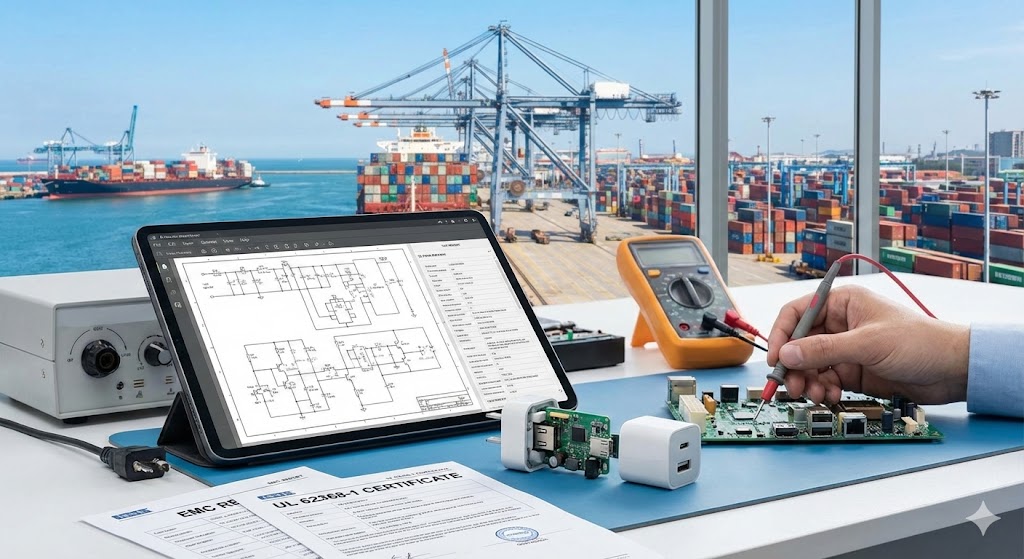
Importing power electronics is rarely a simple logistical task; it is a complex validation of engineering integrity and regulatory adherence. When sourcing a usb wall charger from China, the physical movement of goods is merely the final step in a long chain of technical compliance. For procurement managers and brand owners, understanding the symbiotic relationship between circuit design and customs clearance is critical.
A shipment detained at Long Beach or Rotterdam is rarely due to a missing label; it is frequently caused by a failure to meet electromagnetic compatibility (EMC) standards or safety protocols like UL 62368-1. As engineers, we know that a usb wall charger is not just a plastic shell—it is a high-voltage conversion device that must prove its safety to regulatory bodies before it ever crosses a border.
Industry Pain Points: Where Supply Chains Break Down
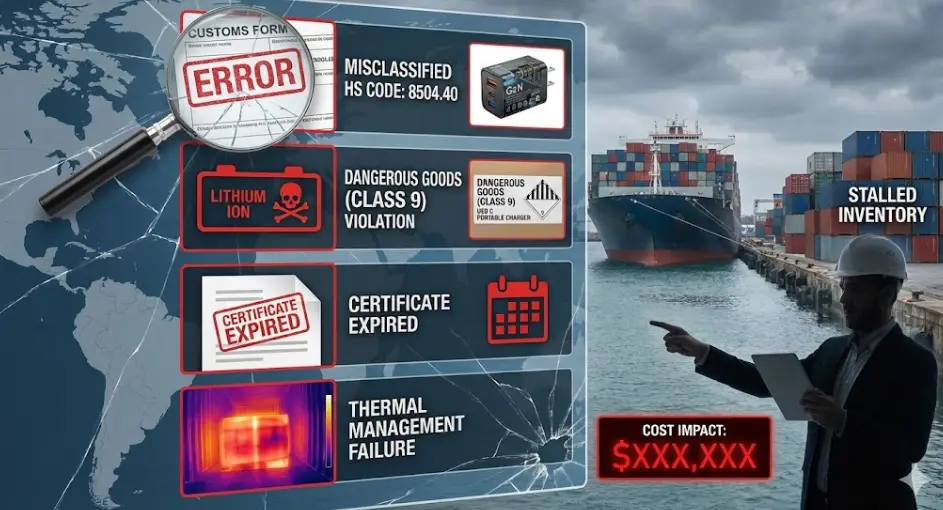
In my decade of managing power supply production, I have seen hundreds of thousands of dollars in inventory stalled due to "engineering oversight" disguised as logistical errors. The market is flooded with generic trading companies that do not understand the technical nuances of export.
Common points of failure include:
Inaccurate HS Code Classification: Misclassifying a complex GaN adapter as a simple transformer, leading to retroactive tariffs.
Battery Regulation Violations: Improper labeling of a usb c portable charger, which falls under dangerous goods (Class 9) due to lithium-ion content.
Lack of Redundancy in Certification: Relying on a single test report that expires mid-shipment.
Thermal Management Documentation: Failure to prove safety under thermal stress during air freight conditions.
Engineering Trade-off Analysis: The Cost of "Gray Market" Logistics
This is where we must draw a hard line between professional engineering and "cutting corners." In the competitive world of consumer electronics, there is a temptation to use logistics providers who promise to "bypass" certain checks or declare lower values to save on duties for a usb wall charger.
From an engineering perspective, this is a fatal trade-off.
To achieve a slightly lower landed cost, you sacrifice traceability and reliability. A legitimate, high-quality power supply requires robust filtering components (Common Mode Chokes, X-Capacitors) to pass EMC testing. These components add cost. "Gray" suppliers often remove these components to lower the BOM cost, then ship via channels that avoid inspection.
However, when a major retailer or customs authority eventually tests that batch, the failure rate is 100%. You save 5% on shipping and duties but risk a 100% loss of inventory and permanent brand damage. True engineering economy comes from First Time Right compliance, not regulatory evasion.
Tommox Design Philosophy: Integrated Compliance for Export
At Tommox, we view the shipping process as an extension of the R&D phase. A usb wall charger is not "finished" until it has the documentation to clear customs in the EU, US, or Japan. Our approach integrates logistics requirements into the initial design review.
We implement the following protocols to ensure seamless importation:
UN38.3 Pre-certification: Every usb c portable charger undergoes rigorous shock, vibration, and altitude simulation testing before mass production begins.
DoE Level VI & CoC Tier 2 Alignment: We ensure efficiency metrics meet the strictest import standards to avoid energy-efficiency blocks.
EMI/EMC Margin Design: We design our EMI filters with a 6dB margin, ensuring that even if component tolerances shift during shipping, the unit remains compliant upon arrival.
Critical Documentation for Power Electronics
Bill of Materials (BOM) Validation: proving no conflict minerals are used.
MTBF (Mean Time Between Failures) Reports: Supporting quality claims for duty drawbacks.
FCC/CE/UKCA Declaration of Conformity: specific to the exact SKU being shipped.
Parameters and Approach Comparison: Selecting the Right Incoterm
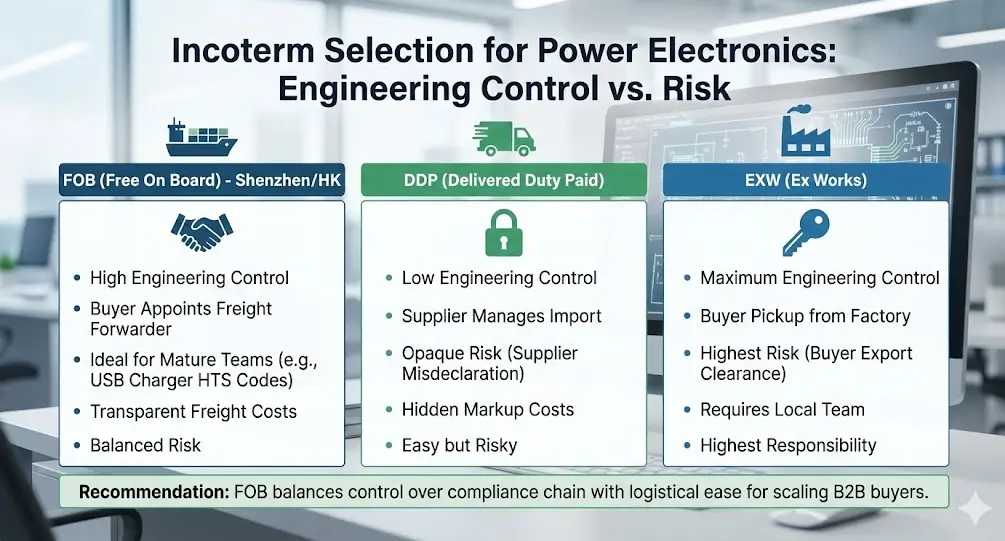
Choosing the right shipping term (Incoterm) dictates who holds the engineering liability during transit. For high-stakes electronics, this decision is technical.
FOB (Free On Board) vs. DDP (Delivered Duty Paid)
1. FOB (Shenzhen/Hong Kong):
Engineering Control: High. You (the buyer) appoint the freight forwarder.
Risk Profile: You manage the import process. Ideal for mature teams who understand usb wall charger HTS codes (e.g., 8504.40).
Cost Efficiency: Transparency in freight costs; better for volume.
2. DDP (Delivered Duty Paid):
Engineering Control: Low. The supplier manages everything.
Risk Profile: Easy, but opaque. If the supplier misdeclares the usb c portable charger to save money, your company is still the importer of record on the box.
Cost Efficiency: Often includes a hidden markup.
3. EXW (Ex Works):
Engineering Control: Maximum. You control pickup from the factory floor.
Risk Profile: Highest. You are responsible for export clearance from China.
Recommendation: Only for buyers with local teams in China.
Note: For most B2B buyers scaling up, we recommend FOB. It balances control over the compliance chain with logistical ease.
FAQ: Sourcing Manager Perspectives
Q: How do duties vary for a GaN-based usb wall charger versus a standard silicon one?
A: Generally, the HS code (usually 8504.40) focuses on function (Power Supply) rather than material (Gallium Nitride). However, GaN chargers often have higher power density, sometimes shifting them into different efficiency regulation brackets which can affect non-tariff barriers rather than duties.
Q: Can I ship a usb c portable charger via air freight?
A: Yes, but it is strictly regulated. They must be shipped as "Cargo Aircraft Only" if over certain limits, or packed in rigid compliance with IATA PI 965/966/967. Ensure your supplier provides a valid MSDS and UN38.3 test report.
Q: Why was my shipment held for "Efficiency Verification"?
A: The US Department of Energy (DoE) and EU Ecodesign directives mandate active efficiency markings (Level VI). If your product label lacks the Roman Numeral VI or the test report is missing from the database, customs will hold the goods.
Future Trends in Electronics Logistics
The future of importing goes beyond physical movement; it is about digital transparency and sustainability.
Digital Product Passports (DPP): The EU is moving towards mandating digital records for battery-containing devices like the usb c portable charger, tracking carbon footprint from raw material to recycling.
Carbon-Adjusted Tariffs: Future duties may be calculated based on the manufacturing energy source (e.g., CBAM), favoring factories with renewable energy grids.
Decentralized Warehousing: To mitigate shipping delays, we see a trend of OEMs moving semi-finished PCBA (printed circuit board assemblies) to local assembly hubs (Vietnam, Mexico) for final assembly (Box Build), altering the "Country of Origin" for duty purposes.
To secure your supply chain with compliant, high-performance power solutions, consider our OEM GaN charger solutions or explore our certified custom power bank services.
 What is the Lifespan of a Nitride Gallium Charger? Real-World Engineering Analysis of Fast Charger Durability