



Deep Dive into the Belkin 112W GaN Charger: Unveiling the Secrets of a Multi-Port Flagship
 02 Mar,2026
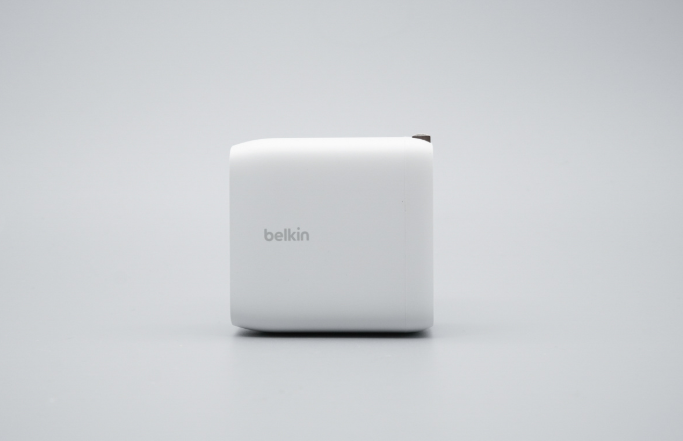
The Belkin 112W Gallium Nitride (GaN) charger, bearing the model number WCH017yz, stands as a testament to the brand’s commitment to minimalist aesthetics and functional elegance. The exterior chassis is constructed from eco-friendly recycled plastics, aligning with modern sustainability goals without compromising on durability or feel. The surface undergoes a sophisticated matte finishing process, resulting in a texture that is not only pleasant to the touch but also highly resistant to fingerprints and smudges, ensuring the device maintains a pristine appearance even after prolonged use.
A distinctive design feature is the tapered contraction at both ends of the unit, which ergonomically enhances grip comfort during plugging and unplugging. The front face prominently displays the Belkin logo, reinforcing brand identity with a subtle yet confident presence. Practicality is further enhanced by the inclusion of foldable national standard prongs, a crucial feature for travelers who need to minimize bulk in their carry-on luggage.
In terms of physical dimensions, rigorous testing reveals the charger measures approximately 66.4 mm in length, 65.8 mm in width, and 33.3 mm in thickness. The weight is meticulously controlled at around 228 grams. When placed side-by-side with Apple’s 96W charger, the Belkin unit demonstrates a significant advantage in volume efficiency, proving that high power density does not necessitate a bulky form factor. This perfect balance between substantial wattage and compact sizing makes it an ideal portable wall charger for business professionals and digital nomads who require reliable power on the go without being weighed down by heavy bricks.
Interface Configuration and Protocol Compatibility
Addressing the complex charging needs of the modern "all-Apple" or multi-device ecosystem, this charger adopts a highly practical 3C1A four-port layout. The three USB-C ports are designed with full symmetry, each capable of delivering a maximum single-port output of 100W. This "blind plug" capability means users can insert their laptop, tablet, or smartphone into any of the three Type-C ports and receive maximum speed without guessing which port is the primary one.
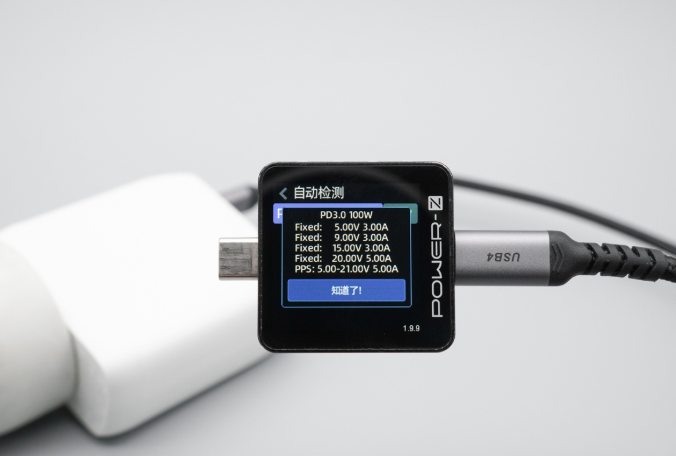
Protocol compatibility is extensive, covering PD 3.0 (Power Delivery), PPS (Programmable Power Supply), and QC5 (Quick Charge 5). Detailed PDO (Power Data Object) analysis confirms support for a comprehensive range of voltage, including 5V, 9V, 15V, and 20V at up to 5A, alongside a flexible 5-21V PPS range. This ensures seamless operation with the latest laptops, high-end Android smartphones, and tablets that demand precise voltage regulation for optimal battery health.
The solitary USB-A port is strategically tuned for low-current devices, providing a steady 12W output. This is perfectly suited for accessories such as wireless earbuds, smartwatches, and fitness trackers, which do not require the high wattage of the USB-C ports. A particularly user-friendly touch is the labeling directly adjacent to each port, which clearly outlines the power distribution ratios for various multi-port combinations. This transparency allows users to instantly understand how power is shared when multiple devices are connected, eliminating the need to consult a manual and facilitating flexible, efficient charging setups for families or individuals with diverse gadget collections.
Internal Architecture and Thermal Management
Upon removing the outer casing, the internal craftsmanship reveals a robust and thoughtfully engineered design. The PCBA (Printed Circuit Board Assembly) module is densely packed and secured with a generous application of blue and white thermally conductive potting compounds. These materials serve a dual purpose: they mechanically fix components to prevent damage from vibration or impact, and they create highly efficient thermal pathways to draw heat away from critical hotspots.
Inside the shell, insulating thermal pads are adhered to the inner walls, while the surface of the main module is covered with Mylar sheets and a unified copper plate. This layered approach significantly enhances heat dissipation capabilities while maintaining strict electrical isolation for safety. The internal architecture utilizes a sophisticated combination of a main board and multiple sub-boards soldered together. Independent sub-boards are positioned along the central axis and at the output end, a vertical stacking strategy that maximizes spatial utilization within the compact enclosure.
Two large transformers are wrapped in high-temperature resistant insulation tape and isolated from surrounding circuitry via additional Mylar sheets, reflecting a rigorous adherence to safety regulations and electromagnetic interference (EMI) standards. This meticulous attention to internal layout ensures that despite the high power output, the unit remains cool and stable during extended operation, a critical factor for any high-performance portable wall charger.

PFC Stage and Primary Side Core Solutions
At the heart of the power conversion system, Belkin employs a cutting-edge hybrid architecture. The Power Factor Correction (PFC) boost circuit is orchestrated by the On Semiconductor NCP1623 controller. This advanced chip utilizes Valley Synchronous Frequency Foldback (VSFF) technology, which dynamically switches operating modes based on load conditions to optimize efficiency across the entire spectrum.
For the switching element, the design incorporates the Navitas NV6136C GaN power IC. This highly integrated chip features a built-in driver and lossless current sensing circuitry, supporting switching frequencies as high as 2MHz. This high-frequency operation allows for a drastic reduction in the size of magnetic components, contributing significantly to the charger's compact footprint. The rectification stage leverages the Senguoke KS06065D Silicon Carbide (SiC) Schottky diode. Together, these components form a highly efficient and stable front-end boost system.
The input stage is further fortified with safety capacitors from WQC, common-mode inductors for EMI suppression, and a dual-bridge rectifier design. This comprehensive setup ensures effective filtering of grid interference and provides robust protection against voltage surges, guaranteeing clean and safe power delivery to the internal circuits.
Multi-Output and Secondary Step-Down Architecture
On the secondary side, the charger features three independent switching power supply rails. The three USB-C outputs are driven by Navitas NV9580 integrated GaN chips, which combine a high-frequency Quasi-Resonant (QR) controller with the power switch in a single package. This integration supports a wide VDD supply range and simplifies the circuit design while maintaining high efficiency.
To achieve precise fast-charging negotiation for various devices, the output stage integrates solutions from Injoinic Technology. The USB-C1 port utilizes the SW3561H, a dual-port step-down SoC with an embedded ARM Cortex-M0 core. Meanwhile, the C2 and C3 ports are each equipped with SW3556 step-down protocol chips. These chips natively support PD 3.1 and various proprietary fast-charging protocols. Crucially, they manage dynamic power allocation through external resistor configurations, eliminating the need for an external microcontroller to intelligently distribute power among the three ports.
The USB-A port is handled by a discrete setup featuring a China Resources Microelectronics MOSFET paired with a Silan SP6574AF synchronous rectification chip. This combination ensures high-efficiency 5V conversion, minimizing heat generation even when charging multiple low-power accessories simultaneously. This complex yet harmonious arrangement of controllers and converters exemplifies the engineering prowess required to build a truly versatile portable wall charger.
Conclusion and Buying Recommendations
In summary, the Belkin 112W GaN charger excels not only in its refined, minimalist exterior but also in its flagship-grade internal component selection. From the Navitas GaN power stages and On Semiconductor PFC controllers to the intelligent Injoinic step-down schemes and premium TMY capacitors from Terui, every detail reflects a pursuit of performance, safety, and reliability.
Its compact internal structure, comprehensive thermal management system, and flexible multi-port power distribution strategies make it a standout choice in a crowded market. It successfully bridges the gap between high-performance desktop charging and the mobility required by modern users. For individuals managing a fleet of high-power devices—ranging from MacBook Pros to iPads and iPhones—this device offers a consolidated, efficient, and travel-ready solution. Whether stationed at a home office desk or packed into a carry-on bag as a reliable portable wall charger, the Belkin 112W unit proves itself to be a worthy investment for anyone seeking the ultimate in charging convenience and speed.
 How Phone Charger Companies Improve User Experience and Device Safety?