



Common Charger Mistakes That Slow Down Charging Speed
 16 Jun,2026
Choosing the Wrong Charger for Your Device
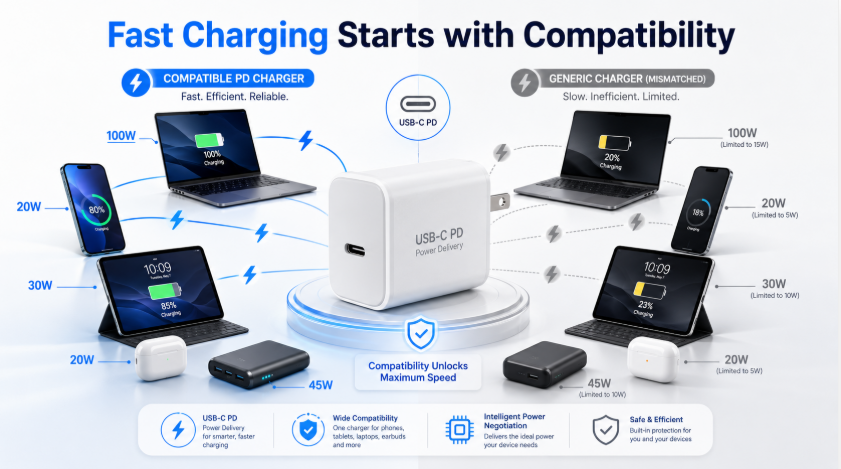
Fast charging starts with compatibility. One of the most common mistakes users make is assuming that any charger can deliver the same charging speed. In reality, smartphones, tablets, laptops, earbuds, power banks, and other electronic devices often require different charging protocols and power outputs. For example, a modern smartphone may support 20W, 30W, or even higher fast charging, while a laptop may require 45W, 65W, or 100W USB-C Power Delivery. If the charger cannot match the device’s charging requirements, the device will automatically charge at a lower speed for safety. This is why choosing high-quality Direct factory PD chargers is important for brands, distributors, and retailers that want to provide reliable charging solutions. A properly matched PD charger helps devices communicate efficiently and receive the right amount of power without unnecessary delay.
Using Low-Quality Charging Cables
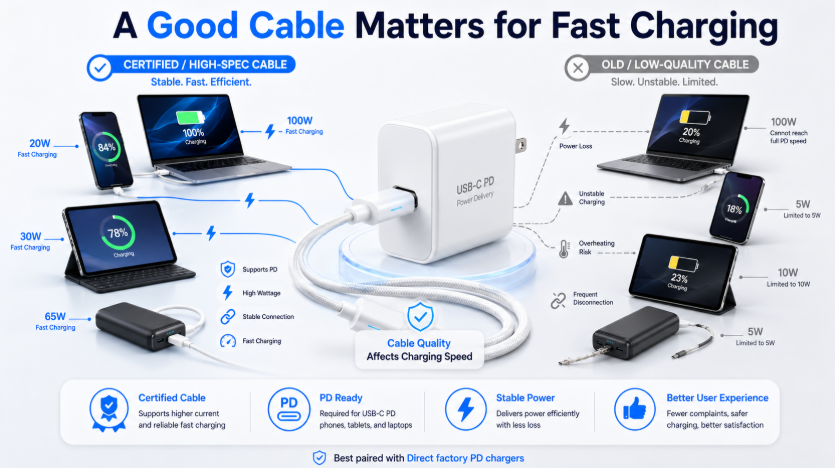
A charger is only one part of the charging system. The cable also plays a major role in charging speed. Many users buy a fast charger but continue using an old, damaged, or low-quality cable. This can significantly reduce the actual power delivered to the device. Some cables are designed only for basic charging and data transfer, while others support higher current and fast charging standards. For USB-C PD charging, the cable must support the required wattage, especially when charging laptops or high-capacity devices. A poor cable may cause unstable charging, overheating, or frequent disconnection. For businesses sourcing Direct factory PD chargers, pairing chargers with certified or high-specification cables can improve customer satisfaction and reduce complaints. A good cable ensures that the charger performs as intended and delivers consistent charging efficiency.
Ignoring Power Delivery Compatibility
USB Power Delivery, commonly known as PD, is one of the most widely used fast charging technologies today. However, many consumers do not understand that fast charging depends on communication between the charger and the device. When a device is connected to a PD charger, they negotiate the best voltage and current level. If the charger does not support the correct PD profile, the charging speed may be much slower than expected. This often happens when users choose generic chargers without checking specifications. Direct factory PD chargers can help solve this issue by offering stable PD protocol support, clear wattage options, and better quality control from production to shipment. For brands and importers, selecting chargers with accurate PD compatibility is essential for building a dependable product line in the competitive charging accessories market.
Charging Multiple Devices at the Same Time Incorrectly
Multi-port chargers are convenient, but users often misunderstand how power is distributed. A charger advertised as 65W or 100W may not deliver the full wattage to every port at the same time. When multiple devices are connected, the charger divides power across ports according to its internal design. If a laptop, smartphone, and tablet are plugged in together, each device may receive less power than expected. This can make charging slower, especially for high-power devices. High-quality Direct factory PD chargers usually provide clear power distribution details, helping customers understand how each USB-C or USB-A port performs under different charging scenarios. For wholesale buyers and electronics brands, transparent power allocation is an important selling point because it reduces confusion and improves the end-user experience.
Using Chargers with Insufficient Wattage
Another frequent mistake is using a charger with wattage that is too low for the device. A 5W or 10W charger may still charge a modern smartphone, but it will do so very slowly. A low-wattage charger may also struggle to charge tablets, handheld gaming devices, or USB-C laptops. In some cases, the device may consume power faster than the charger can supply it, especially while the device is being used. To avoid this, users should choose chargers based on the device’s recommended charging power. For example, a compact 20W or 30W PD charger is suitable for many smartphones, while 65W and above may be better for laptops. Direct factory PD chargers are available in different wattage levels, allowing brands and distributors to build complete product ranges for different customer needs.
Overlooking Heat and Safety Protection
Heat is one of the biggest enemies of charging efficiency. When a charger becomes too hot, it may automatically reduce power output to protect the device and internal components. This process is called thermal throttling, and it can make charging much slower. Low-quality chargers often lack proper heat management, advanced chips, or safety protection systems. Over time, this may lead to unstable performance or even safety risks. Reliable Direct factory PD chargers are typically designed with multiple protection features, such as over-current protection, over-voltage protection, short-circuit protection, temperature control, and flame-retardant materials. For B2B buyers, these safety features are not just technical details; they are key selling points that influence product reliability, market compliance, and long-term customer trust.
Charging While Running Heavy Apps
Many users complain about slow charging without realizing that their device is using a large amount of power at the same time. Gaming, video streaming, GPS navigation, video calls, and background apps can all increase power consumption. When the device is working hard, part of the charger’s power is used to run the device instead of charging the battery. As a result, the battery percentage rises more slowly. Even when using high-performance Direct factory PD chargers, charging speed may be affected by device usage, battery temperature, and software behavior. A practical recommendation is to close unnecessary apps, turn off the screen, or enable airplane mode when fast charging is needed. This helps the device focus more energy on battery charging and reduces heat buildup.
Relying on Old or Damaged Chargers
Chargers do not last forever. Over time, internal components may degrade, plugs may loosen, and output performance may become unstable. A charger that worked well two years ago may no longer deliver the same charging speed today. Physical damage, exposure to moisture, frequent travel, and poor storage conditions can also affect performance. Using old or damaged chargers may cause slow charging, device warnings, or safety concerns. Businesses that sell charging accessories should educate customers about replacing unreliable chargers with modern PD models. Direct factory PD chargers offer a strong solution for companies looking to refresh their product catalog with efficient, compact, and market-ready charging products. Newer PD chargers often provide better energy efficiency, smaller designs, and stronger compatibility with current USB-C devices.
Not Considering Certification and Quality Control
For consumers, charger specifications may look simple. For importers, wholesalers, and brand owners, quality control is much more important. A charger must perform consistently across different batches and meet the safety expectations of target markets. Products without proper testing may create high return rates, negative reviews, or compliance issues. This is why sourcing Direct factory PD chargers from a professional manufacturer can be a smart decision. Direct factory cooperation often allows better control over materials, chip solutions, shell design, packaging, logo customization, testing standards, and delivery schedules. Whether you are building a private-label charging brand or expanding your electronics accessory line, working directly with a factory can help improve cost efficiency and product consistency.
How to Get Faster and Safer Charging
To improve charging speed, users should choose the right charger, use a compatible cable, avoid damaged accessories, reduce heavy device usage during charging, and select chargers with proper safety protection. For businesses, the key is to offer products that combine performance, safety, and market demand. Direct factory PD chargers are an excellent choice for B2B buyers who need fast charging solutions for smartphones, tablets, laptops, and other USB-C devices. With the growth of mobile work, travel, and multi-device lifestyles, demand for reliable PD chargers continues to rise. By avoiding common charger mistakes and choosing professionally manufactured PD charging products, both consumers and businesses can enjoy faster, safer, and more efficient charging every day.
 What Is PPS Charging?