



What Buyers Should Know Before Ordering Phone Chargers?
 16 Jun,2026
Understanding the Real Needs of Your Market
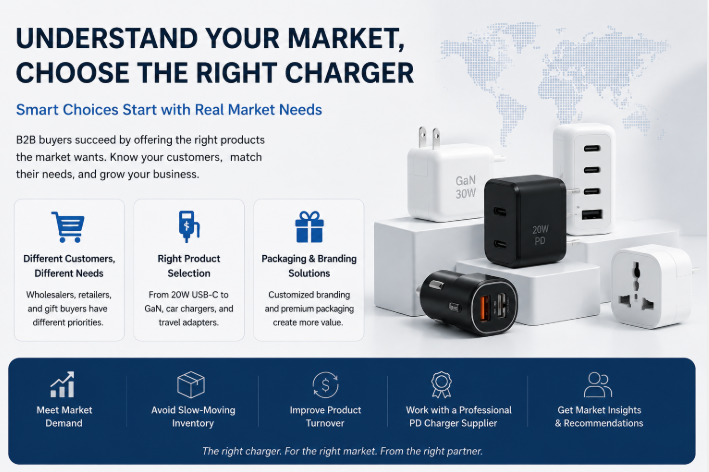
Before placing a bulk order for phone chargers, B2B buyers should first understand the real charging needs of their target market. Different customer groups may require different charger types, power outputs, plug standards, and packaging solutions. For example, smartphone accessory wholesalers may focus on fast-moving 20W or 30W USB-C chargers, while electronics retailers may need a wider product range, including multi-port chargers, GaN chargers, car chargers, and travel adapters. Corporate gift buyers may care more about customized branding and premium packaging. By clearly identifying the market demand before ordering, buyers can avoid overstocking slow-moving models and improve product turnover. A professional PD charger supplier can usually provide market-oriented product recommendations based on regional trends, device compatibility, and common purchasing behavior.
Why PD Fast Charging Matters
Power Delivery, commonly known as PD, has become one of the most important fast-charging technologies in the mobile accessories industry. Compared with traditional chargers, PD chargers can deliver higher power more efficiently and adjust the output according to the connected device. This makes them suitable for smartphones, tablets, earbuds, handheld game consoles, and even some laptops. For B2B buyers, choosing PD chargers means offering products that match current consumer expectations. Many end users now look for chargers that can reduce charging time while remaining safe and stable. Therefore, working with a reliable PD charger supplier helps buyers source products that are compatible with mainstream devices and meet modern fast-charging requirements.
Checking Product Certifications and Compliance
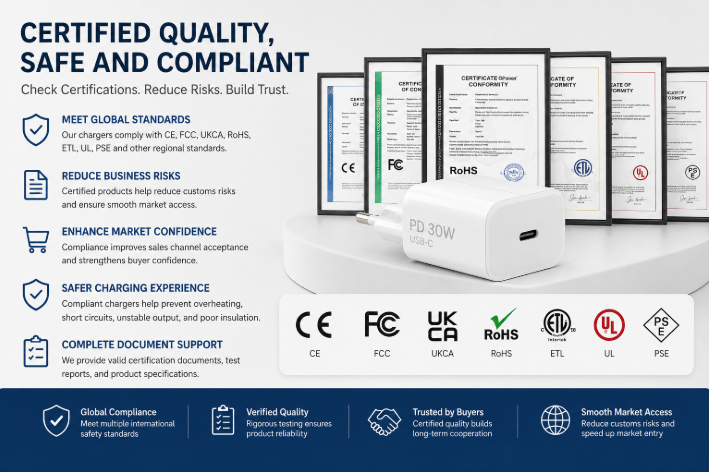
Certifications are a critical factor when ordering phone chargers for wholesale, retail, or brand distribution. Chargers are electrical products, and different markets have different safety and compliance requirements. Buyers should check whether the products can meet certifications such as CE, FCC, UKCA, RoHS, ETL, UL, PSE, or other regional standards depending on the destination country. Certified products can reduce customs risks, improve sales channel acceptance, and strengthen buyer confidence. More importantly, compliant chargers help reduce safety problems such as overheating, short circuits, unstable output, or poor insulation. A qualified PD charger supplier should be able to provide valid certification documents, test reports, and product specifications before mass production or shipment.
Evaluating Charger Power and Port Options
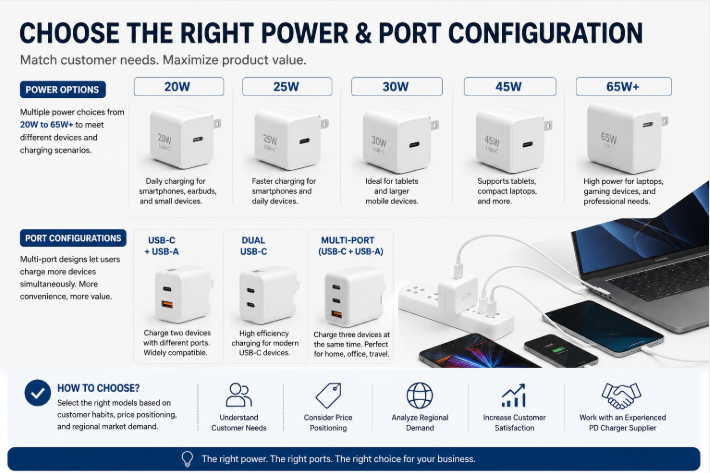
When ordering phone chargers, B2B buyers should pay close attention to power output and port configuration. Common power options include 20W, 25W, 30W, 45W, 65W, and higher wattages for advanced models. A 20W USB-C charger may be ideal for daily smartphone charging, while 30W or 45W models can support tablets and compact laptops. Multi-port chargers, such as USB-C plus USB-A or dual USB-C designs, are also popular because users often need to charge multiple devices at the same time. Buyers should choose product models based on customer habits, price positioning, and regional demand. An experienced PD charger supplier can help compare different power solutions and recommend the most suitable models for bulk purchasing.
Reviewing Build Quality and Safety Features
Product appearance is important, but internal quality is even more essential for phone chargers. A high-quality charger should have stable components, good heat dissipation, durable housing materials, and reliable circuit protection. Key safety features include over-current protection, over-voltage protection, short-circuit protection, over-temperature protection, and intelligent power distribution. Poor-quality chargers may look attractive at first, but they can easily lead to returns, complaints, and damage to the buyer’s brand reputation. Before confirming an order, B2B buyers should request product samples for testing. They should check charging speed, surface temperature, plug firmness, housing finish, and long-term stability. A responsible PD charger supplier will usually support sample testing and provide clear technical information.
Considering OEM and Branding Requirements
For many B2B buyers, chargers are not only products but also part of a brand strategy. OEM and ODM services can help businesses build their own product lines with customized logos, colors, packaging, manuals, labels, and barcode requirements. Some buyers may need simple logo printing, while others may want exclusive housing designs or customized product bundles. Before placing an order, buyers should confirm the supplier’s customization capabilities, minimum order quantity, lead time, packaging options, and design support. A professional PD charger supplier should understand how to balance branding requirements with production efficiency and compliance standards. Clear communication at the beginning can prevent packaging errors, labeling issues, and delivery delays later.
Comparing Price with Long-Term Value
Price is always important in B2B purchasing, but the lowest price is not always the best choice. Phone chargers involve electronic components, safety standards, production control, and after-sales responsibility. Extremely low prices may indicate lower-grade materials, unstable performance, missing certifications, or weaker quality inspection. B2B buyers should compare quotations based on complete value, including product quality, certification support, warranty policy, packaging quality, delivery speed, and supplier reliability. A slightly higher unit price may be worthwhile if it reduces return rates and improves customer satisfaction. When choosing a PD charger supplier, buyers should look beyond the initial quotation and evaluate the supplier’s ability to support long-term business growth.
Confirming Production Capacity and Delivery Time
Stable supply is essential for wholesalers, distributors, e-commerce sellers, and retail chains. Before ordering phone chargers in bulk, buyers should confirm the supplier’s production capacity, standard lead time, peak-season schedule, and stock availability. This is especially important before major sales periods such as back-to-school season, Black Friday, Christmas, or regional shopping festivals. Delayed shipments can affect sales plans, customer relationships, and cash flow. Buyers should also ask about inspection procedures before shipment, including appearance checks, function tests, aging tests, and packaging inspections. A dependable PD charger supplier should provide realistic delivery timelines and keep buyers updated throughout production, rather than promising unrealistic schedules.
Building a Reliable Supplier Partnership
Ordering phone chargers is not just a one-time transaction. For B2B buyers, building a stable relationship with the right supplier can bring long-term advantages. A reliable supplier can provide new product updates, market insights, technical guidance, certification support, and flexible solutions as business needs change. Good communication is also important. Buyers should evaluate how quickly the supplier responds, how clearly they answer technical questions, and how professionally they handle problems. A trustworthy PD charger supplier will focus on consistent quality, transparent communication, and sustainable cooperation. By choosing the right partner, B2B buyers can reduce sourcing risks, improve product competitiveness, and create stronger value for their customers.
 Common Charger Mistakes That Slow Down Charging Speed