



Yongming High Capacitance Density Solid-State Capacitors: Solving Four Major Design Pain Points for USB C Chargers
 26 Dec,2025
As a power supply engineer, have you frequently encountered these dilemmas when debugging PD USB C chargers, USB wall chargers, 45W chargers, Type C port chargers, or power bank prototypes: abnormal capacitor heating under full load, high standby power consumption, tight PCB space, and insufficient filtering capacity? This article will focus on Yongming's VPX/VPT/VP4/NPX series of high capacitance density solid-state capacitors, combined with actual test data and real application cases, to conduct an in-depth analysis of how they systematically overcome these design challenges for various chargers including USB wall chargers and Type C port chargers.
I. Ultra-low ESR characteristic: fundamentally eliminates capacitor heating, with data to validate temperature rise optimization
Core Pain Point Analysis: Taking the mainstream 65W GaN PD USB C charger as an example, if an ordinary solid-state capacitor with an ESR (Equivalent Series Resistance) of 40mΩ is used to carry a ripple current of 2A in a USB wall charger or 45W charger, the loss of a single capacitor can reach 0.16W. In the sealed space of Type C port chargers and PD USB C chargers, this loss will directly cause the temperature of core components to exceed 85℃, seriously affecting product stability and service life.
Yongming's Technical Solution: Relying on the research and development of high-conductivity polymer materials, combined with optimized electrode structure design, it fundamentally reduces ion migration resistance and achieves a significant reduction in ESR value—critical for meeting the high-performance requirements of USB wall chargers, 45W chargers, and Type C port chargers.
Actual Performance Verification: Yongming's VPX series solid-state capacitors have an ESR value as low as 20mΩ at 100kHz. Under the same operating conditions as the aforementioned ordinary capacitors in PD USB C chargers and 45W chargers, the loss of a single capacitor is directly reduced to 0.08W, and the heat generation is halved. More importantly, the test data before and after reflow soldering shows that the ESR change rate of this series is generally controlled within 15%, demonstrating excellent thermal stability for long-term use in USB wall chargers and Type C port chargers.
Core Design Value: It provides a fundamental "cooling" solution for high-power density power supply products such as PD USB C chargers and 45W chargers, which not only directly improves system operating efficiency but also significantly enhances the long-term reliability of USB wall chargers and Type C port chargers.
II. Extreme Thin Design: Resolving Space Conflicts, Layout Innovation Witnessed by Cases (Applicable to Compact Type C Port Chargers & PD USB C Chargers)
Core Pain Point Analysis: With the continuous improvement of the integration of electronic devices, the contradiction between PCB layout height and wiring density has become increasingly prominent in compact USB wall chargers, 45W chargers, and Type C port chargers. Traditional electrolytic capacitors are large in size, while MLCC arrays, although small, require multiple combinations—both occupy a lot of PCB space and limit the miniaturization design of PD USB C chargers.
Yongming's Technical Solution: Launching the world's thinnest VP4 series solid-state capacitors with a thickness of only 3.95mm; at the same time, innovatively proposing a "one replaces MLCC cluster" application scheme, which fundamentally optimizes space occupation—ideal for space-constrained Type C port chargers and PD USB C chargers. This solution also provides greater design flexibility for USB wall chargers and 45W chargers.
Typical Application Case: Anker 14-in-1 Display Desktop Charging Dock (Compatible with Multiple PD USB C Chargers & Type C Port Chargers)
Yongming's thin solid-state capacitor solution has been successfully applied to Anker's 160W 14-in-1 display desktop charging dock, which supports various USB wall chargers and 45W chargers. It provides key space support for the product's high-density interconnection design and complex function realization, especially for the stable operation of built-in Type C port chargers and PD USB C chargers.
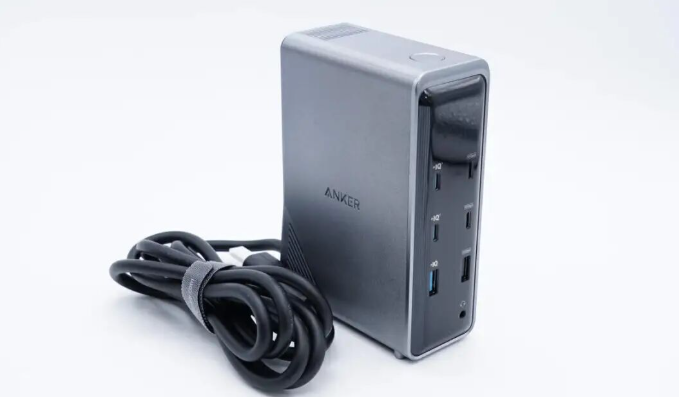
Core Product Parameters: This docking station integrates 14 multi-functional interfaces, including 5 USB-C interfaces (compatible with PD USB C chargers), 5 USB-A interfaces, 2 HDMI interfaces, a 3.5mm audio interface, and a Gigabit wired network interface. The HDMI interface supports dual-screen expansion and 4K60Hz video output, covering all scenarios of daily office and entertainment. It can seamlessly connect with various USB wall chargers and 45W chargers through its Type C port chargers.
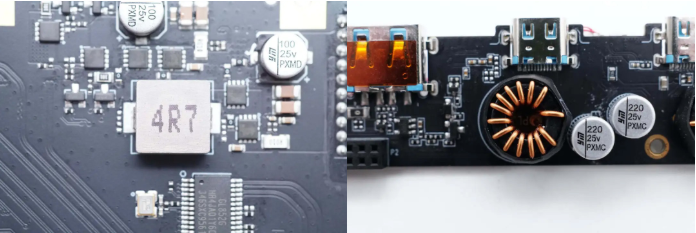
Capacitor Application Details: The product is equipped with 2 Yongming VPX series 25V220μF (specification 6.3×5.8mm) chip-type solid-state capacitors and 2 VPX series 25V100μF (specification 6.3×4.5mm) chip-type solid-state capacitors. These capacitors provide core guarantees for the stable operation of the docking station's built-in Type C port chargers and its ability to adapt to different PD USB C chargers and 45W chargers.
Taking the commonly used 100μF/25V specification as an example, the size advantage of Yongming's VPX series capacitors is extremely significant: only Φ6.3×4.5mm. Compared with traditional capacitors of the same specification (Φ6.3×5.8mm), the volume is reduced by 22% and the height is reduced by 1.3mm. The adoption of this capacitor increases the PCB space utilization rate by nearly 30%, freeing up key space for battery capacity expansion or the addition of functional modules—especially crucial for miniaturized USB wall chargers, 45W chargers, and PD USB C chargers. At the same time, it greatly improves layout flexibility and signal integrity for Type C port charger designs.
III. Summary of Core Application Advantages (For USB Wall Chargers, 45W Chargers, and PD USB C Chargers)
Yongming's ultra-thin high capacitance density solid-state capacitors bring quantifiable performance improvements to the design of high-density electronic devices, especially for USB wall chargers, 45W chargers, Type C port chargers, and PD USB C chargers. They are an ideal solution to balance "high performance" and "small size", and their core advantages are reflected in two major dimensions for these chargers:
1. Freeing Up Design Space: Significantly reducing the PCB area and height occupied by capacitors themselves, providing sufficient space redundancy for more complex wiring designs, integration of additional functional circuits, or optimized heat dissipation schemes—key for the miniaturization of PD USB C chargers and Type C port chargers. It also helps USB wall chargers and 45W chargers achieve more compact designs.
2. Expanding Performance Upgrade Possibilities: The freed-up space can be flexibly used to improve the overall operating performance of the system, enhance product reliability, or add differentiated functions—helping USB wall chargers, 45W chargers, Type C port chargers, and PD USB C chargers form core advantages in the fierce market competition.
 Delta DC24S1215 DC-DC Power Module In-Depth Analysis