



OEM vs ODM Chargers: What’s the Difference?
 02 Jul,2026
When sourcing chargers for your brand, you may often hear two common terms: OEM and ODM. For buyers, distributors, retailers, and electronics brands, understanding the difference between OEM and ODM chargers is essential before starting a new project.
Both OEM and ODM cooperation models are widely used in the charger industry. However, they are not the same. The right choice depends on your brand strategy, budget, target market, technical requirements, and product launch timeline.
If you are planning to develop an OEM USB Charger or expand your charger product line, knowing how OEM and ODM work can help you communicate more clearly with suppliers, avoid unnecessary costs, and bring products to market more efficiently.
What Is an OEM Charger?
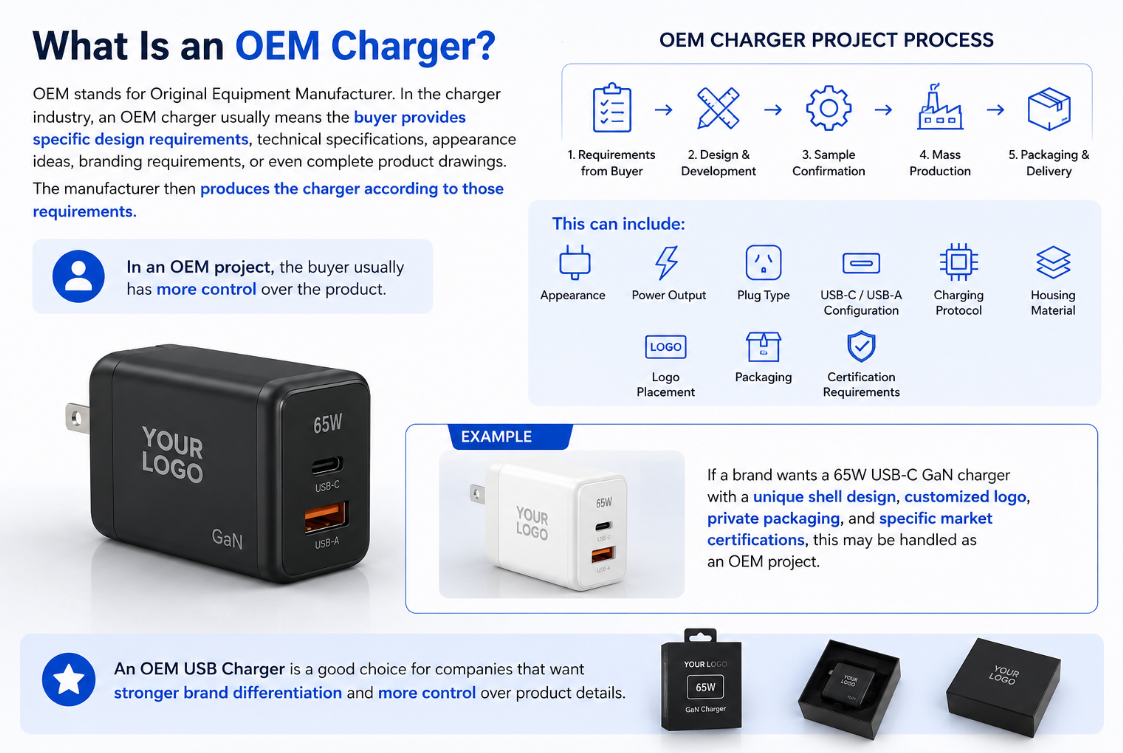
OEM stands for Original Equipment Manufacturer. In the charger industry, an OEM charger usually means the buyer provides specific design requirements, technical specifications, appearance ideas, branding requirements, or even complete product drawings. The manufacturer then produces the charger according to those requirements.
In an OEM project, the buyer usually has more control over the product. This can include the charger’s appearance, power output, plug type, USB-C or USB-A port configuration, charging protocol, housing material, logo placement, packaging, and certification requirements.
For example, if a brand wants a 65W USB-C GaN charger with a unique shell design, customized logo, private packaging, and specific market certifications, this may be handled as an OEM project.
An OEM USB Charger is a good choice for companies that want stronger brand differentiation and more control over product details.
What Is an ODM Charger?
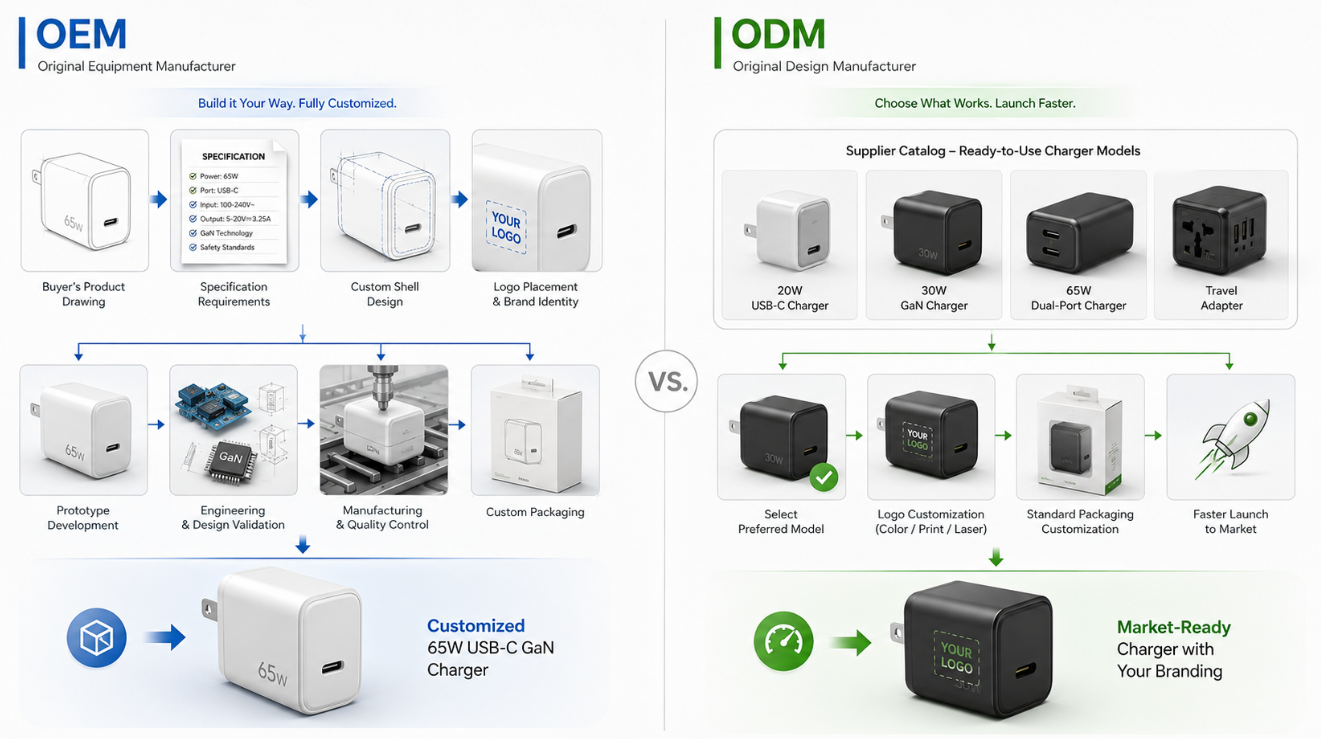
ODM stands for Original Design Manufacturer. In an ODM project, the supplier already has an existing charger design or ready-developed model. The buyer selects from the supplier’s available products and customizes certain elements, such as logo, color, packaging, cable bundle, or minor specification options.
ODM chargers are usually faster to launch because the product design, internal structure, tooling, and testing process are already completed. The buyer does not need to develop a charger from zero.
For example, a supplier may already have a 20W USB-C PD charger, 30W GaN charger, 65W dual-port charger, or travel adapter model available. The buyer can choose one of these existing designs, add their brand logo, customize the retail box, and confirm certifications for the target market.
ODM is often suitable for importers, wholesalers, e-commerce sellers, and brands that want to launch products quickly with lower development risk.
OEM vs ODM Chargers: The Main Difference
The biggest difference between OEM and ODM chargers is the level of customization.
OEM usually starts from the buyer’s requirements.
ODM usually starts from the supplier’s existing product.
With OEM, the buyer has more control over design and specifications. With ODM, the buyer saves time and development cost by using a charger model that has already been designed and tested.
This does not mean one model is always better than the other. OEM and ODM simply serve different business needs.
If your company wants a unique product that competitors cannot easily copy, OEM may be the better option. If your company wants to test the market quickly or add a proven product to your catalog, ODM may be more practical.
Customization Level
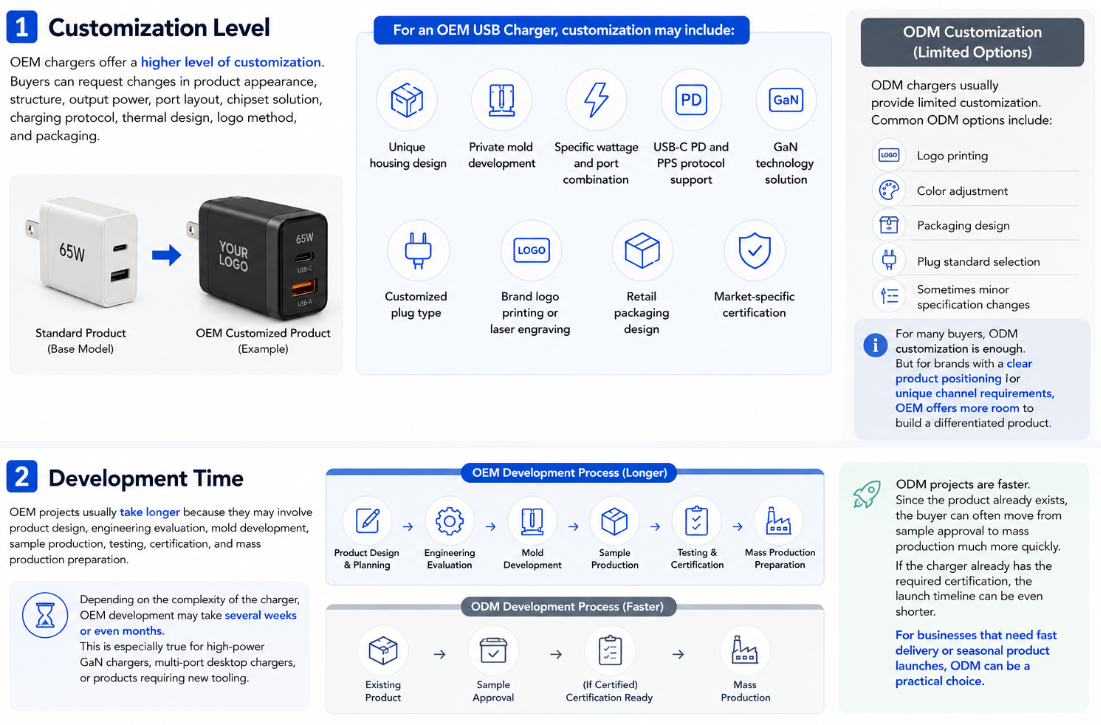
OEM chargers offer a higher level of customization. Buyers can request changes in product appearance, structure, output power, port layout, chipset solution, charging protocol, thermal design, logo method, and packaging.
For an OEM USB Charger, customization may include:
Unique housing design
Private mold development
Specific wattage and port combination
USB-C PD and PPS protocol support
GaN technology solution
Customized plug type
Brand logo printing or laser engraving
Retail packaging design
Market-specific certification
ODM chargers usually provide limited customization. Common ODM options include logo printing, color adjustment, packaging design, plug standard selection, and sometimes minor specification changes.
For many buyers, ODM customization is enough. But for brands with a clear product positioning or unique channel requirements, OEM offers more room to build a differentiated product.
Development Time
OEM projects usually take longer because they may involve product design, engineering evaluation, mold development, sample production, testing, certification, and mass production preparation.
Depending on the complexity of the charger, OEM development may take several weeks or even months. This is especially true for high-power GaN chargers, multi-port desktop chargers, or products requiring new tooling.
ODM projects are faster. Since the product already exists, the buyer can often move from sample approval to mass production much more quickly. If the charger already has the required certification, the launch timeline can be even shorter.
For businesses that need fast delivery or seasonal product launches, ODM can be a practical choice.
Cost and MOQ
OEM chargers usually require higher upfront investment. This may include design fees, mold costs, engineering costs, testing fees, certification costs, and higher minimum order quantities.
However, OEM also gives the buyer more exclusivity and product control. For long-term brands, this investment can be worthwhile.
ODM chargers usually have lower development costs because the supplier has already completed the product design and tooling. The MOQ may also be more flexible, depending on the model and customization requirements.
If you are testing a new market or starting with a smaller order, ODM may reduce your risk. If you already have stable sales channels and want to build your own product identity, OEM may create more long-term value.
Branding and Market Positioning
Branding is another key difference between OEM and ODM chargers.
OEM is better for companies that want a unique product identity. You can create a charger that matches your brand’s design language, target price level, and market positioning. This is especially important for premium brands, retail chains, and companies selling through competitive online channels.
ODM is suitable for companies that want to sell reliable, ready-made chargers under their own brand name. The product may not be fully exclusive, but it can still be professionally packaged and positioned for your target customers.
For example, a distributor may choose an ODM 20W USB-C charger for basic retail channels, while a premium accessory brand may develop an OEM USB Charger with a custom GaN design and private packaging.
Certification Requirements
Whether you choose OEM or ODM, certification is very important. Chargers must meet the safety and regulatory standards of the target market.
For the European market, buyers may need CE and related compliance documents. For the United States, FCC and safety standards are important. Other markets may require UKCA, PSE, KC, RCM, or other local certifications.
In an OEM project, certification may need to be arranged according to the final customized design. Any major change in structure, components, output power, or plug type may affect certification.
In an ODM project, the supplier may already have existing certifications for certain models. This can save time and cost, but buyers still need to confirm whether the certificates match the exact product version and target market.
A professional charger manufacturer should provide clear guidance on certification, testing, and documentation.
Which Option Is Better for Your Business?
The best option depends on your business stage and goals.
Choose OEM if you want a unique charger design, strong brand differentiation, specific technical requirements, and long-term product control. OEM is ideal for established brands, retail chains, and companies with stable sales volume.
Choose ODM if you want faster delivery, lower development cost, proven product designs, and easier market testing. ODM is ideal for wholesalers, importers, online sellers, and brands expanding their product catalog quickly.
In many cases, companies use both models. They may start with ODM chargers to test demand, then develop OEM models once sales become stable.
How to Choose the Right Charger Manufacturer
Whether you need OEM or ODM, choosing the right supplier is critical. A reliable charger manufacturer should have strong R&D capability, stable production capacity, strict quality control, and experience with international certification.
When evaluating a supplier, buyers should check:
Product development experience
USB-C PD and PPS technical capability
GaN charger design experience
Quality control process
Certification support
Customization options
Production lead time
After-sales support
For an OEM USB Charger project, communication is especially important. The manufacturer should understand your target market, product positioning, price range, technical requirements, and packaging needs before recommending a solution.
Conclusion
OEM and ODM chargers are two different cooperation models in the charger industry. OEM gives buyers more customization and product control, while ODM offers faster launch time and lower development cost.
If your goal is to build a unique product with strong brand identity, an OEM USB Charger may be the right choice. If your priority is speed, cost efficiency, and proven product availability, ODM chargers may be more suitable.
For brands, distributors, and importers, the key is not simply choosing OEM or ODM. The real goal is to choose the right charger solution for your market, your customers, and your long-term business growth.
 Inside Aohai’s Compact 60W GaN Dynamic Fast Charger: Design, Performance and Component Teardown