



Lenovo CC100 100W Multi-Port USB-C GaN Charger Review: AHB Architecture and 1.5x Peak Output Tested
 20 Oct,2026
A Compact High-Power Charger Built for Multi-Device Users
As laptops, phones, tablets, and accessories multiply, carrying several chargers has become a daily annoyance. High-power multi-port GaN chargers are now a practical choice for desks, commutes, and business travel.
Lenovo previously earned positive feedback with its 150W commercial GaN charger, thanks to strong safety quality and reliable performance. Now Lenovo has introduced the CC100, a 100W multi-port USB-C GaN power adapter with AHB adaptive hybrid buck architecture, a compact body, three USB-C ports, and up to 100W PD fast charging from a single port.
Its headline features include no high-temperature power derating, no tingling sensation on metal-bodied devices, 1.5x peak power output for gaming-laptop beast modes and AI PC burst loads, stable operation at altitudes up to 5,000 meters, and clean output that avoids interference-related lag on computers and phones. This review examines its design, circuit architecture, no-load power, efficiency, ripple, thermal behavior, and real-world charging performance.
Unboxing and Accessories: Ready to Use Out of the Box
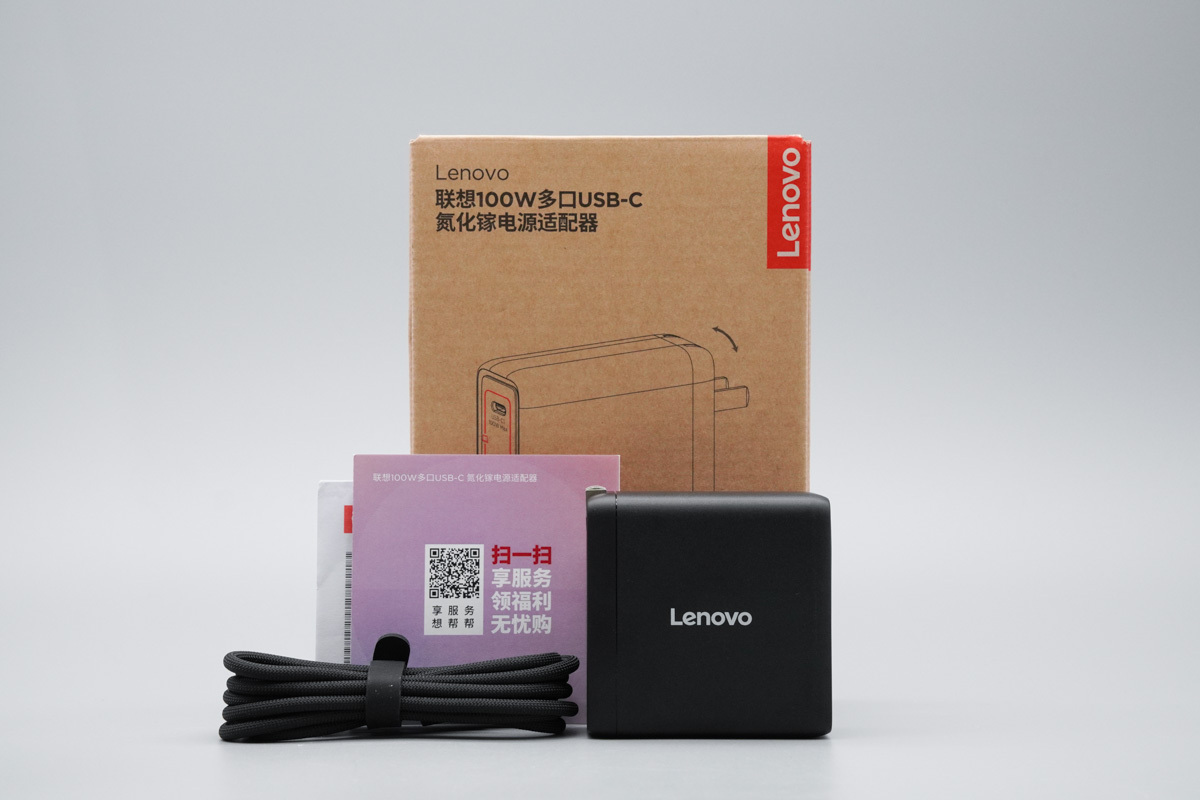
The Lenovo CC100 ships in a simple kraft-paper box with a line drawing of the product and a clear GaN 100W logo. The packaging shows the three USB-C ports and foldable plug design.
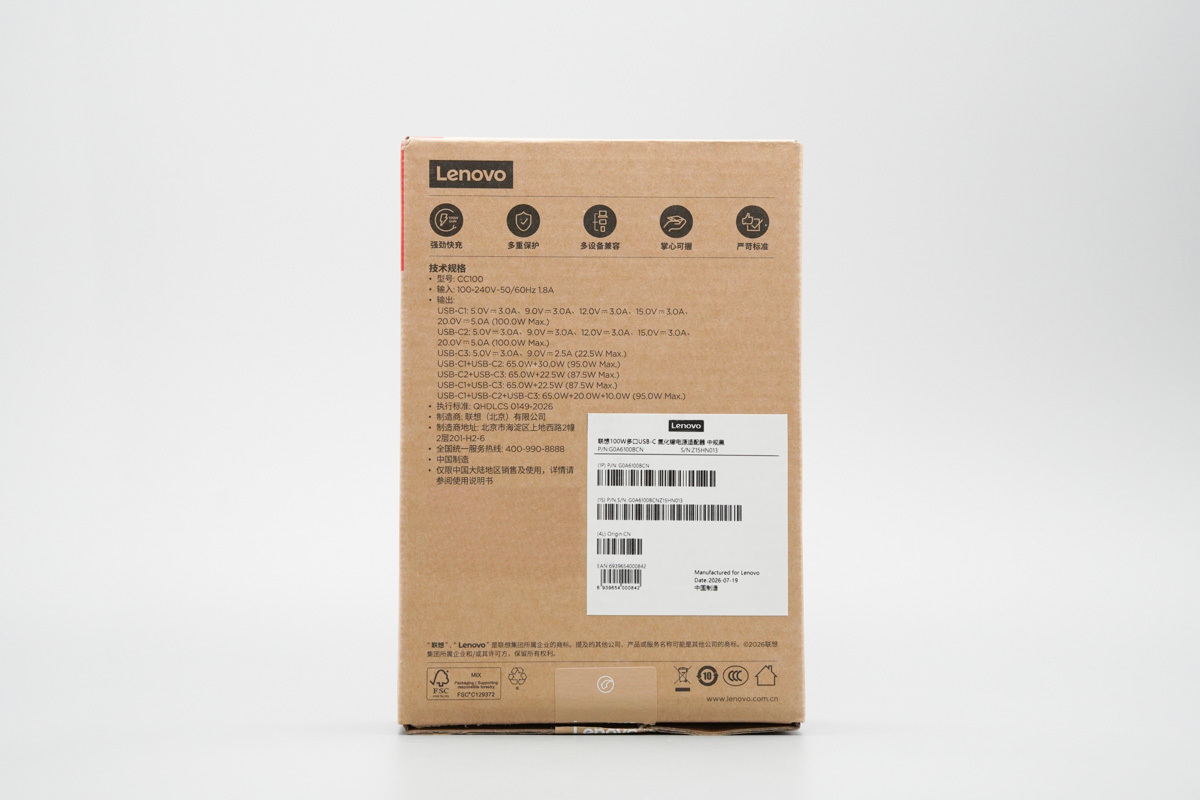
The back lists five core selling points: powerful fast charging, multiple protections, multi-device compatibility, palm-sized portability, and strict standards. It also prints full technical parameters, manufacturer information, and the product serial number.
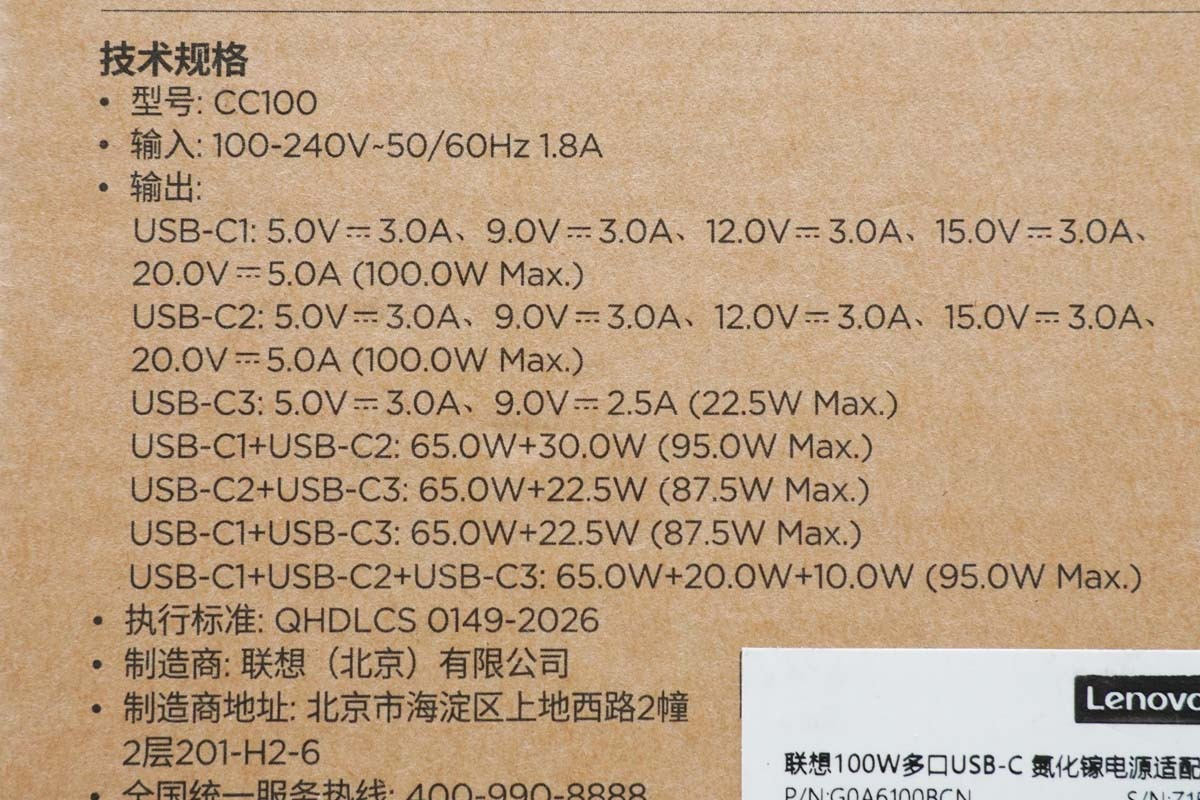
The specification table clearly lists input and output ratings: C1 and C2 support up to 100W each, while C3 supports up to 22.5W. It also details intelligent power allocation for dual-port and triple-port use under standard QHDLCS 0149-2026. The bottom of the box displays CE, UKCA, FCC, UL, EAC, and other international safety certifications, indicating compliance for travel across multiple regions.
Included Cable and First Impressions
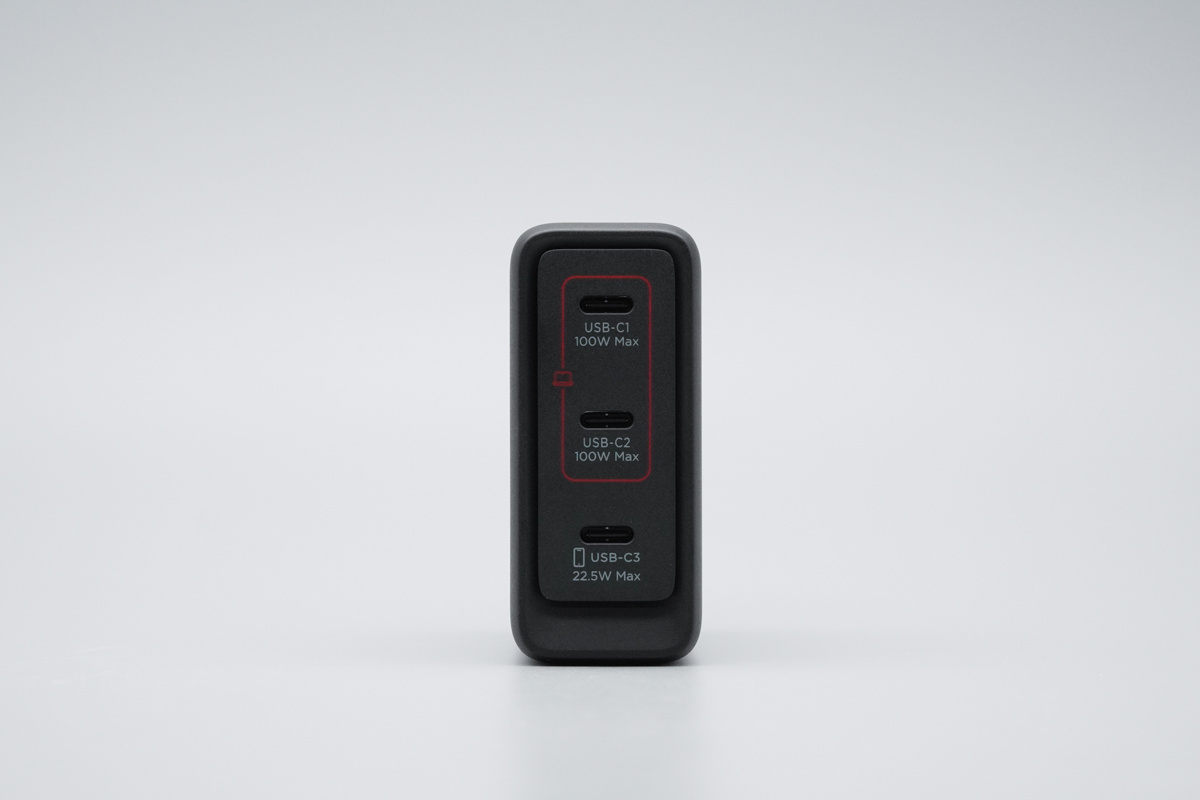
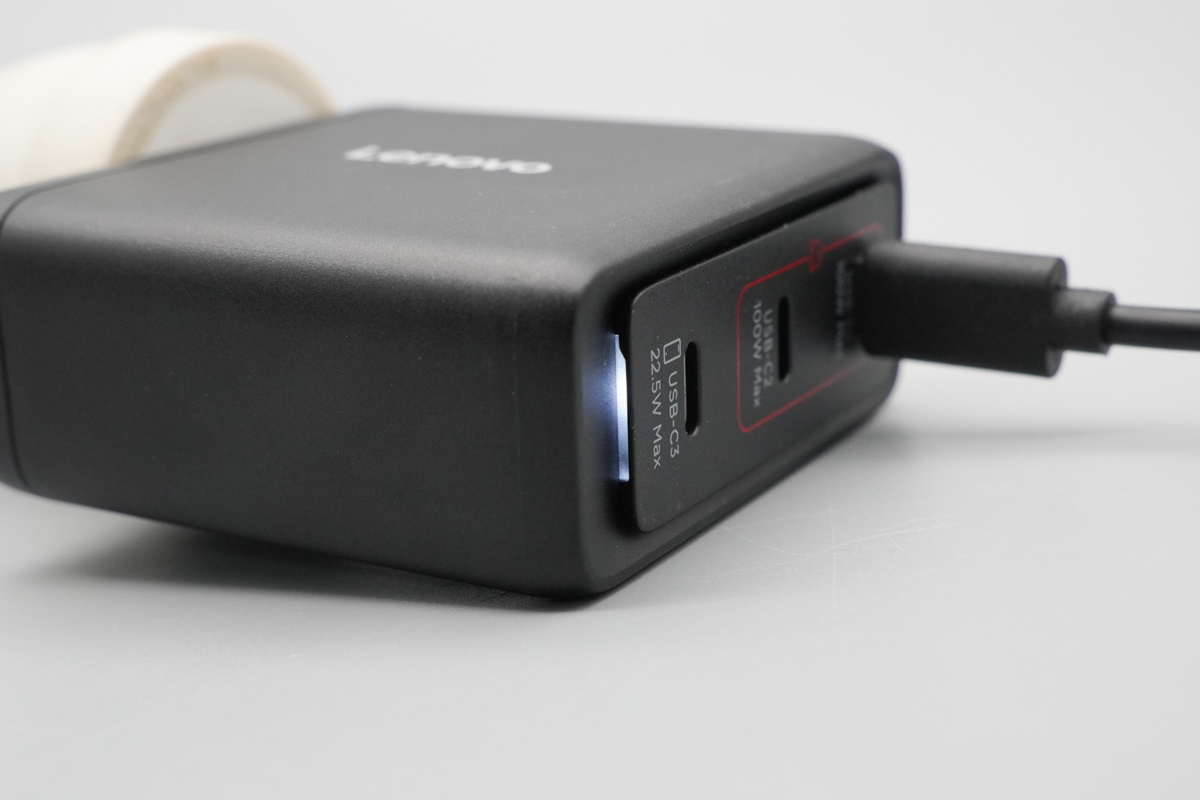
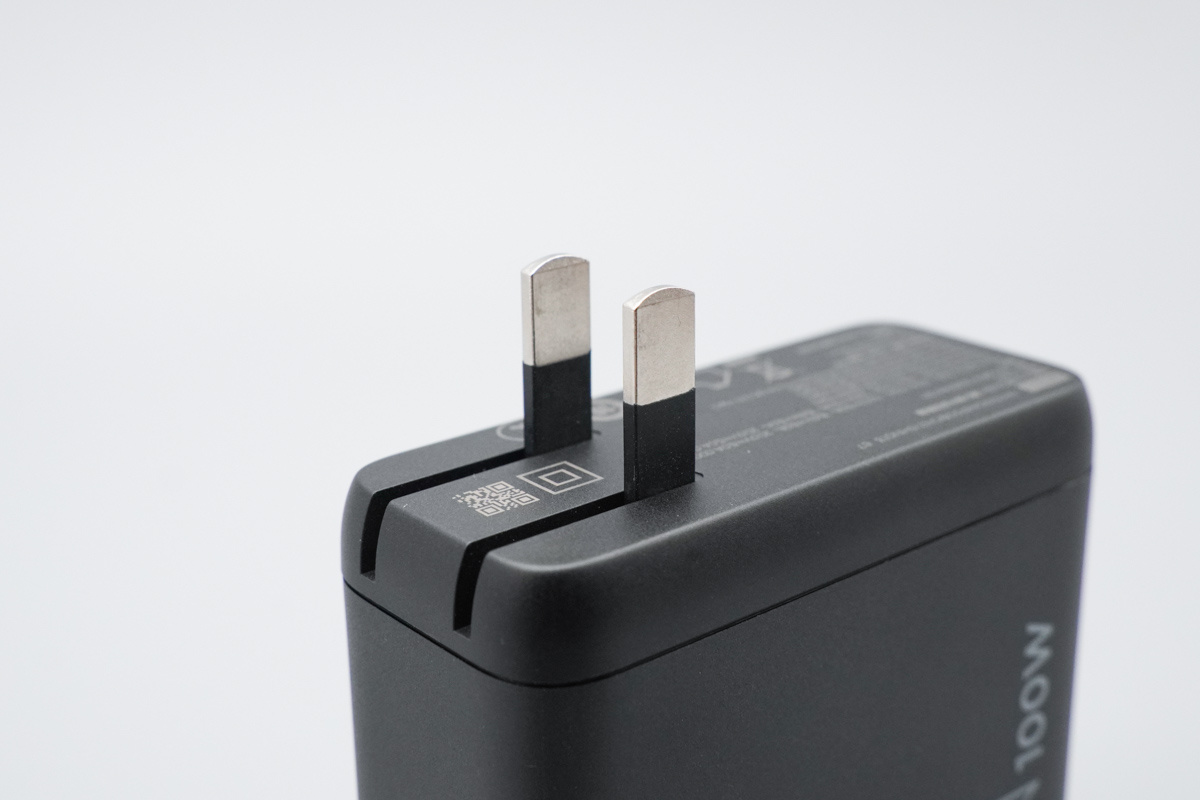
The box contains the Lenovo CC100 charger, a 100W braided C-to-C cable, a user manual, and service cards. The charger has a matte black finish, a foldable two-prong plug, and a front-facing three-port layout. C1 and C2 are the high-power ports, while C3 is an auxiliary 22.5W fast-charge port.
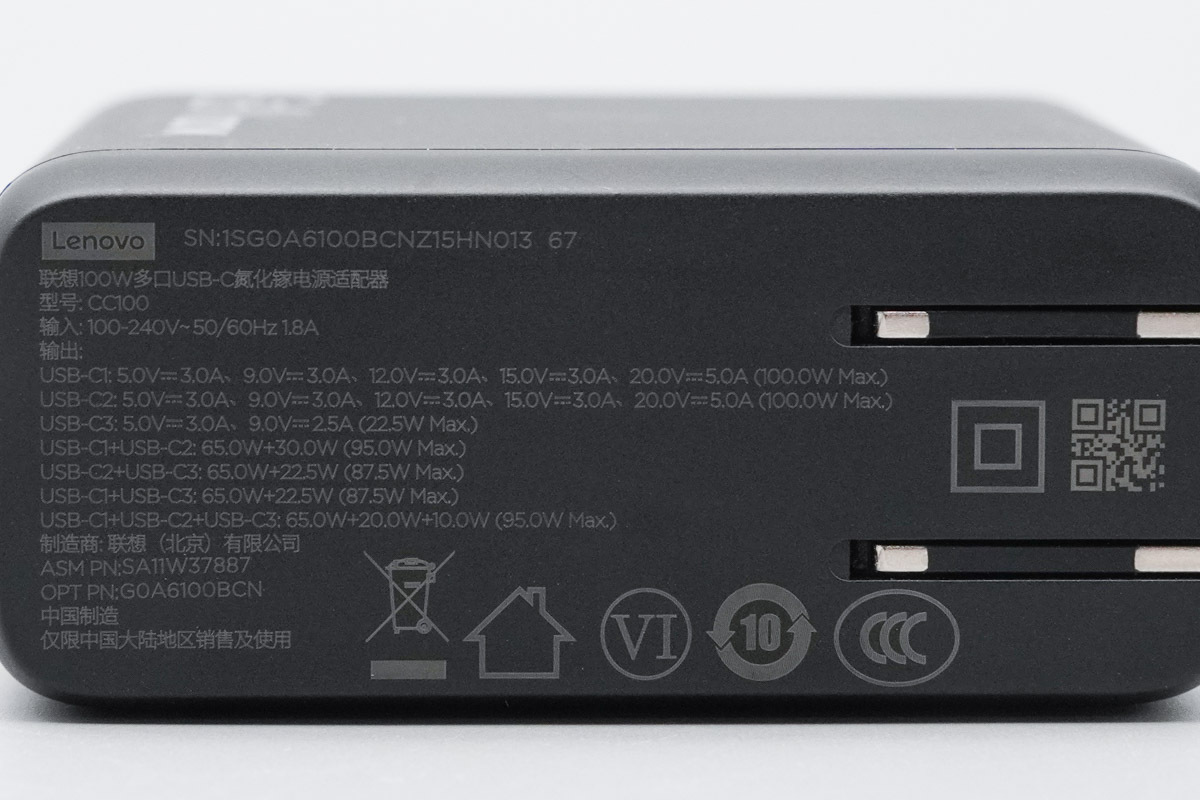
The matte texture resists fingerprints, and the Lenovo logo gives the product a clean business look. A side label reads “GaN 100W,” confirming the technology and power class. After powering on, a white breathing light beside C3 indicates operating status. The foldable plug sits flush inside the body when stored, reducing the risk of scratching cables or devices in a bag.
The included braided cable has a rubber cable tie, Lenovo-branded connector shells, and reinforced bend reliefs. It measures about 1.8 meters, offering flexible desktop and sofa use. An E-Marker readout shows a Lenovo solution supporting 20V/5A, 100W, and USB 2.0 data, enough to run 100W PD charging reliably.
Dimensions, Weight, and Portability
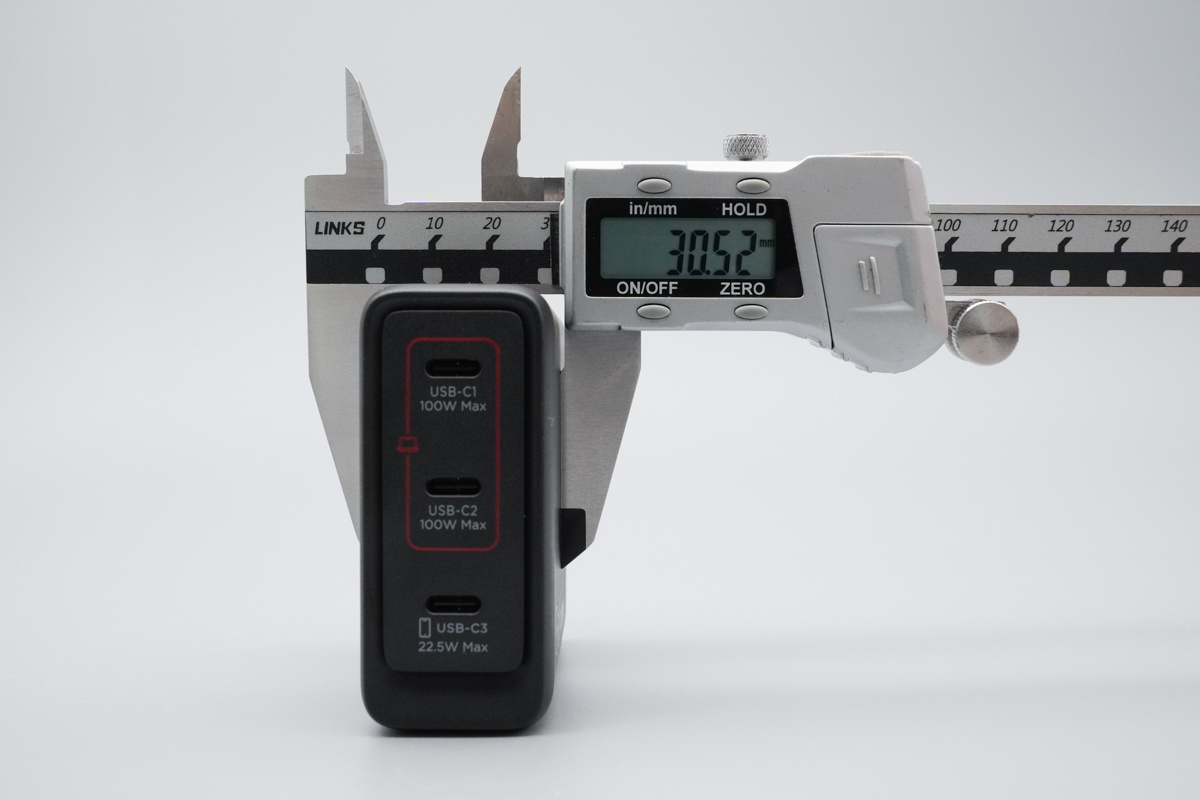
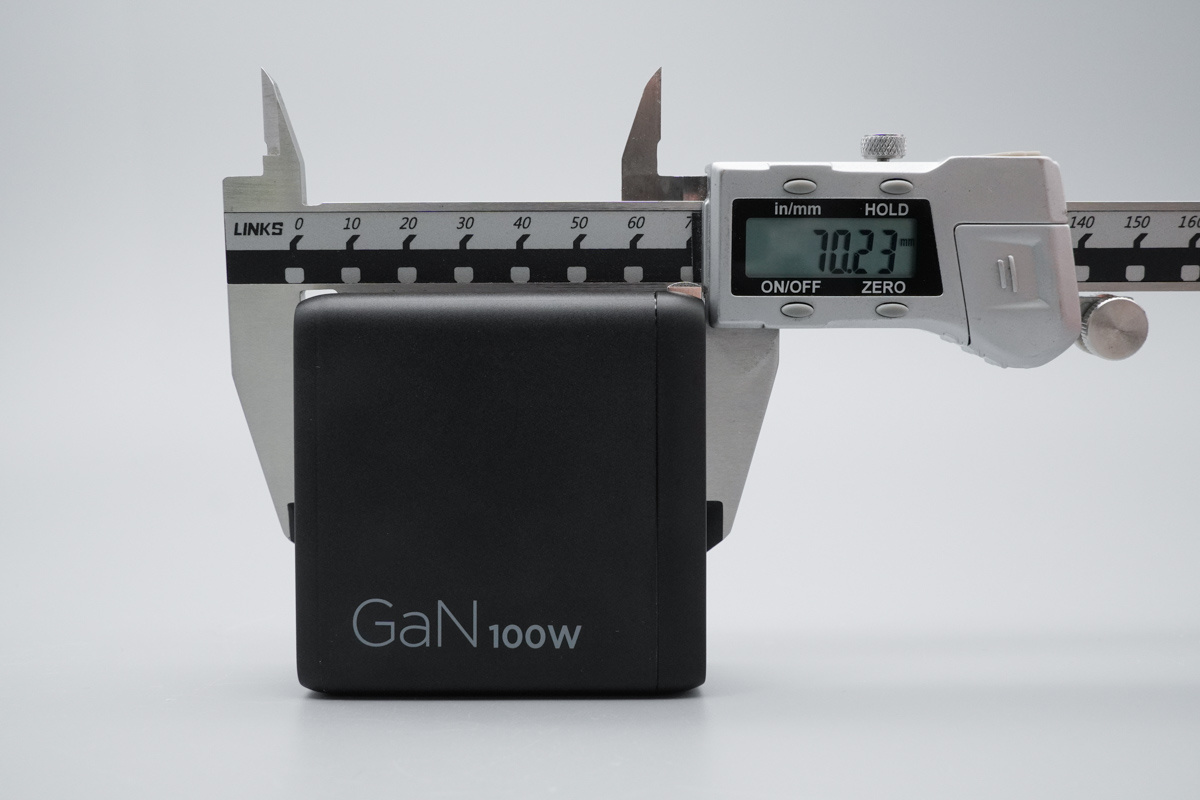
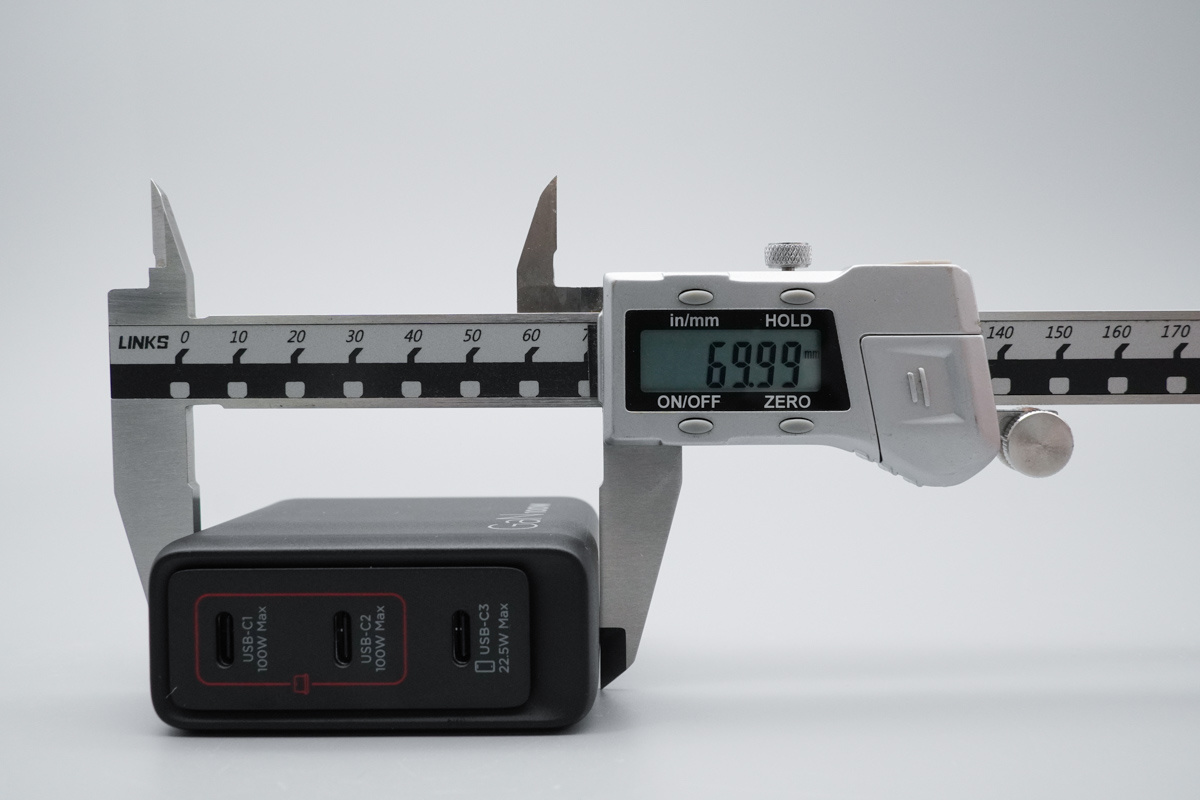
Measured with digital calipers, the charger is 30.52mm thick, 70.23mm wide, and 69.99mm long, making it nearly square. The three USB-C ports are arranged in a row with enough spacing that multiple cables can be inserted without crowding.
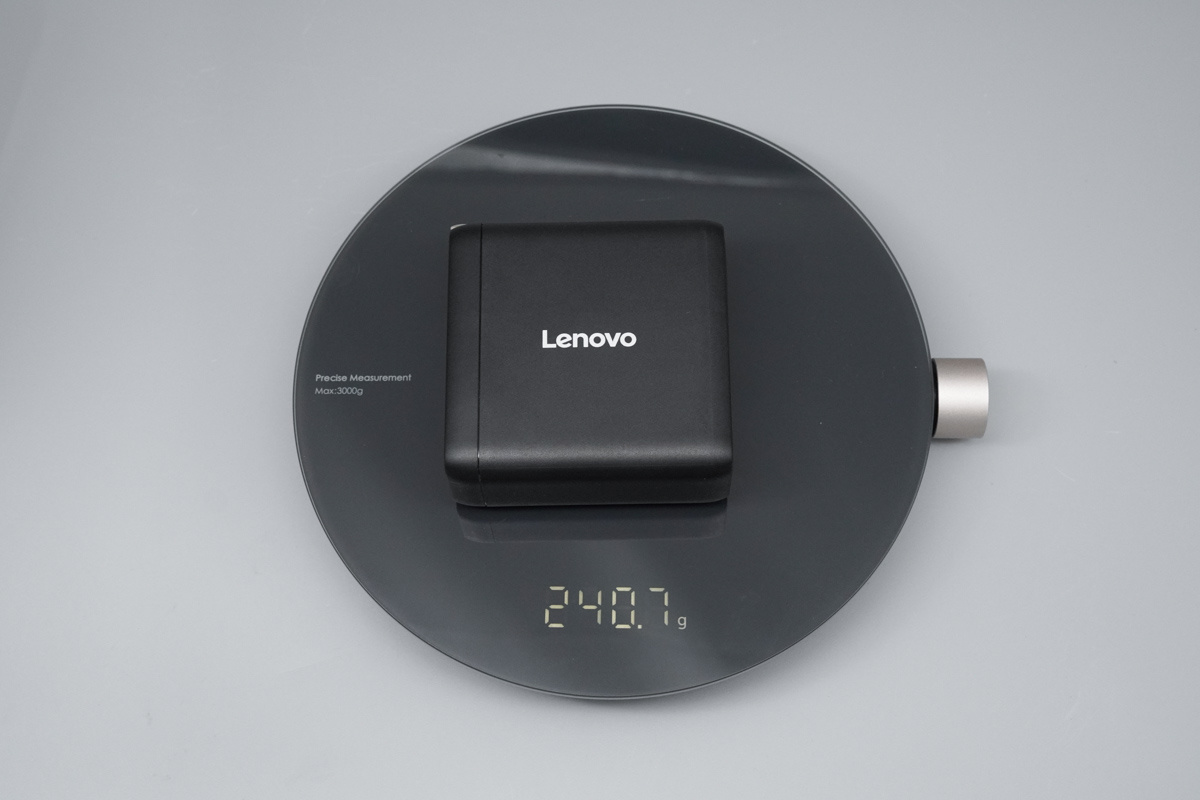
Compared with a traditional bulky laptop power adapter, the GaN design dramatically reduces volume while retaining 100W output, making business travel noticeably lighter. The unit can be held comfortably in one hand, and the matte shell feels solid without being heavy. On an electronic scale, it weighs 240.7g, a reasonable figure for a 100W three-port GaN charger. It fits easily into a backpack side pocket and balances high output with portability.
AHB Architecture: Efficiency, Thermal Control, and Stable Output
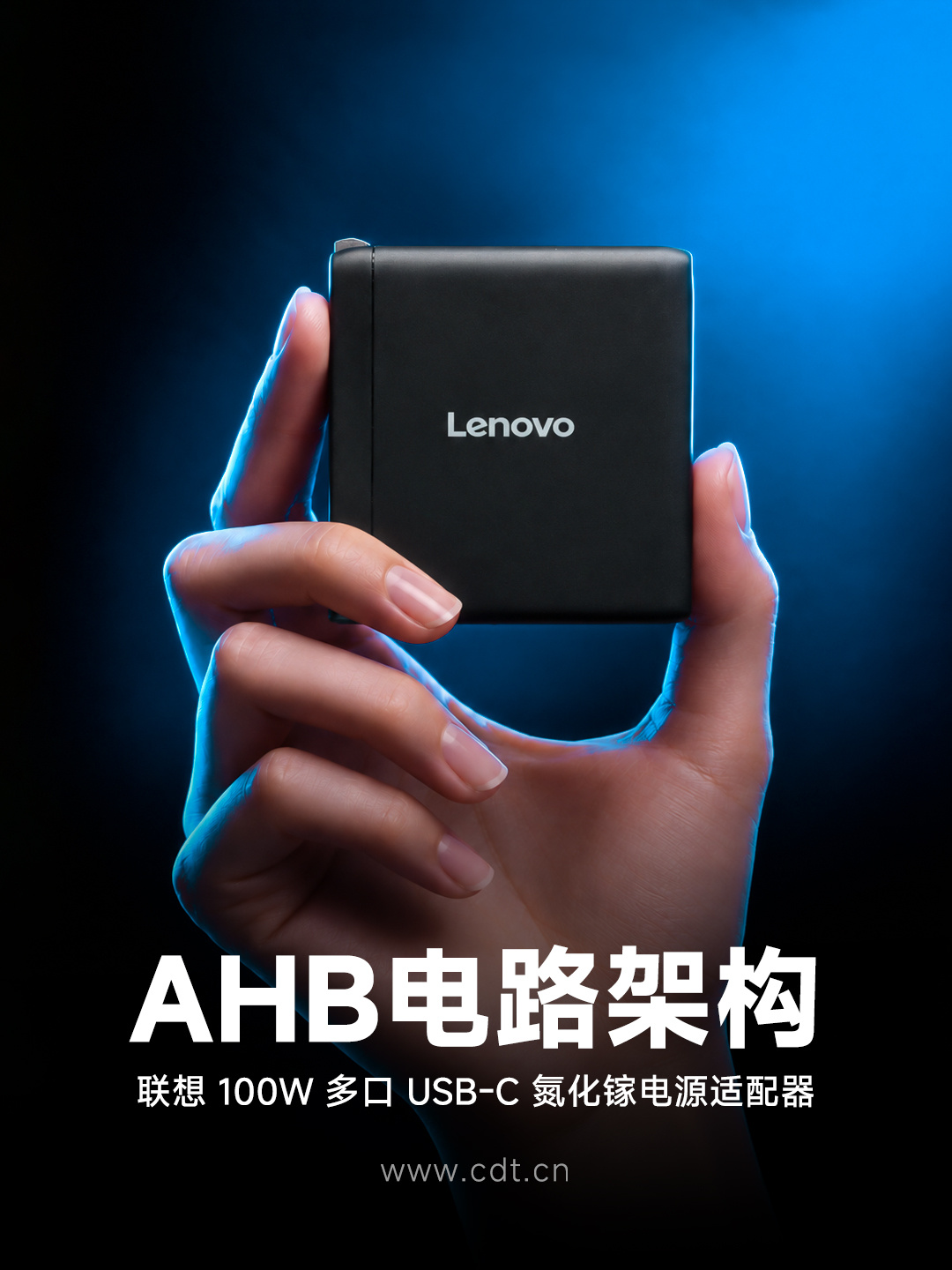
The Lenovo CC100 uses AHB, or Adaptive Hybrid Buck, architecture rather than a conventional independent flyback design. AHB integrates and reuses main power switches, synchronous rectification devices, and related components, using adaptive hybrid conversion to deliver wide-range voltage output with higher efficiency in the high-power range.
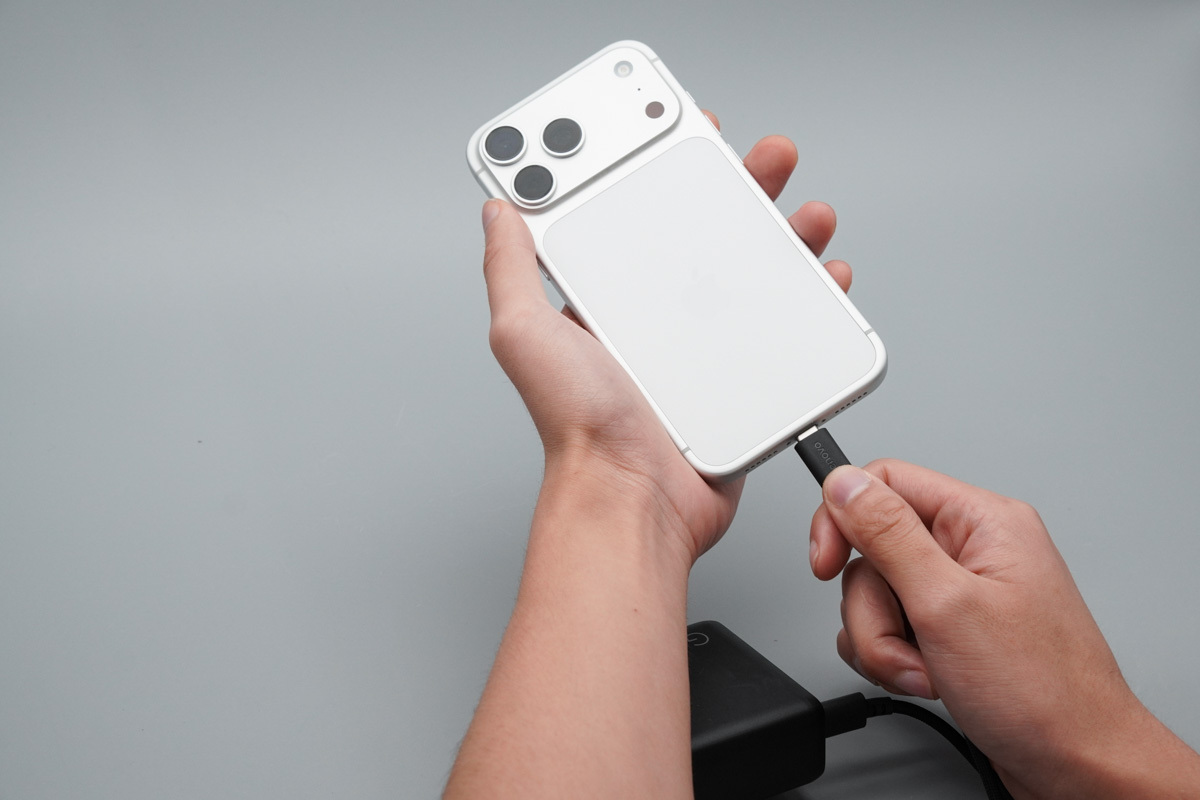
Compared with traditional designs, AHB offers higher full-load efficiency, better heat control, smaller size through device reuse, stable voltage regulation during load steps and voltage switching, and smoother flexible power allocation when multiple ports are loaded. These benefits matter for a compact 100W charger because thermal headroom and stable regulation directly affect sustained charging speed and device safety.
No Tingling Sensation on Metal-Bodied Laptops
A common complaint with metal-bodied laptops is a slight leakage current or tingling sensation when using some chargers. Lenovo addresses this by optimizing the isolation circuit to eliminate micro-current induction during charging. In practice, metal-bodied devices can be touched without the uncomfortable tingling feeling, reducing user safety concerns and making daily use more reassuring.
1.5x Peak Power for Gaming Laptops and AI PCs
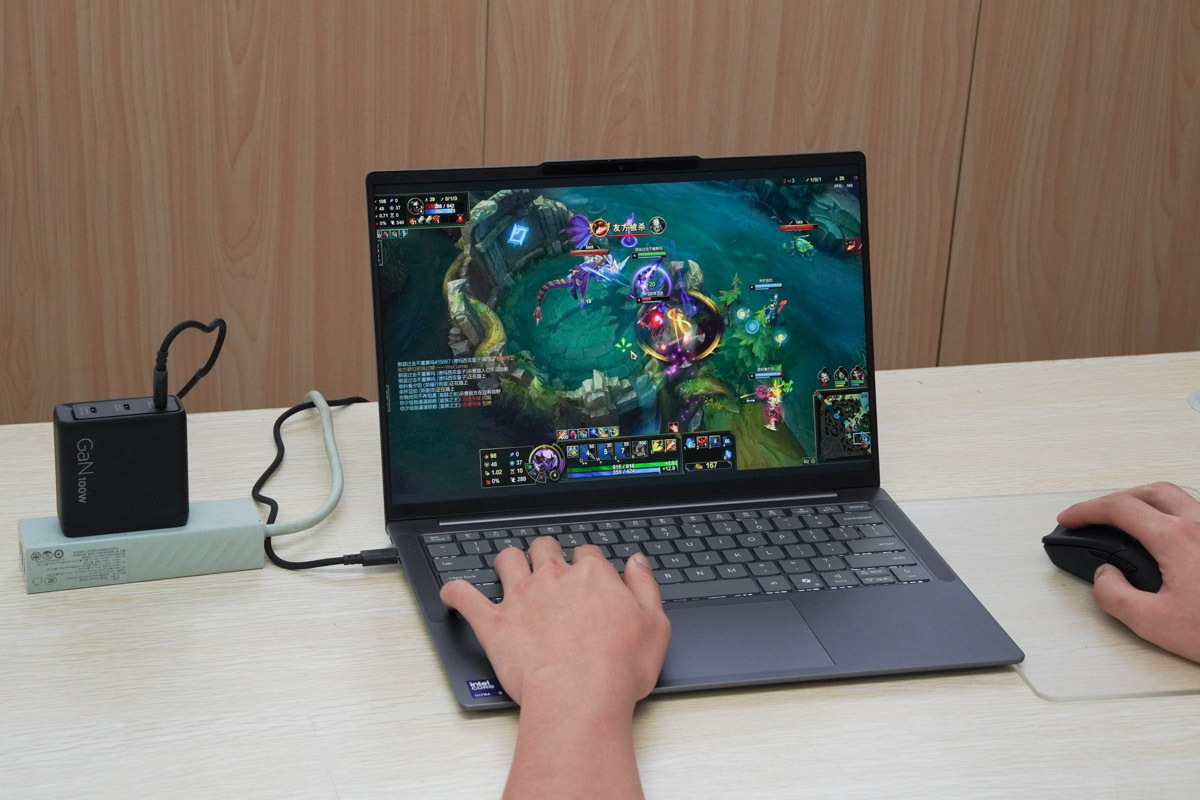
The CC100 supports instantaneous high peak power output, up to 1.5x the peak performance of ordinary fast chargers. Lenovo positions this for gaming laptops in beast mode and AI PCs with sudden high-load power demands.
When a device briefly spikes its power draw, the charger can follow the load instead of becoming a bottleneck, helping avoid frequency reduction, stutter, or app crashes caused by insufficient supply. This is a meaningful differentiator for users who need more than steady-state 100W behavior.
Clean Power Delivery and Zero Interference
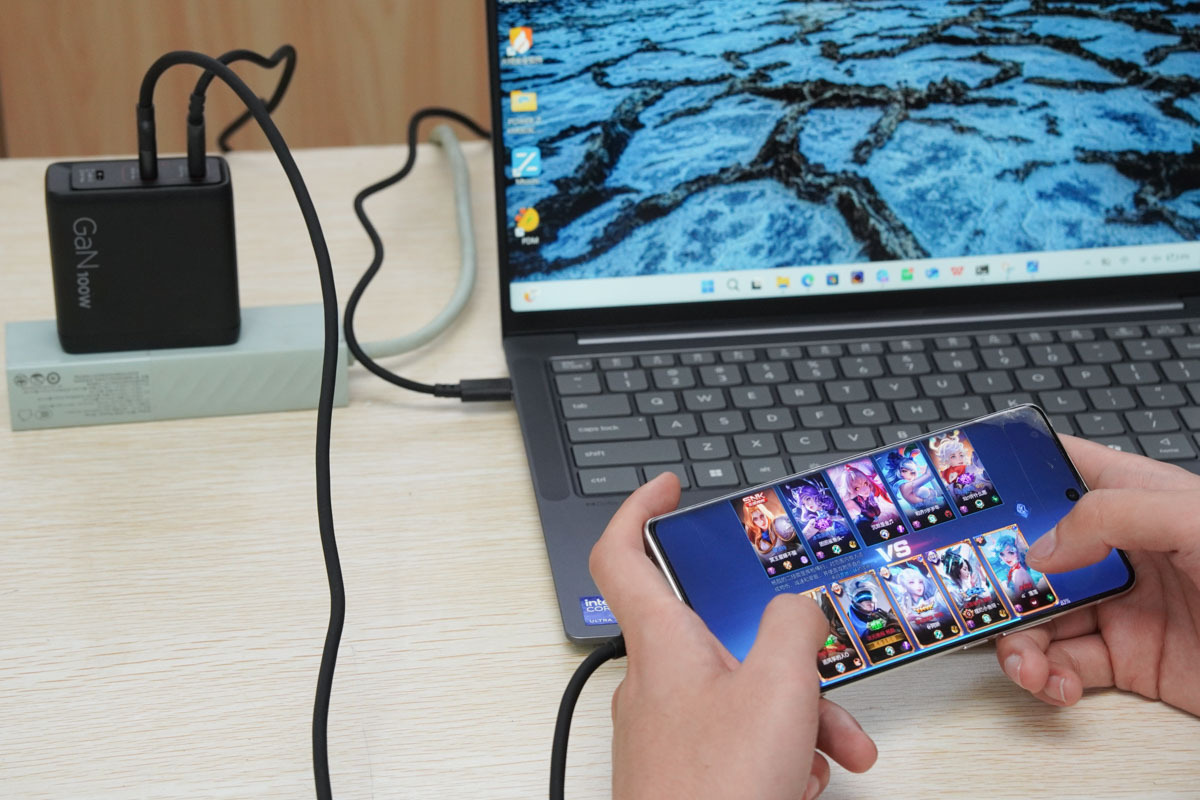
The charger includes a high-frequency filtering and voltage-regulation circuit to reduce current noise and voltage fluctuation during charging. Lenovo says this prevents interference with phone and computer processors and signal modules. The practical claim is smoother phone operation, lower game latency, and stable computer performance while charging. For users who charge while working or gaming, clean output is an important part of the experience, not just a marketing extra.
High-Altitude Safety and Global Certification
The CC100 has passed dedicated high-altitude withstand-voltage and insulation tests and can operate safely at altitudes up to 5,000 meters. This covers low-pressure and low-air-density environments from plateau cities to outdoor camping and cross-border travel. Combined with CE, UKCA, FCC, UL, EAC, and CCC certifications, the charger is designed for broad regional compliance and environmental adaptability beyond ordinary consumer fast chargers.
Smart Power Allocation: Dual-Port and Triple-Port Testing
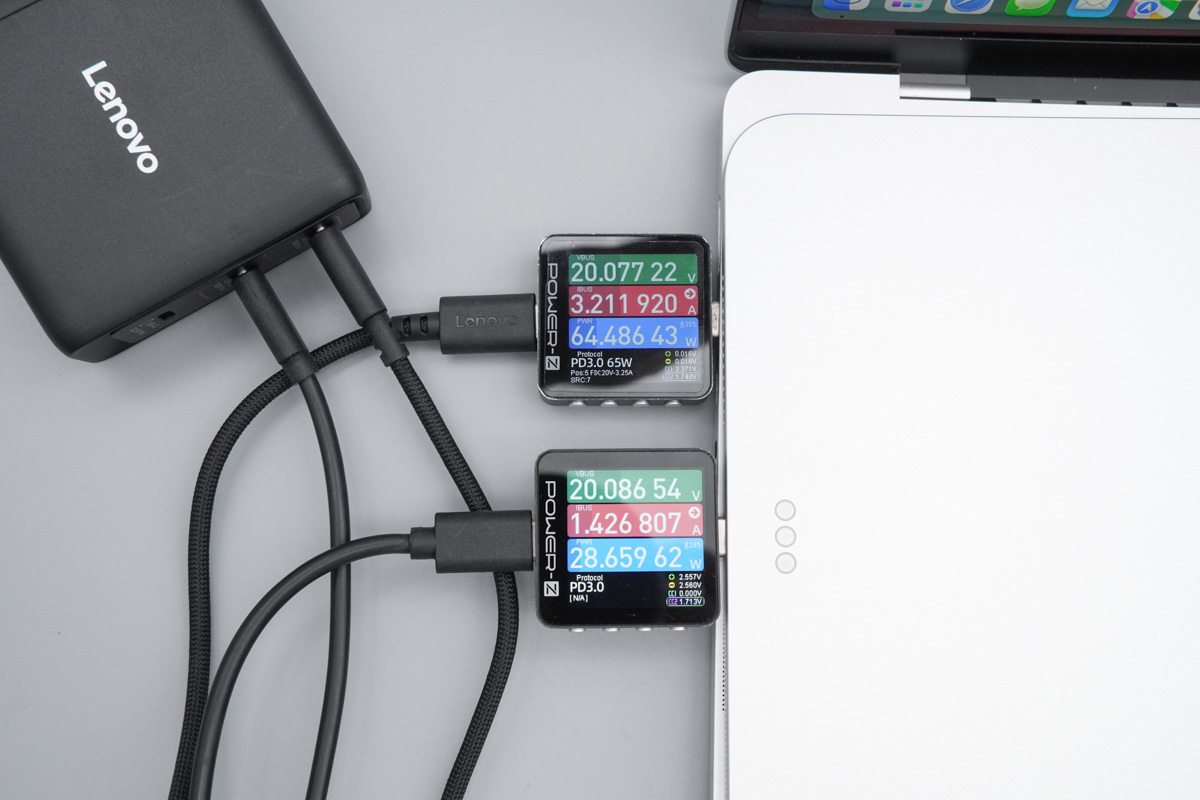
Many multi-port chargers slow down or lock power when more devices are connected. The CC100 uses an intelligent power-allocation chip to distribute power according to connected devices and their needs.
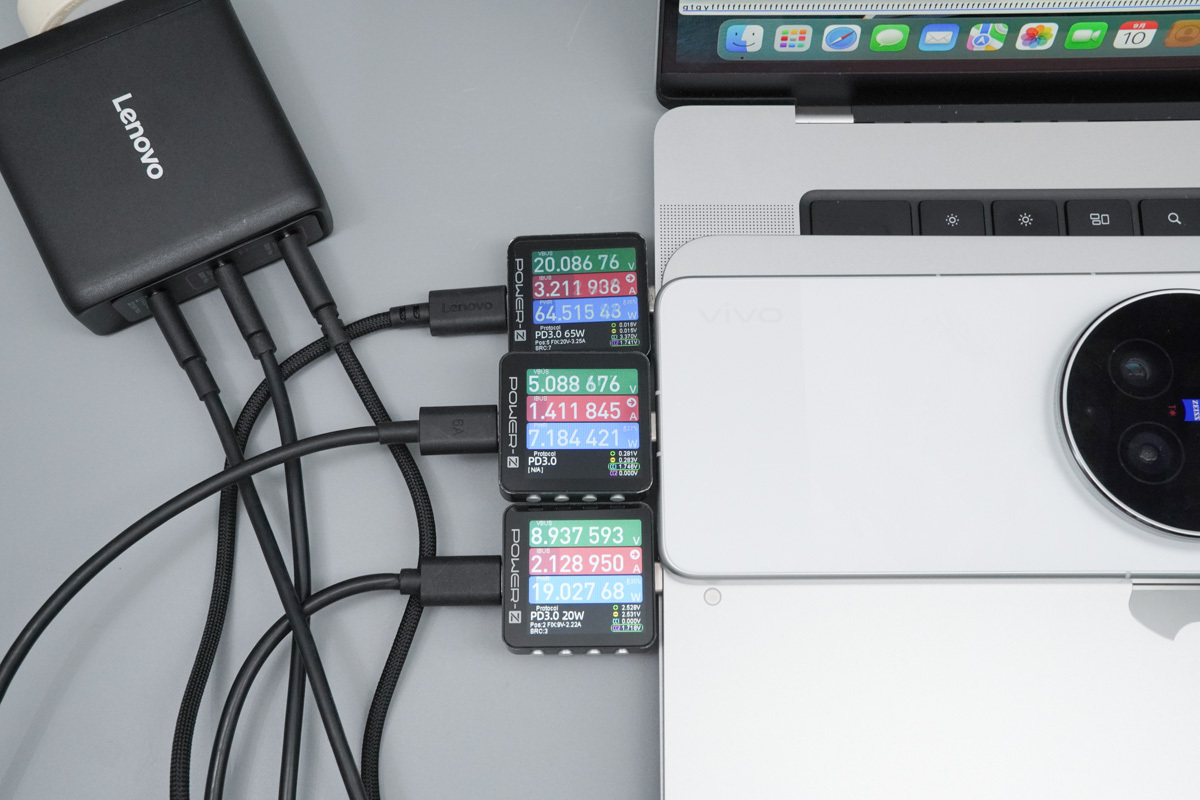
In a dual-port test with a MacBook Pro M4 Pro and iPad Pro 11, the POWER-Z KM003C showed C1 at 20.07V/3.211A, or 64.49W, negotiating a PD3.0 65W level, while C2 delivered 20.08V/1.42A, or 28.66W.
The combined output was about 93W, matching the labeled “C1+C2: 65W+30W” strategy. Two laptops can charge at the same time without taking turns. In a triple-port test with a MacBook Pro M4 Pro, iPad Pro M5, and vivo X300 Pro, output was 64.52W, 7.18W, and 19.03W respectively, totaling about 90.73W. The laptop received the main 65W allocation, while remaining power was shared intelligently, validating the “65W+20W+10W” triple-port strategy.
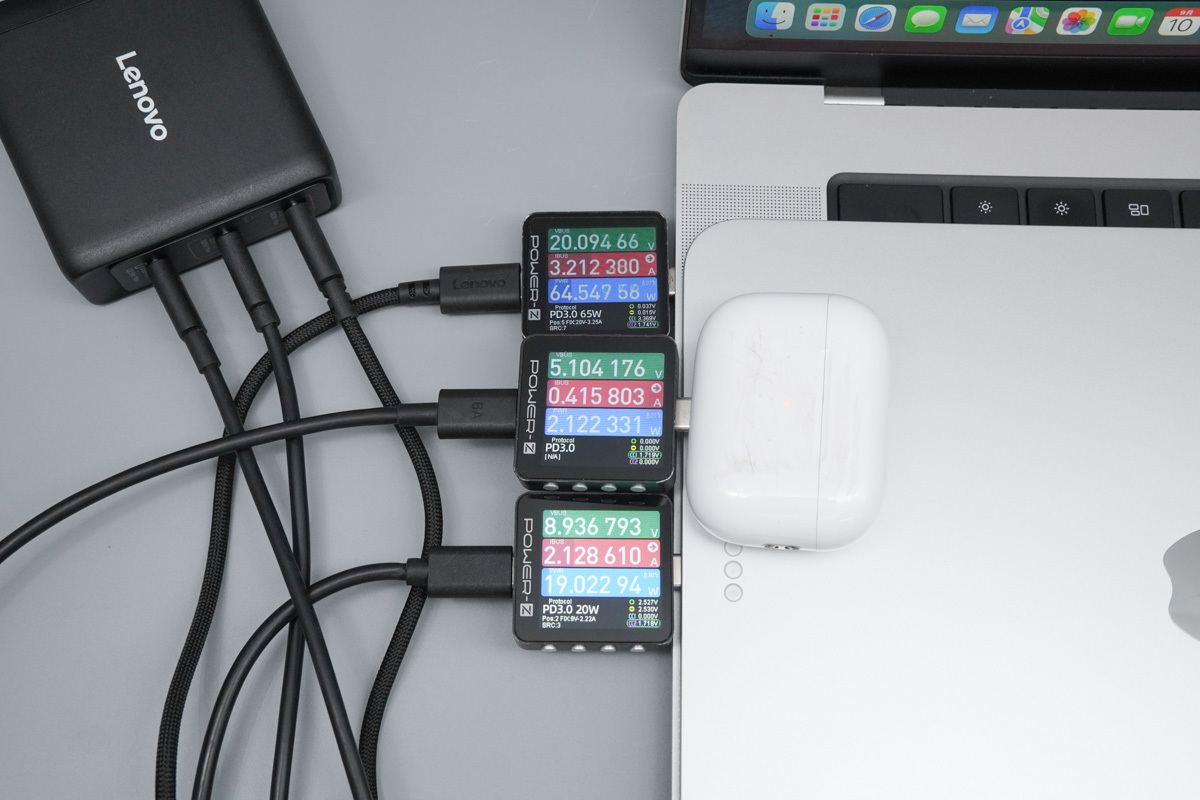
In another test with a laptop, wireless earbuds, and a phone, output was 64.55W, 2.12W, and 19.02W. When a device needs very little power, such as earbuds at 2W, the charger does not force a full allocation, showing flexible scheduling and preventing low-power devices from wasting shared capacity.
Real-World Use: Desk, Travel, and Socket-Friendly Design
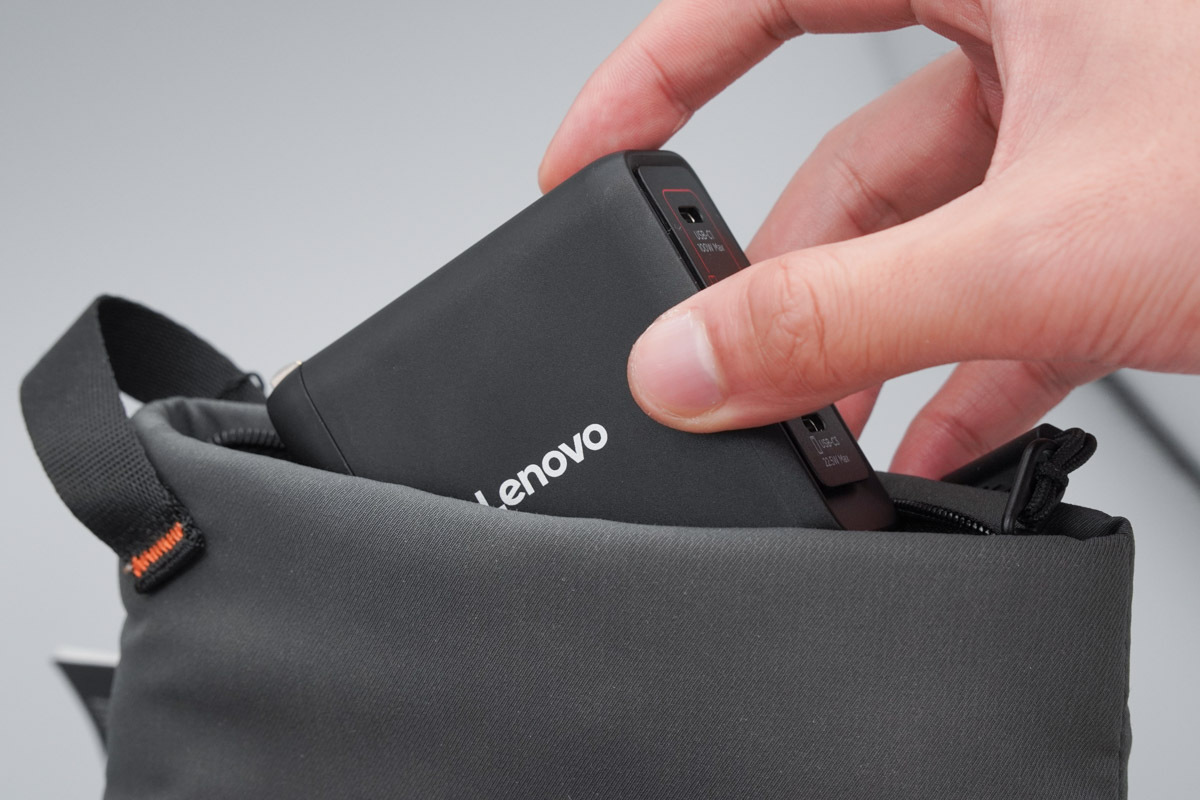
In daily use, the CC100 can replace the bulky original notebook power adapter. By providing a full 100W power supply for the notebook to ensure efficient office work, it significantly reduces the burden of travel. Its slim design makes it easy to be used with desktop power sockets: after being plugged into the socket, it won't block the adjacent sockets, and other chargers can still function normally.
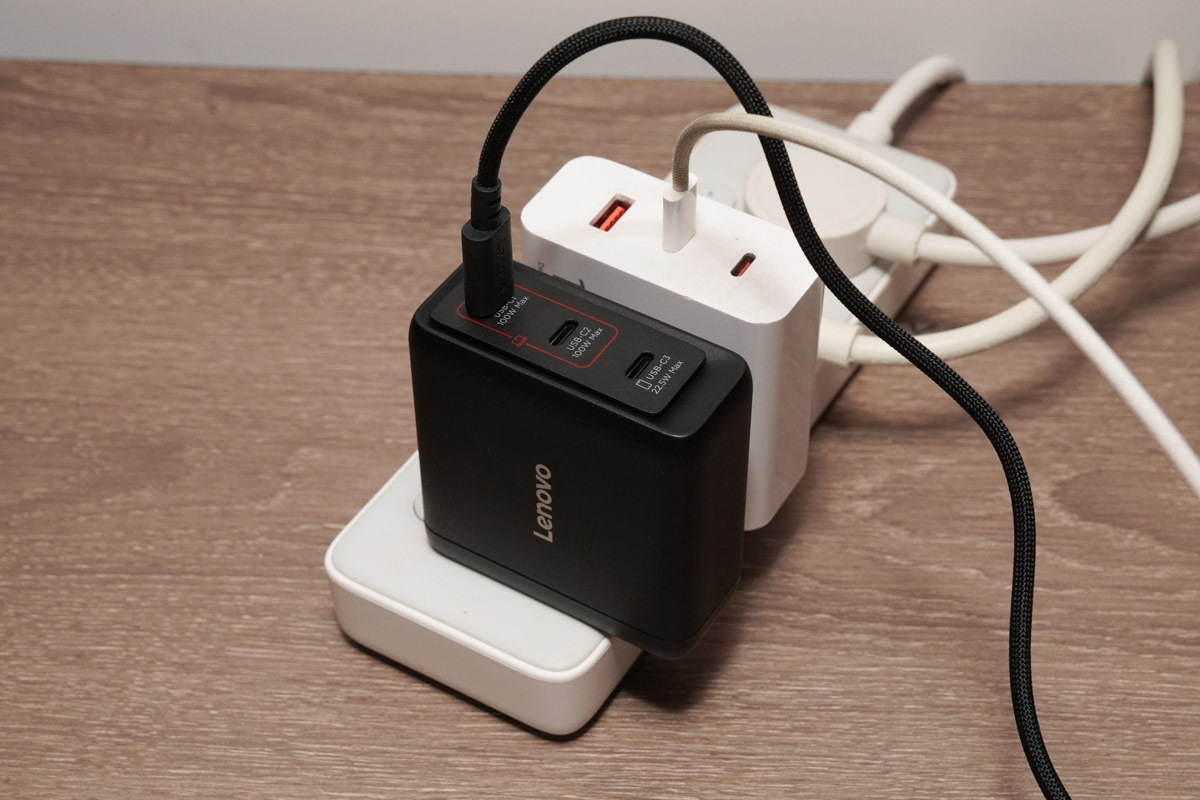
For commuters, business travelers, students, and desktop users with multiple electronic devices, this design that combines portability with multi-port output is very practical.
2050 Fast-Charge Benchmark: 50% in About 21 Minutes
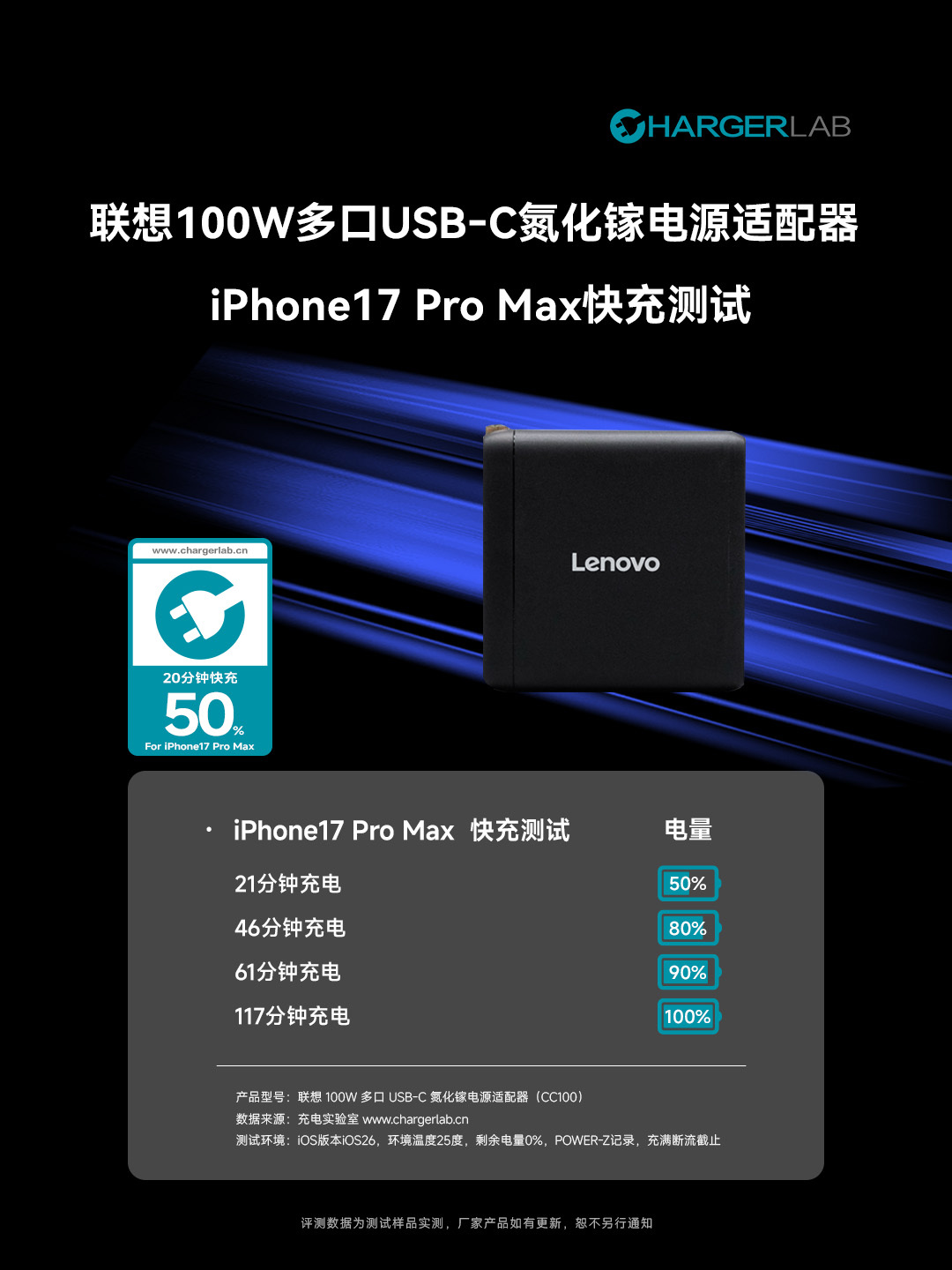
In testing, the Lenovo CC100 charged an iPhone 17 Pro Max to 50% in 21 minutes and passed the 2050 fast-charge benchmark. The 2050 standard uses “20 minutes to 50%” as a simple indicator, while related 1050 and 3050 tests use 10-minute and 30-minute thresholds. Such benchmarks help users compare real-world charging speed more intuitively instead of relying only on wattage labels.
Verdict: A Well-Rounded Original 100W GaN Charger
Overall, the Lenovo CC100 100W three-port GaN charger is a flagship-grade original accessory that balances performance, portability, safety, compatibility, and user experience. It combines small GaN size, high power, intelligent three-port power sharing, broad device compatibility, international certifications, and strict original-equipment quality control. It also targets common pain points with no high-temperature derating, no tingling on metal laptops, 1.5x peak power for gaming laptops and AI PCs, 5,000-meter altitude adaptability, and clean, interference-free output. Compared with traditional original adapters, it is more portable and versatile.
Compared with generic third-party fast chargers, it offers stronger stability, better detail-oriented experience, and higher safety, plus an included 100W braided cable for immediate use. It suits Lenovo laptop, gaming laptop, and AI PC users; frequent business travelers; high-altitude and outdoor users; dorm students; and desk users with multiple devices. For buyers who want one charger for many devices and demanding scenarios without obvious experience gaps, the Lenovo CC100 is a strong, low-risk choice.
 UGREEN FingerTip 45W Charger Review: Tiny Body, Full-Speed Output