



HarmonyOS 7 Beta Fast-Charging Test: UFCS and PPS Reach 100W, Third-Party Chargers Stabilize Above 90W
 22 Sep,2026
Introduction: A System Update That Reshapes Fast Charging
Huawei has begun pushing the HarmonyOS 7 Beta update to its devices. While the release brings broad improvements to system features and user interaction, one of the most important changes sits beneath the surface: an upgraded fast-charging protocol stack. This update specifically improves support for PPS and UFCS, two universal fast-charging protocols, across most Huawei phones released in 2025 and later.
The core change is straightforward but significant. After upgrading, the power supported by PPS and UFCS can align with the phone’s own maximum fast-charging specification. In other words, a phone that natively supports 100W fast charging can now support up to 100W through PPS and UFCS as well. This closes a long-standing gap between Huawei’s private fast-charging protocol and universal third-party standards. To verify the real-world impact, the Huawei Mate 80 Pro was selected for testing.
Why PPS and UFCS Support Matters
PPS, or Programmable Power Supply, is a widely used PD fast-charging extension that allows fine-grained voltage and current adjustment. UFCS, or Universal Fast Charging Specification, is a cross-brand fast-charging standard designed to improve compatibility among different devices and chargers. Both are important for users who want to charge a Huawei phone with third-party power adapters.
Previously, Huawei phones often delivered their highest charging speeds only with proprietary chargers and cables. Universal protocols such as PPS and UFCS were typically limited to much lower power. With HarmonyOS 7 Beta, Huawei is allowing these universal protocols to reach the same ceiling as the phone’s native fast-charging capability.
For a 100W-class device like the Mate 80 Pro, that means PPS and UFCS can now theoretically support up to 100W. The practical result is better compatibility, faster third-party charging, and less dependence on original accessories.
Test Setup: Mate 80 Pro, Six Third-Party Chargers, and a Critical Cable
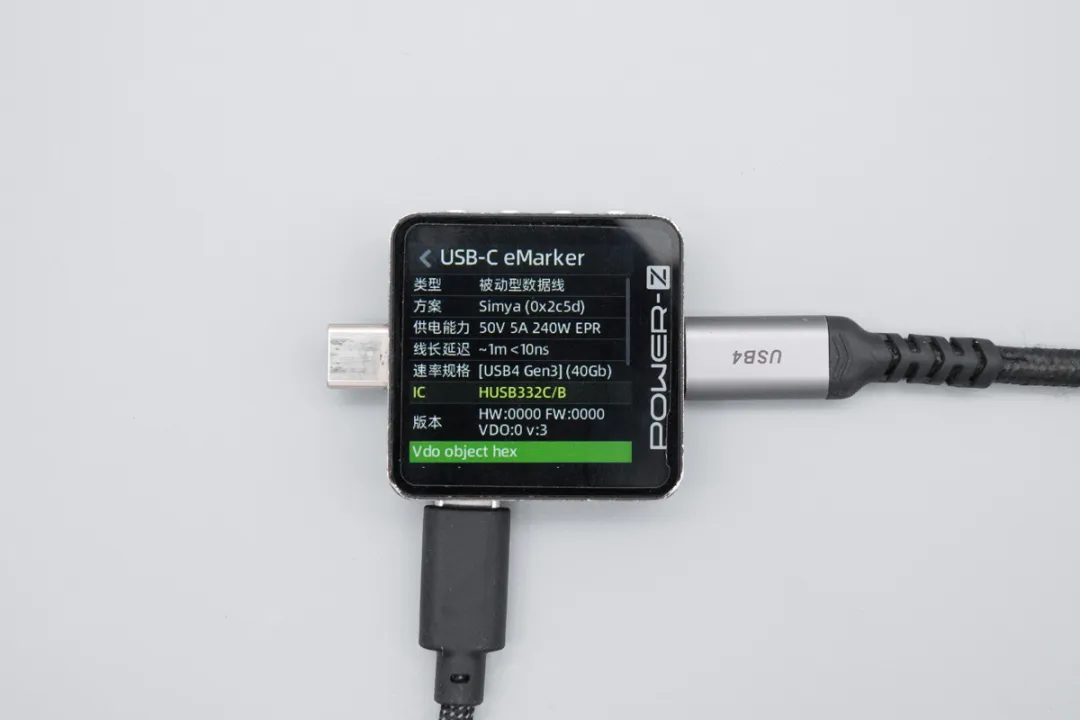
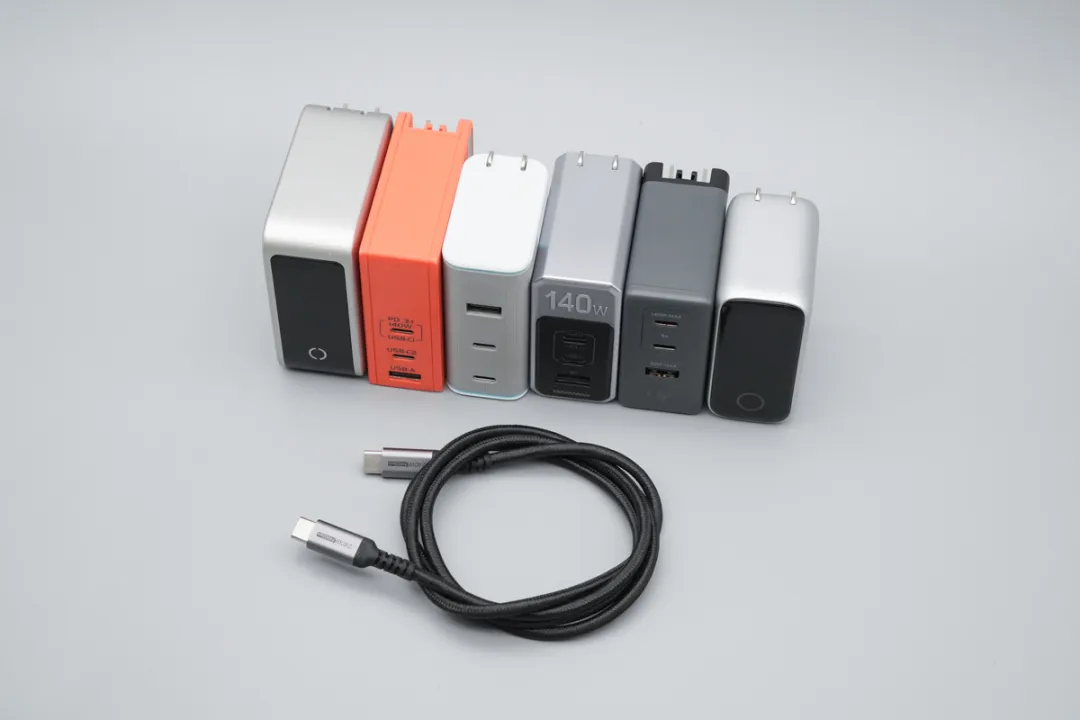
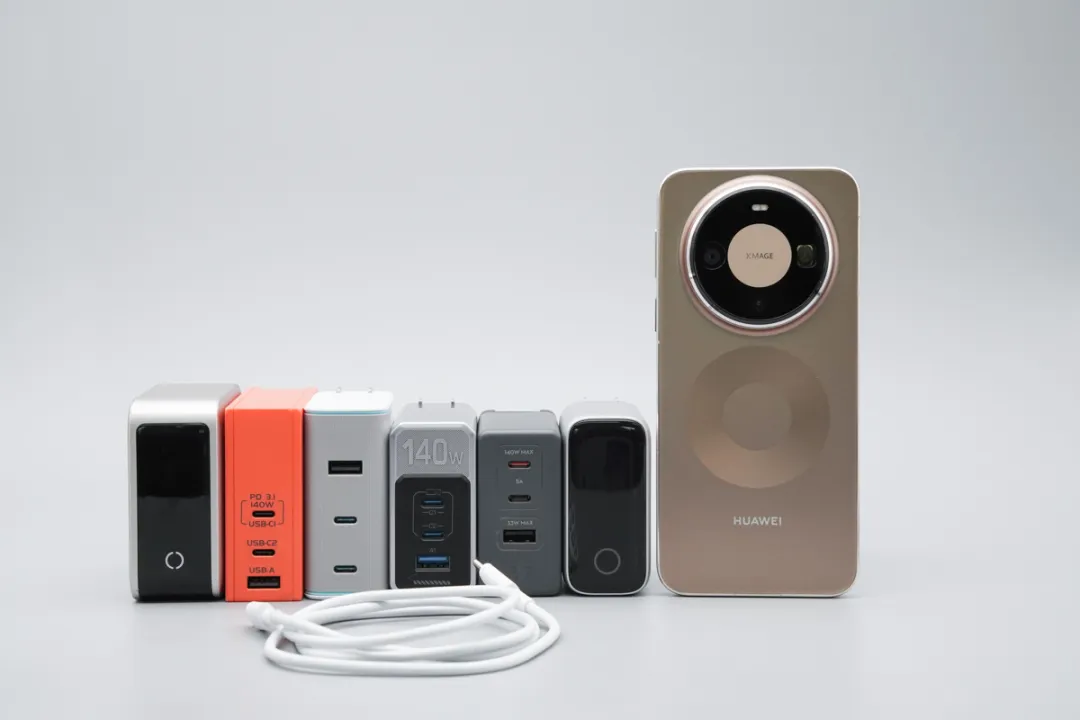
The test device was a Huawei Mate 80 Pro running HarmonyOS 7.0.0.105 SP6. The test matrix included six mainstream third-party fast chargers from different brands and power classes, plus Huawei’s original 6A USB-C to USB-C cable. All tests used the same cable to eliminate cable bottlenecks and ensure consistent results.
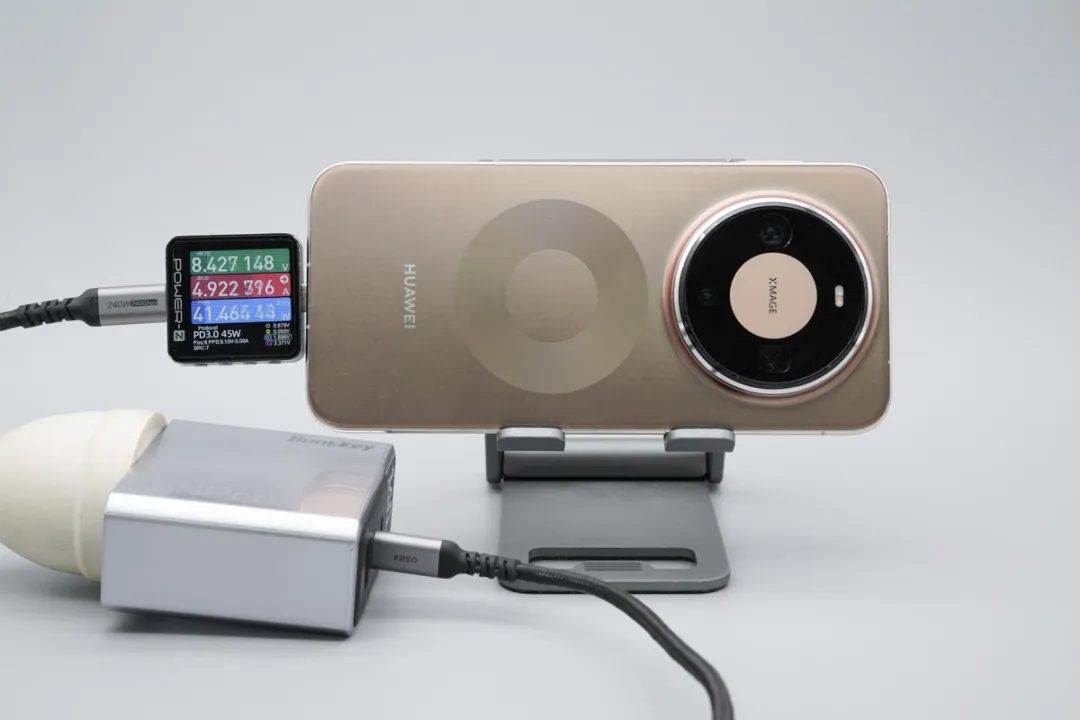
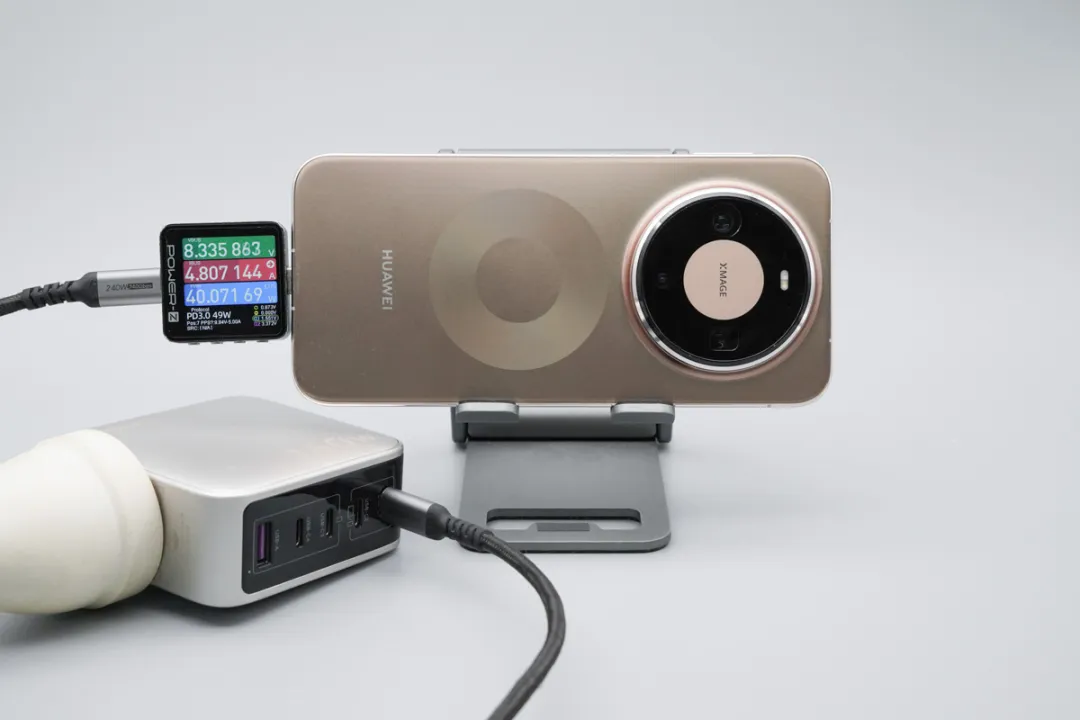
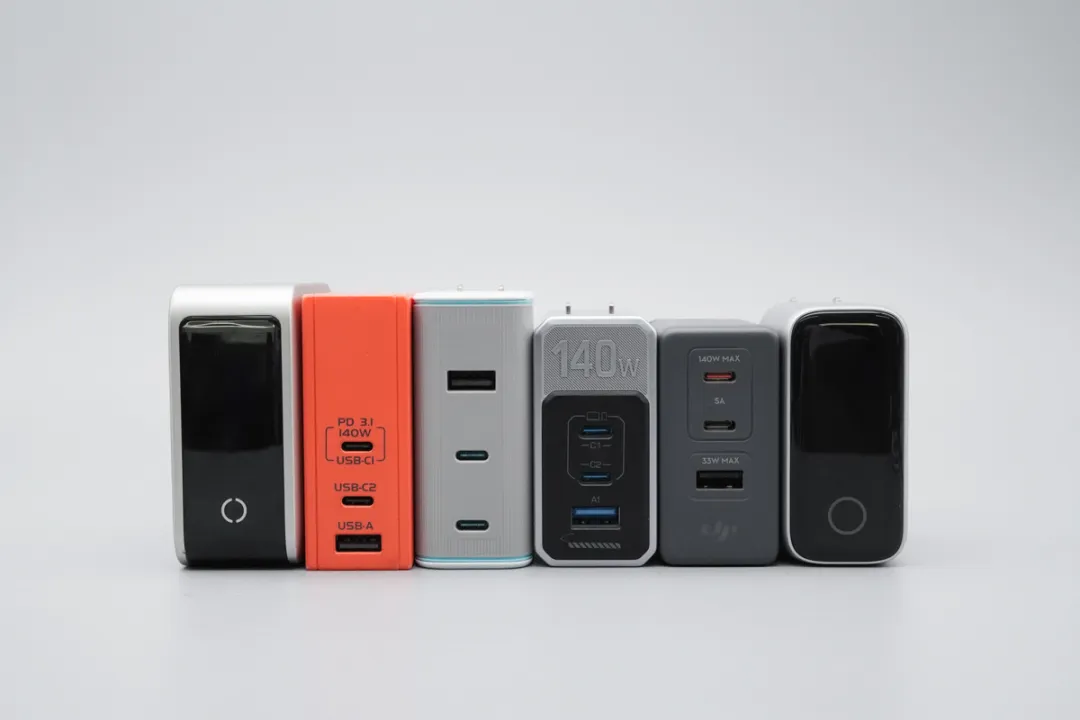
The chargers covered popular models such as Anker 100W, Huntkey 140W, UGREEN 160W, Sharge 140W, DJI 140W, and Cuktech 120W. One key requirement emerged during testing: activating high-power PPS or UFCS requires Huawei’s 6A C-to-C cable. Using ordinary 5A cables may not only limit power but also affect safety and stability during high-current charging.
Third-Party 5A Cables: Power Stuck Around 40W
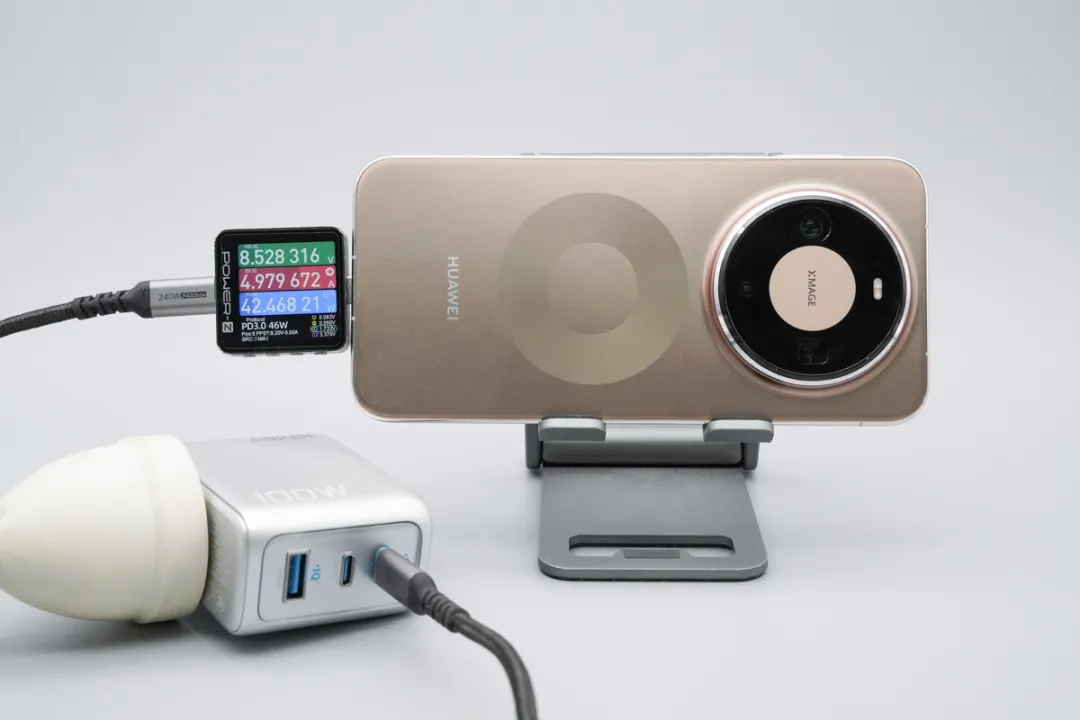
The first round of testing used regular third-party 5A C-to-C cables. With an Anker 100W charger, the Mate 80 Pro drew 8.53V at 4.98A, or 42.47W. With a Huntkey 140W charger, it reached 8.43V at 4.92A, or 41.46W. With a UGREEN 160W charger, it reached 8.34V at 4.81A, or 40.07W.
These results show that ordinary 5A cables keep power stable at around 40W+. Even when paired with 100W, 140W, or 160W chargers, the phone cannot trigger high-power PPS or UFCS. The charger may be powerful, but the cable becomes the limiting factor. For users who want the full benefit of the HarmonyOS 7 Beta upgrade, cable selection is therefore just as important as charger selection.
Original 6A C-to-C Cable: Third-Party Chargers Reach 82–89W
The second round used Huawei’s original 6A C-to-C cable.
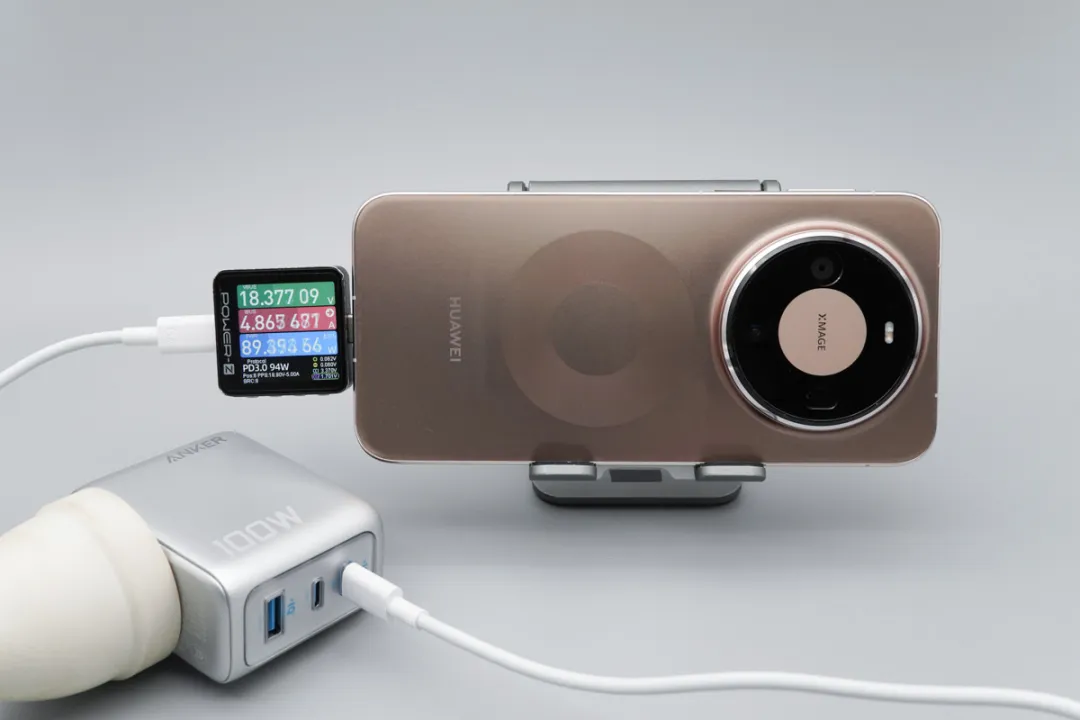
The difference was dramatic. With the Anker 100W charger, the Mate 80 Pro reached 18.38V at 4.86A, or 89.39W.
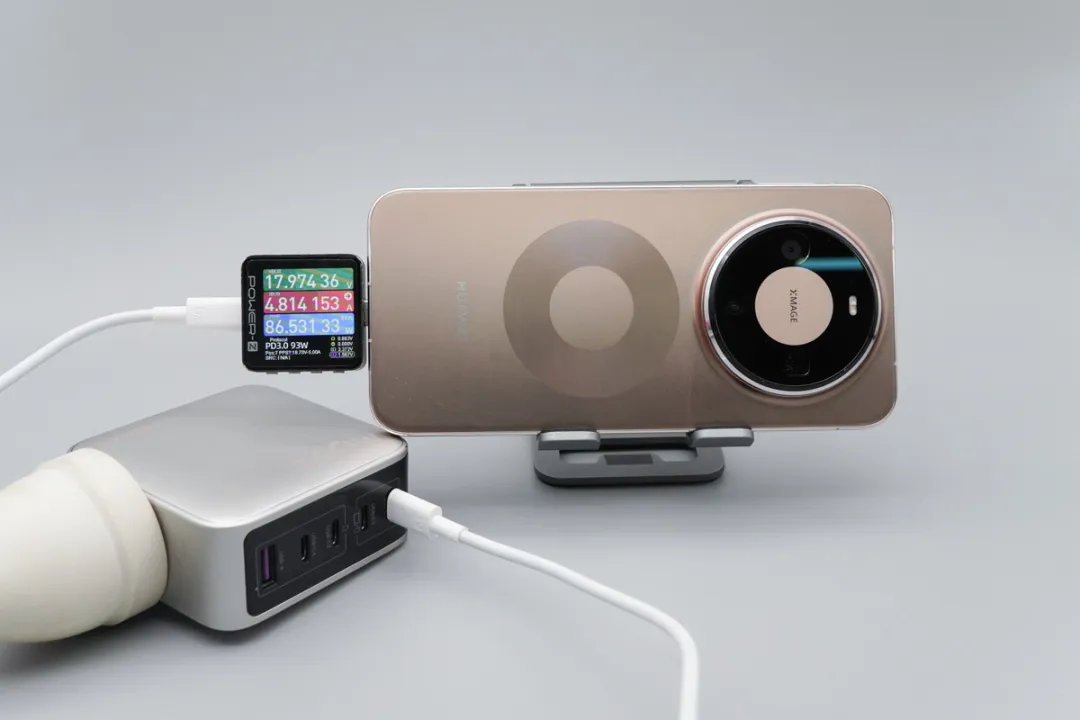
The UGREEN 160W charger delivered 17.97V at 4.81A, or 86.53W.
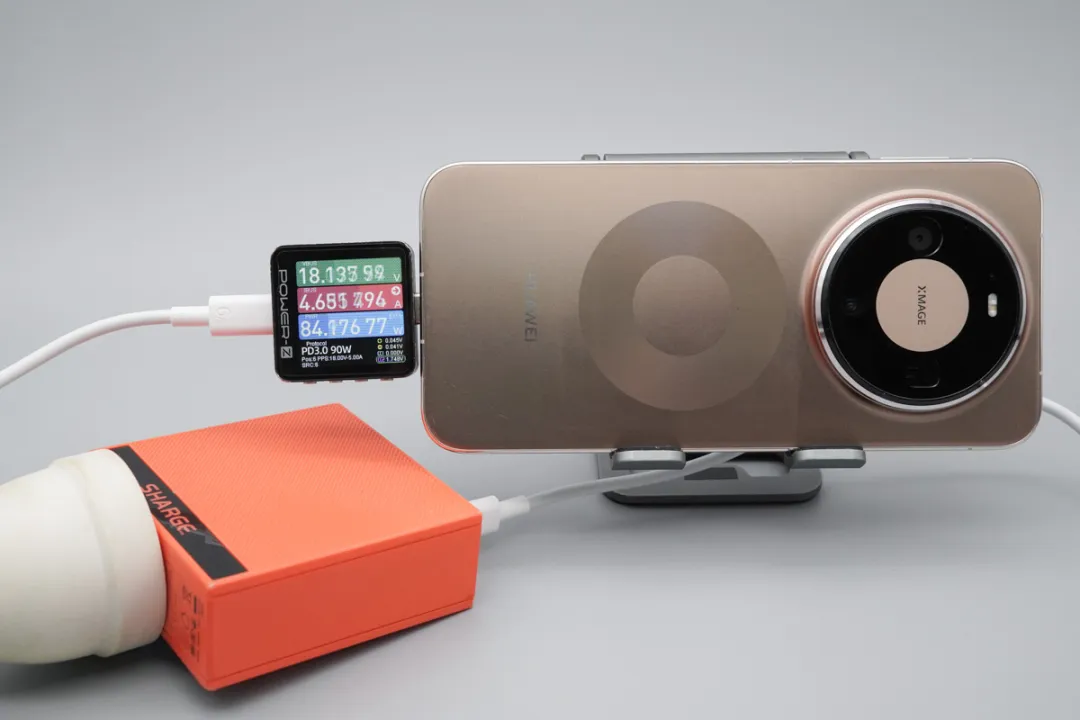
The Sharge 140W charger reached 18.13V at 4.65A, or 84.17W.
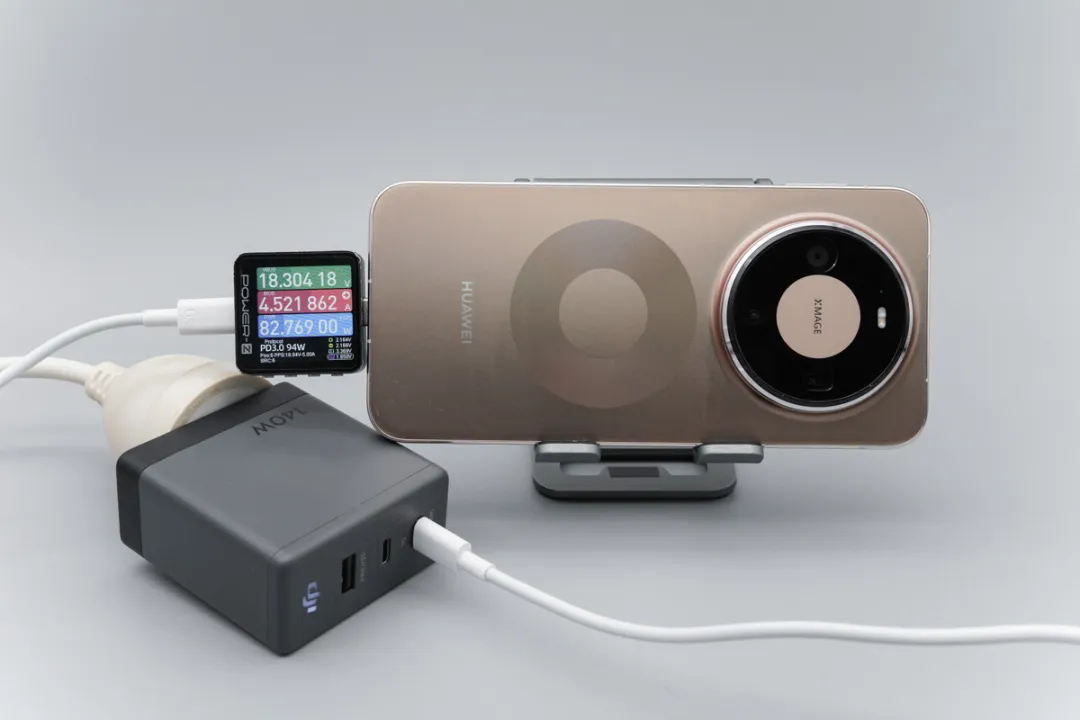
The DJI 140W charger reached 18.3V at 4.52A, or 82.77W.
The Huntkey 140W charger delivered 17.91V at 4.83A, or 86.36W.
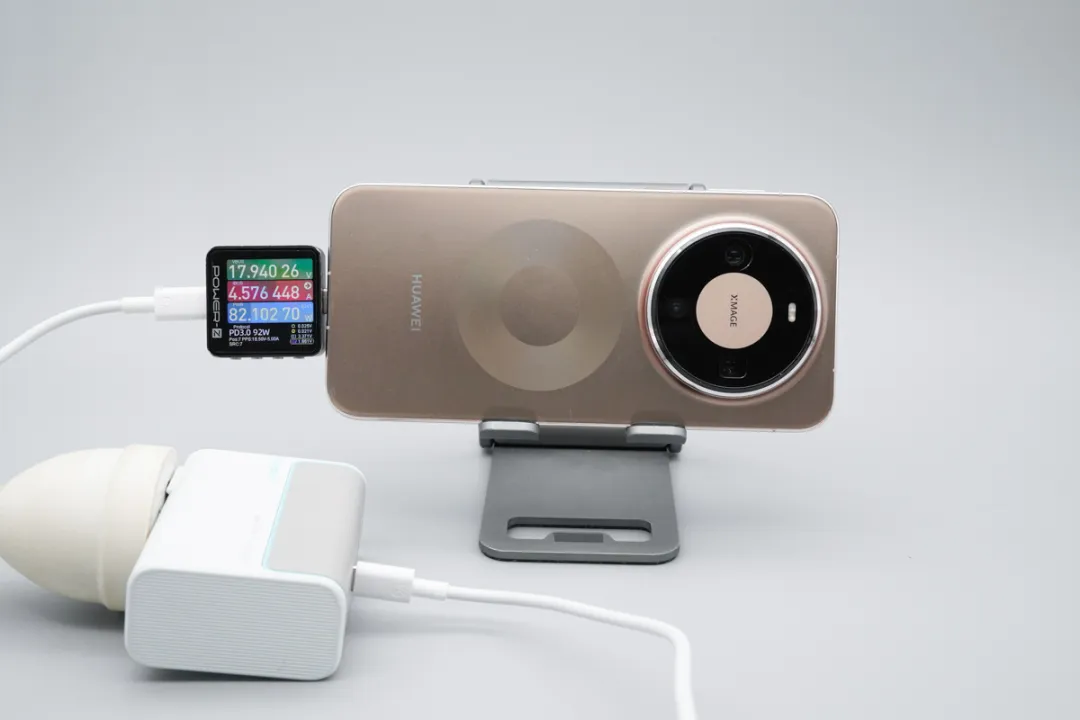
The Cuktech 120W charger reached 17.94V at 4.58A, or 82.1W.
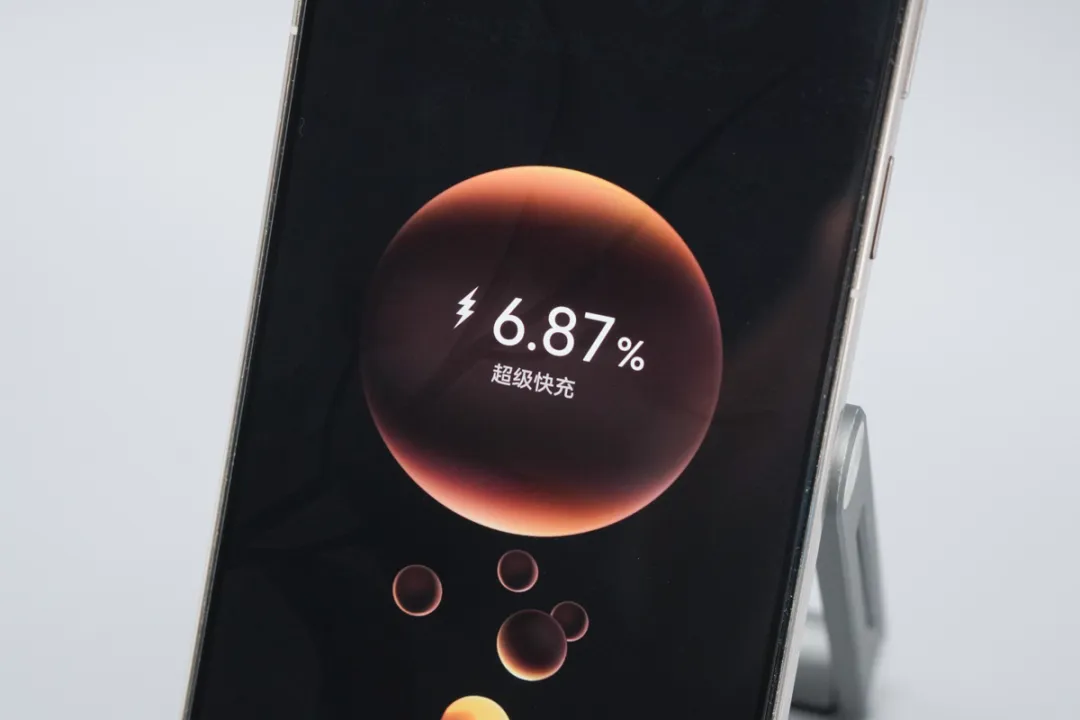
All six third-party chargers successfully triggered high-power charging. The phone displayed the Super Fast Charging UI animation, and battery percentage was shown to two decimal places. These results confirm that the update is not merely cosmetic. Third-party chargers that support the right protocols can now deliver more than 80W, with some approaching 90W. That is a major improvement over the roughly 40W ceiling seen with ordinary 5A cables.
Full Charging Test: Anker 100W from Empty to Full
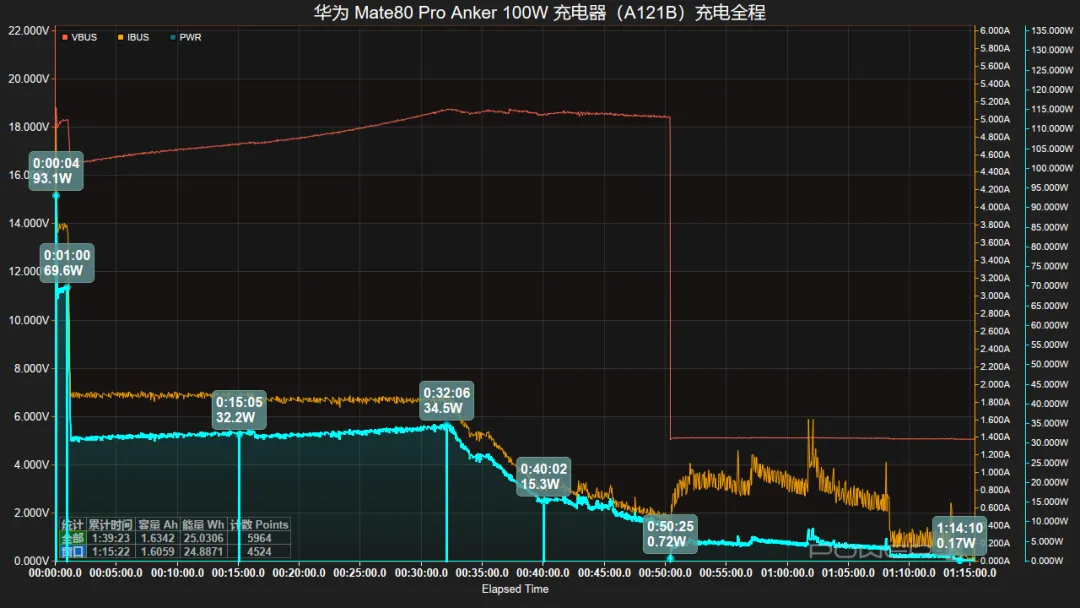
To measure end-to-end performance, the Mate 80 Pro was drained completely, then placed in a 25°C temperature chamber with an Anker 100W charger. Charging optimization was disabled, Super Fast Charging mode was enabled, and data was recorded throughout the session.
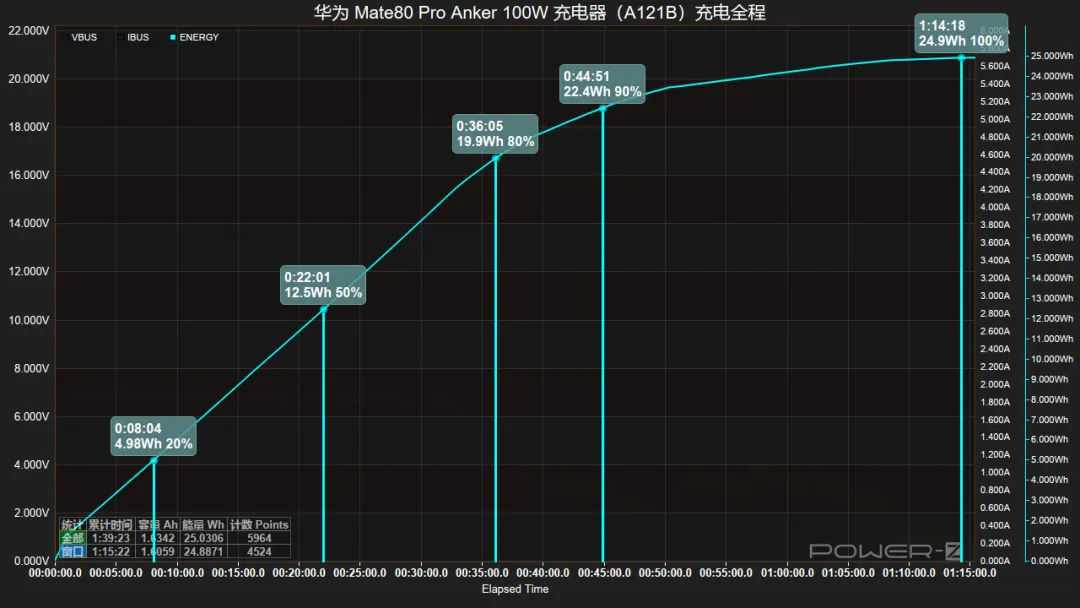
After connecting, the phone negotiated 17V. Peak power reached 93.1W, then dropped to 69.6W. It maintained that level for about one minute before falling to around 32.2W. For the next 31 minutes, power remained in the 32–34W range. At the 32-minute mark, power began a steady decline. At 50 minutes, voltage dropped to 5V and the phone entered trickle charging. The full charge took 1 hour and 14 minutes.
The battery curve was equally informative. The phone reached 20% in 8 minutes, 50% in 22 minutes, 80% in 36 minutes, and 100% in 74 minutes. These figures were recorded with the Huawei original 6A C-to-C cable and HarmonyOS 7.0.0.105 SP6. The curve was smooth and predictable, with fast early charging and a gradual slowdown as the battery filled.
2050 Fast-Charging Benchmark: Passed
The Huawei Mate 80 Pro passed the 2050 fast-charging benchmark, which uses a simple but practical standard: 20 minutes or 30 minutes to reach 50% battery. In this test, the Mate 80 Pro reached 50% in 22 minutes, satisfying the 2050 requirement. This kind of benchmark helps users quickly understand real charging speed instead of relying only on peak wattage claims.
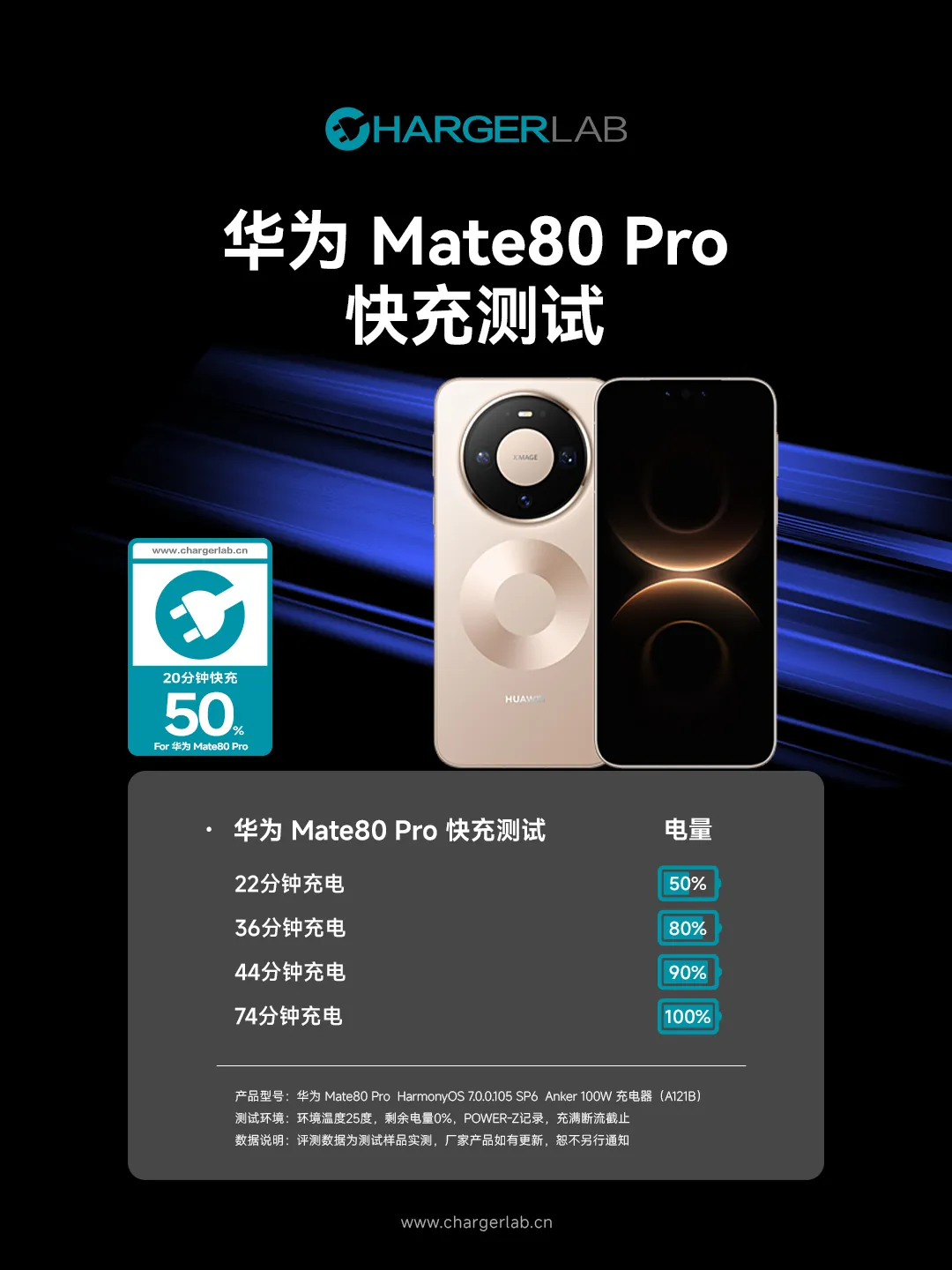
The result is especially meaningful because it was achieved with a third-party charger, not Huawei’s own first-party power adapter. It demonstrates that the HarmonyOS 7 Beta upgrade has made universal fast charging genuinely usable at high power.
Thermal Performance: Warm but Controlled
Thermal behavior was also tested during charging. After 10 minutes, the highest temperature on the back of the phone was 37.1°C, with charging power around 32W. After 20 minutes, the maximum temperature was 38.5°C, again at about 32W. After 30 minutes, the highest temperature reached 38.9°C, with power around 34W.
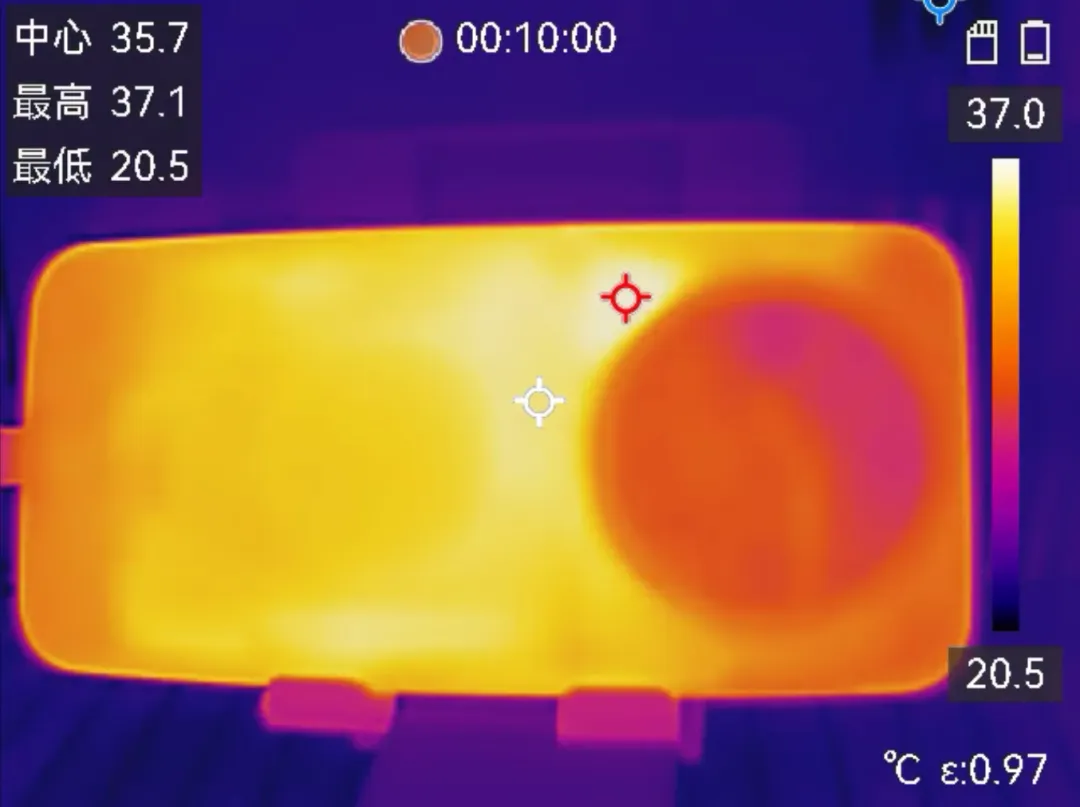
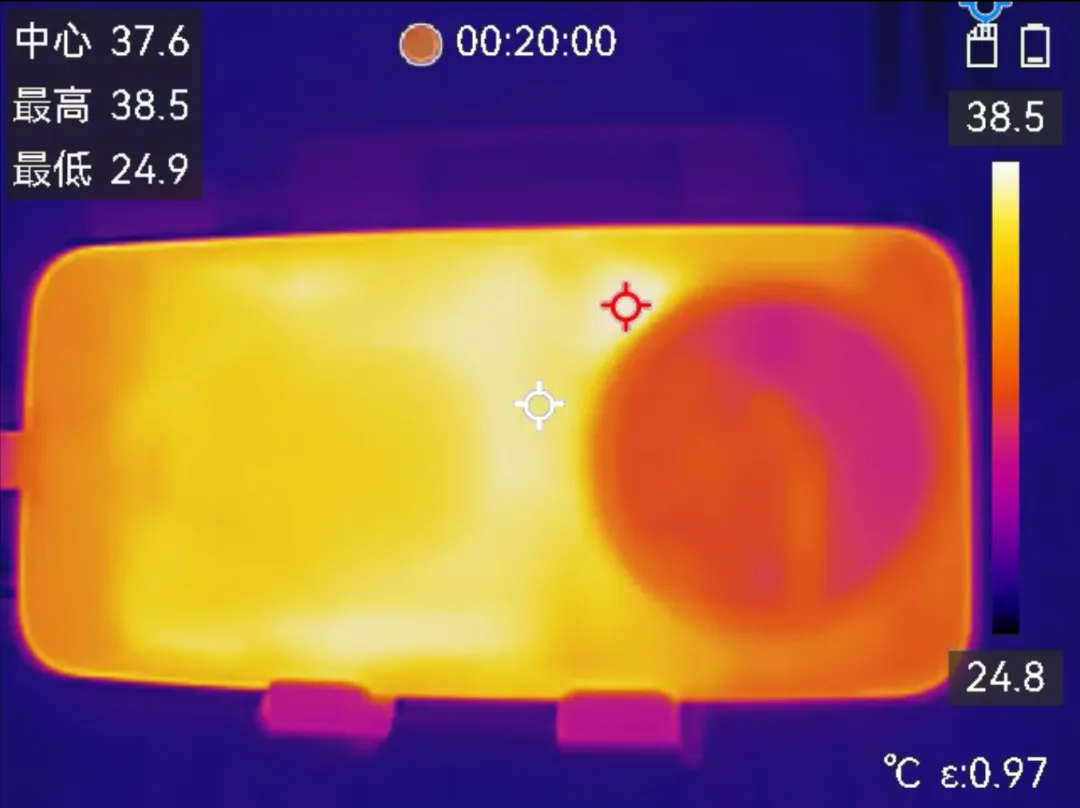
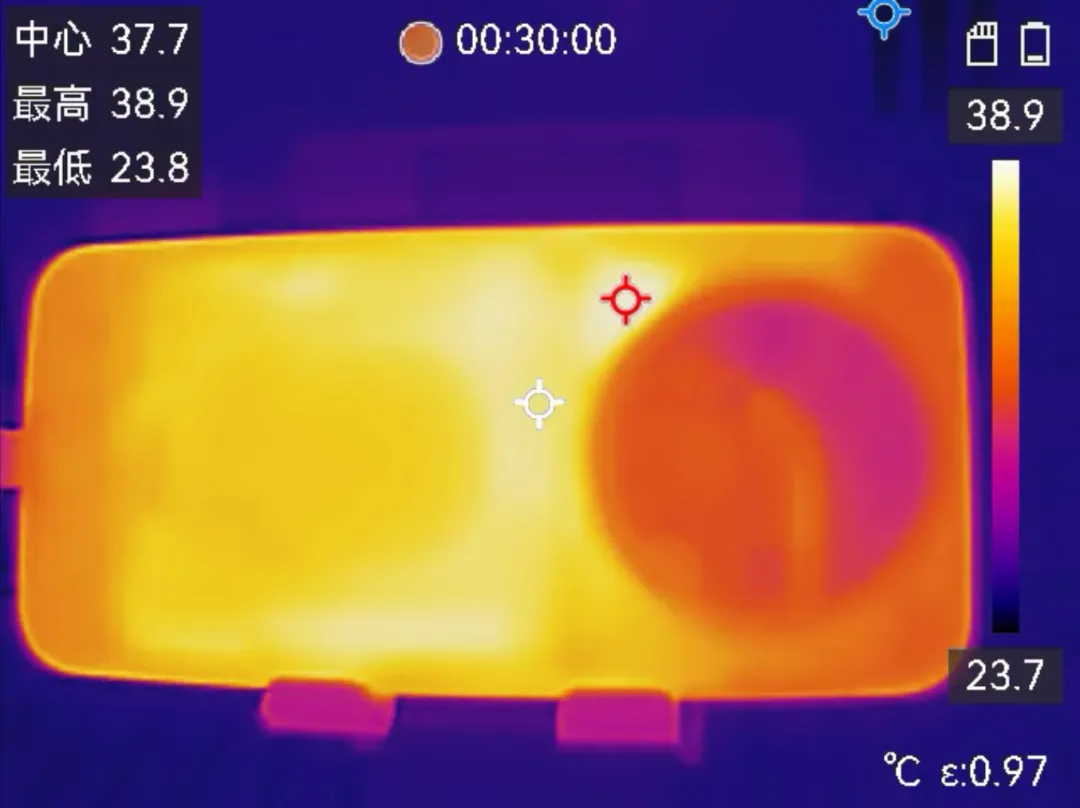
These temperatures are moderate for a flagship phone under fast charging. The phone remained warm but not excessively hot, and power delivery stayed stable. This suggests that the upgraded PPS and UFCS support is not pushing the device beyond safe thermal limits.
What This Means for Huawei Users and the UFCS Ecosystem
The HarmonyOS 7 Beta fast-charging upgrade is an important step for Huawei’s universal fast-charging strategy. By allowing PPS and UFCS power to align with the phone’s native maximum, Huawei is making third-party chargers far more useful. Mate 80 Pro users can now achieve 90W+ charging with compatible third-party adapters and the correct 6A cable. This reduces the need to carry an original charger and improves the everyday charging experience.
The update applies to Huawei phones released in 2025 and later. As HarmonyOS 7 moves from Beta to a full public rollout, more devices are expected to receive the same protocol improvements. That should lead to better compatibility with universal fast-charging accessories and stronger momentum for the UFCS ecosystem. It also supports the broader industry goal of standardized, cross-brand fast charging.
Final Thoughts
The HarmonyOS 7 Beta update turns PPS and UFCS from limited fallback protocols into high-power charging options. On the Huawei Mate 80 Pro, PPS and UFCS support now reaches 100W, and real-world tests with third-party chargers delivered 82–89W when using the original 6A C-to-C cable. Ordinary 5A cables remain capped around 40W, so cable choice is critical.
The Mate 80 Pro passed the 2050 benchmark by reaching 50% in 22 minutes, and full charging took 74 minutes with stable thermal performance. For Huawei users, this update makes third-party fast charging more practical, more transparent, and much closer to original-charger performance. It is a meaningful improvement for both daily convenience and the wider universal fast-charging ecosystem.
 Lenovo 100W USB-C Standard Power Adapter Review: Genuine PD Fast Charging for Lenovo Laptops