



Lenovo 100W USB-C Standard Power Adapter Review: Genuine PD Fast Charging for Lenovo Laptops
 15 Sep,2026
Introduction: A Genuine 100W USB-C Power Solution
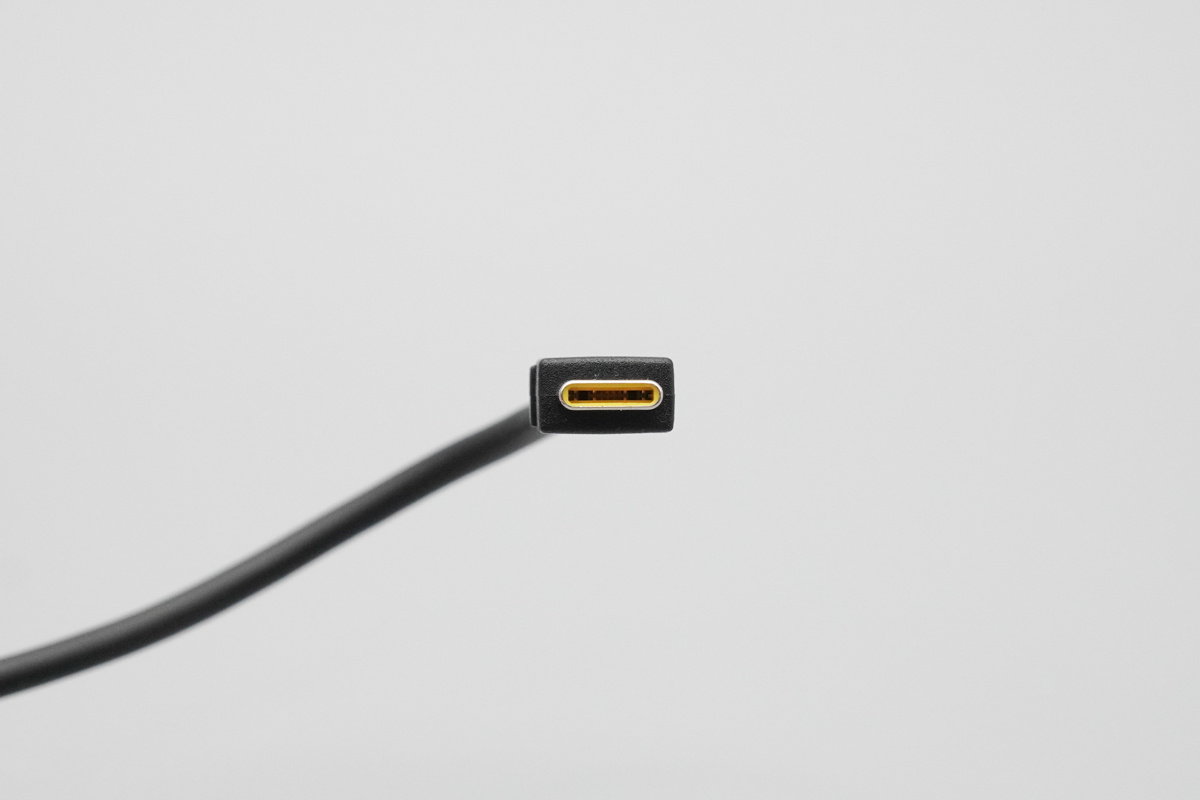
For Lenovo laptop users who rely on USB-C charging, an original, dependable fast charger is more than an accessory—it is part of the daily workflow. This review focuses on the Lenovo 100W USB-C Standard Power Adapter, model ADL100UDGC3A. As an official first-party accessory, it is designed to deliver stable power, convenient portability, and broad compatibility. Its integrated cable design means users do not need to pack a separate USB-C cable, reducing clutter in a bag or on a desk.
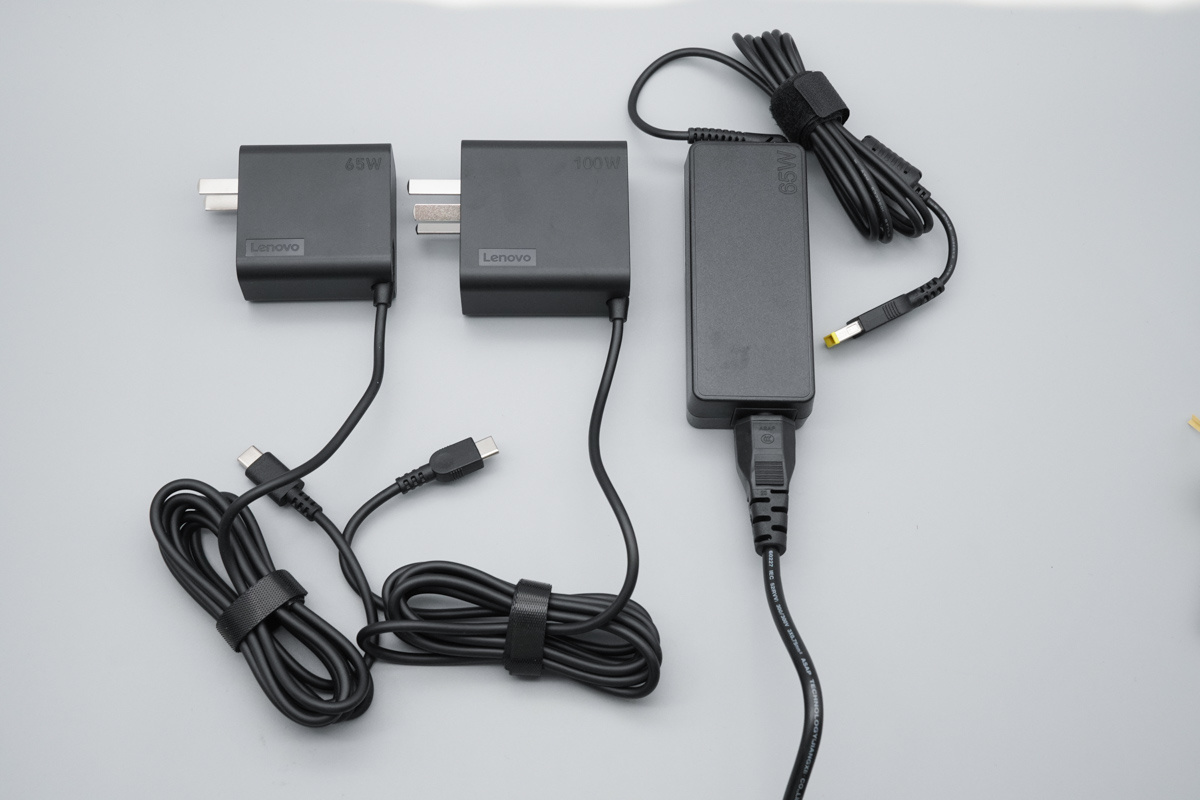
The adapter supports wide-voltage input and a full set of PD fast-charging profiles, with a maximum output of 100W. It can power Lenovo notebooks while also charging smartphones, tablets, and other USB-C devices. The following sections examine its design, protocols, efficiency, ripple, thermals, and real-world charging performance.
What’s in the Box: Simple, Official, and Complete
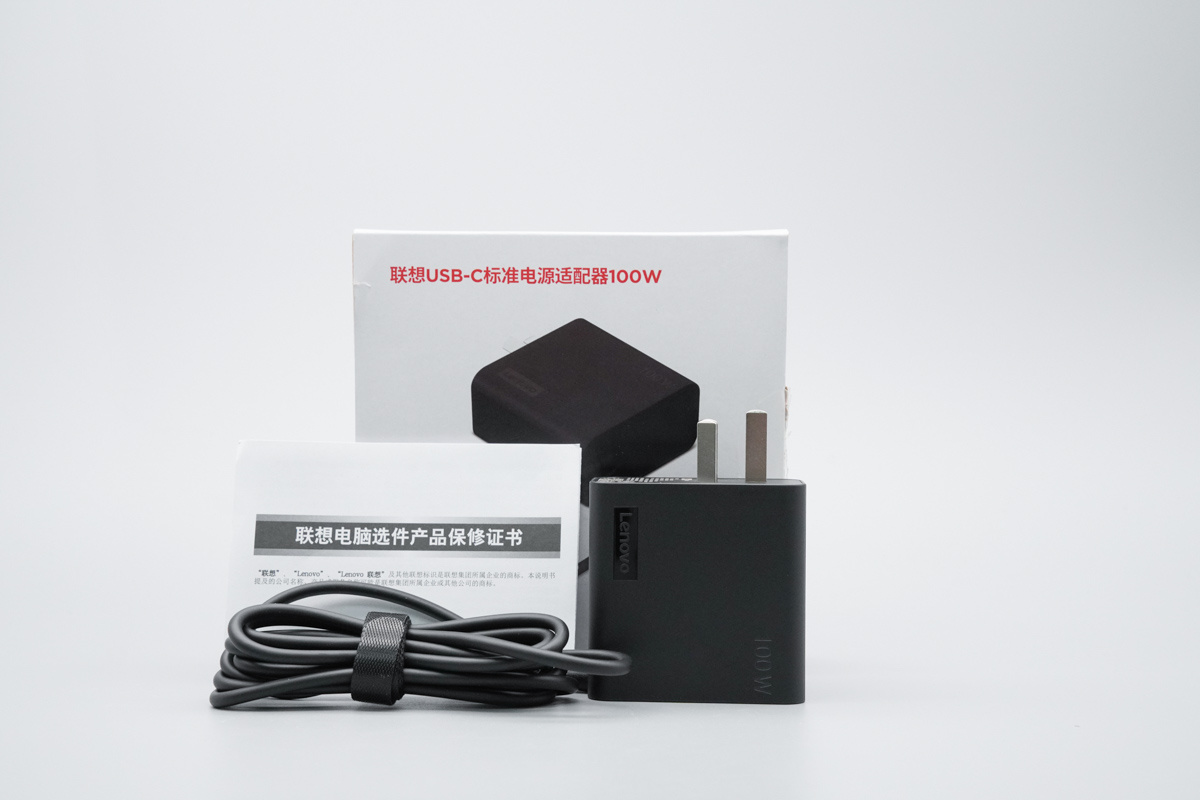
The Lenovo 100W USB-C Standard Power Adapter arrives in a clean white retail box. The front displays a product render, the product name, an official orientation mark, and the classic red-and-white Lenovo logo.
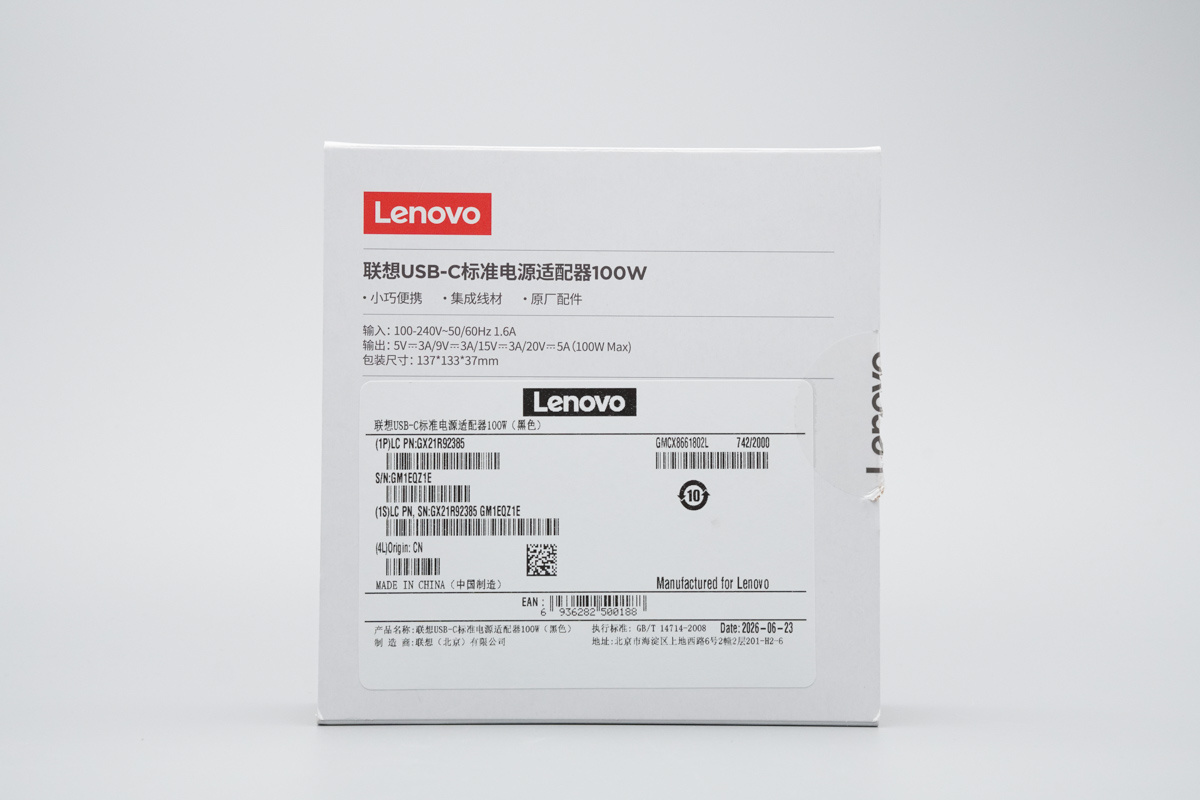
The back lists detailed specifications. Inside, buyers receive the adapter with its built-in Type-C cable and a warranty certificate. The package is simple but appropriate for an official option, and the included warranty documentation adds peace of mind.
Design and Build: Matte, Integrated, and Durable
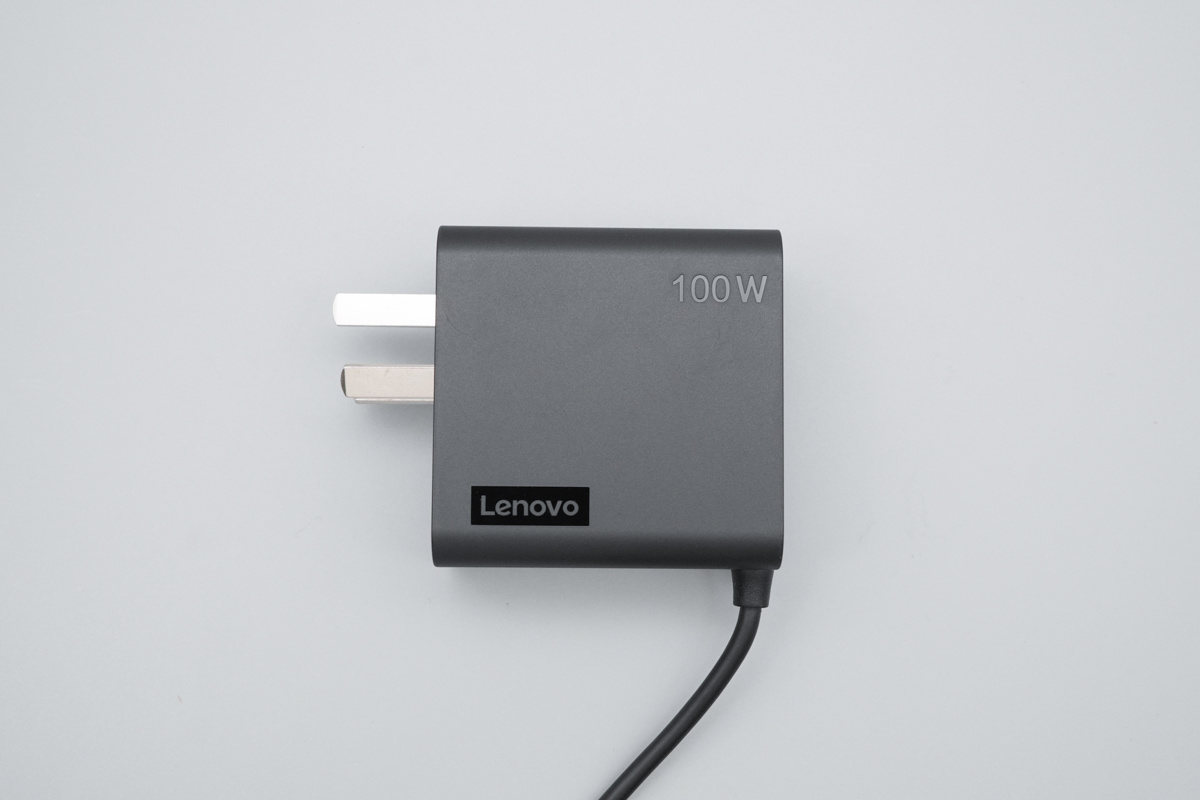
The adapter uses a black matte PC housing with a refined, understated look. The material incorporates 90% recycled content while maintaining flame resistance and a smooth, fingerprint-resistant finish. A glossy “100W” mark sits on one corner, clearly indicating the rated output. The cable is permanently attached, and the exit point features a molded channel that keeps the cable aligned with the body.
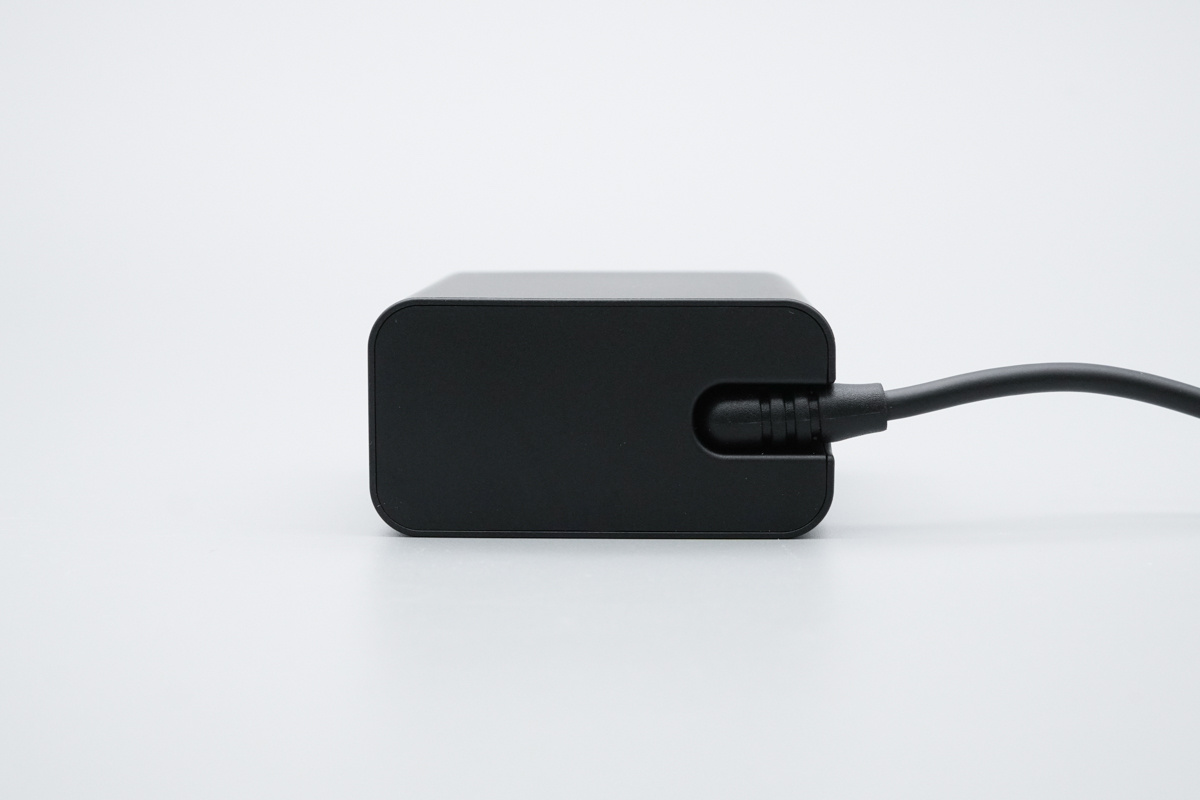
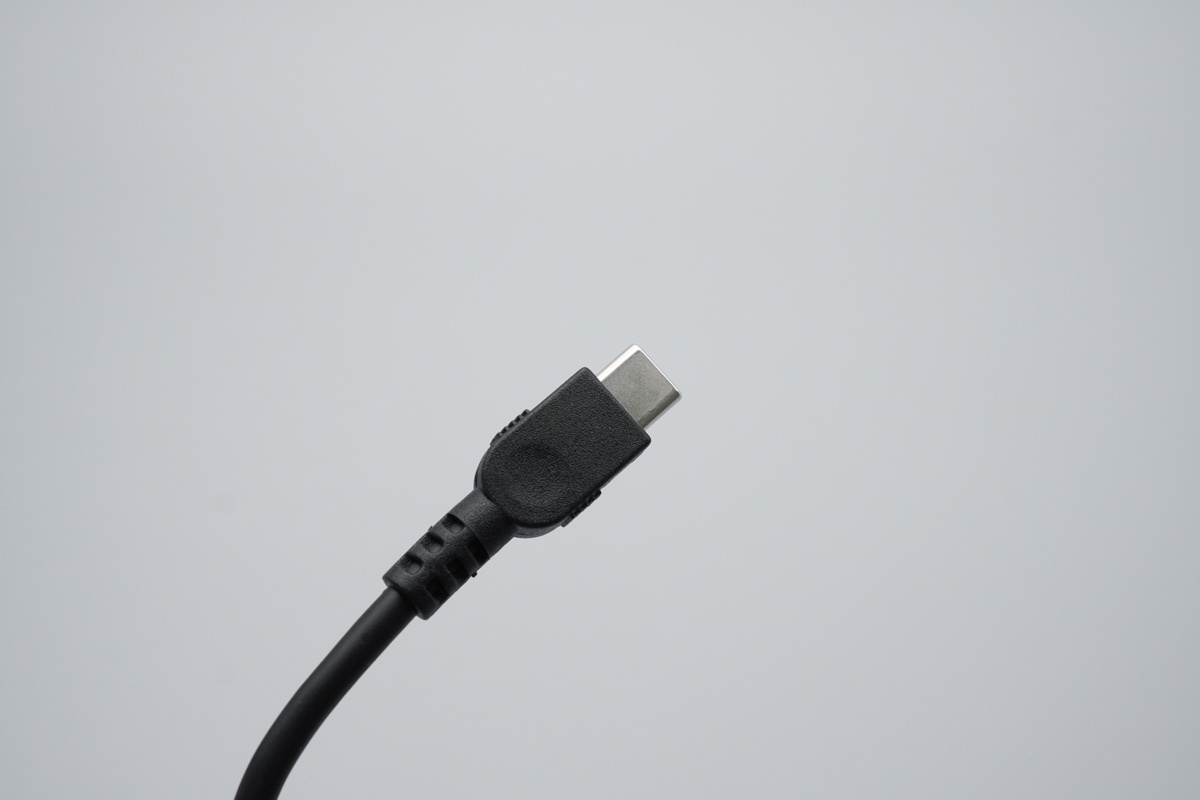
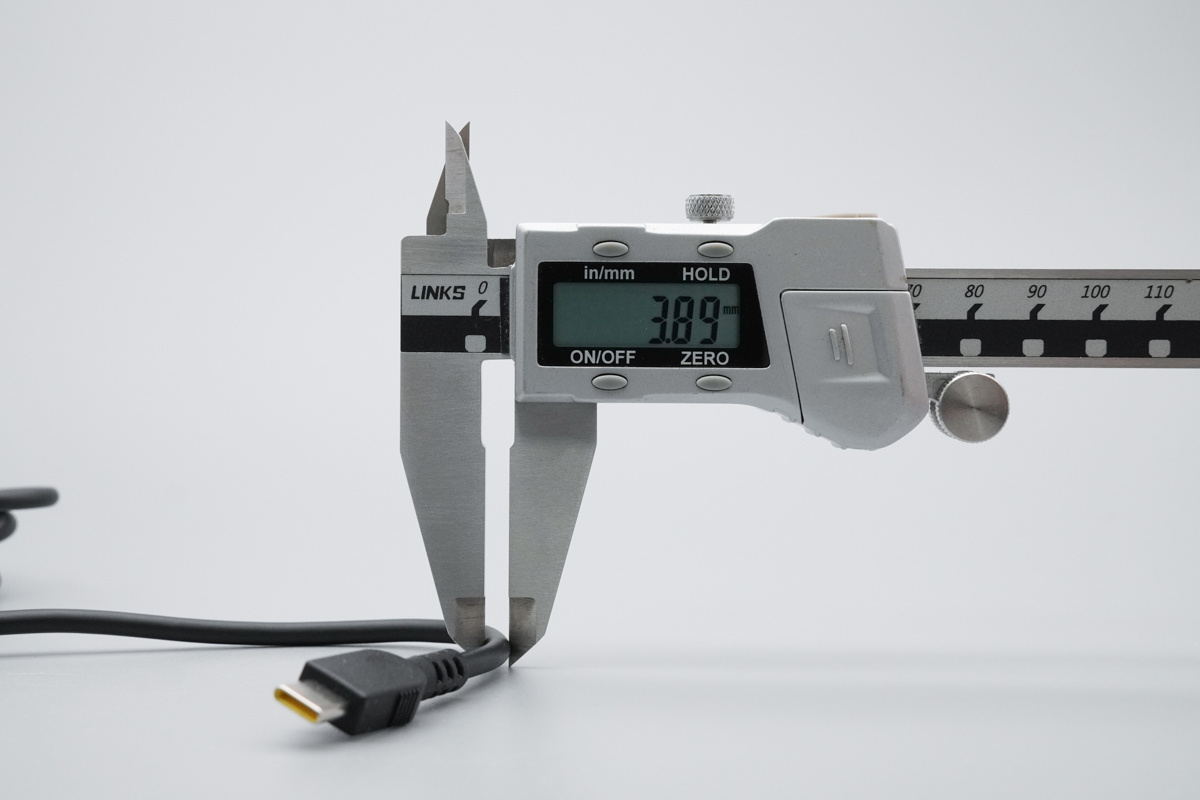
At both the housing exit and the USB-C connector, the cable includes multiple ring-shaped strain reliefs. These are designed to spread bending stress and reduce the risk of cracking or broken conductors over time. The connector itself has a thickened, corrugated relief sleeve. The cable is PVC-jacketed, flexible, and durable, with gold-plated contacts inside the USB-C plug. Measured cable outer diameter is 3.89mm, which is substantial enough for 100W current delivery while remaining easy to manage.
Cable Length and Everyday Convenience
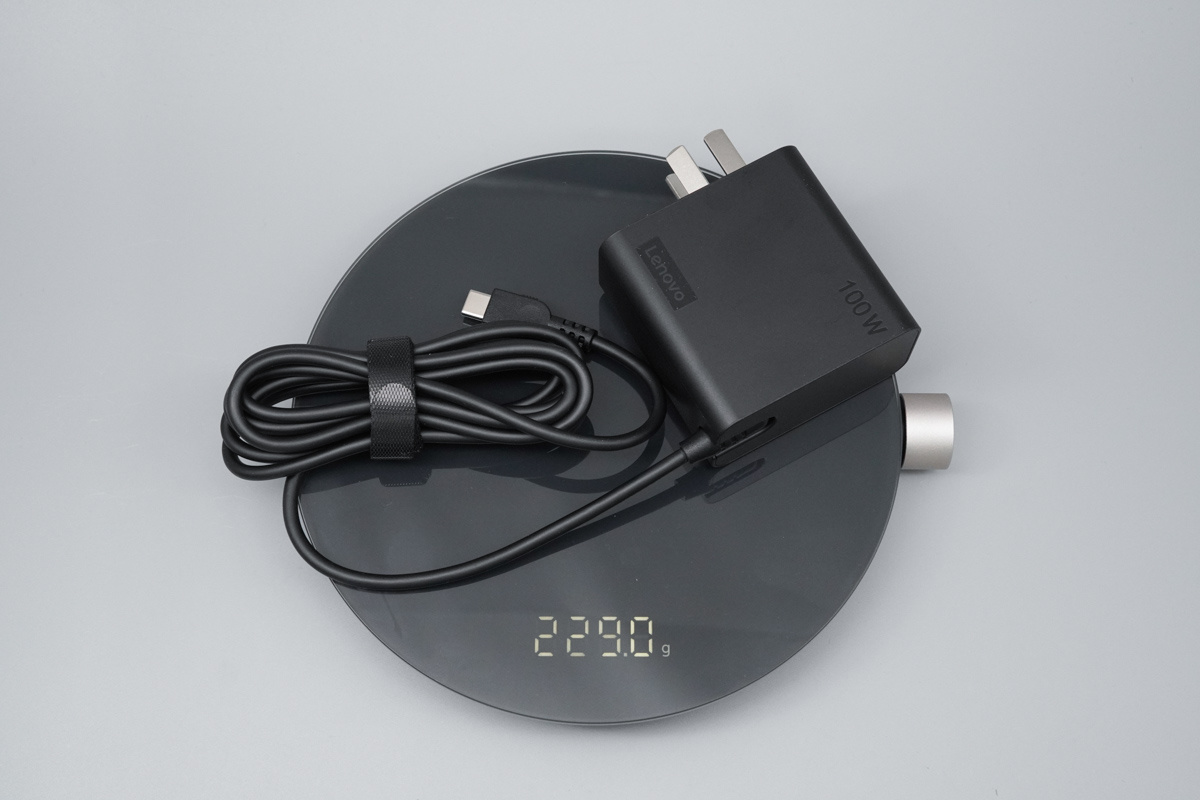
The integrated cable measures approximately 175cm in actual testing, although it is specified as a 1.8-meter cable. That length is generous for desk work, home use, and hotel rooms where the wall outlet may be far from the laptop. A built-in magic tie keeps the cable neatly wrapped during transport. Because the cable cannot be detached, users never have to search for a separate high-power USB-C cable. The trade-off is that replacing a damaged cable is not possible without replacing the whole adapter.
Size, Weight, and Portability
The adapter body measures about 62.59mm long, 62.48mm wide, and 32.27mm thick. Its volume is roughly 126.21cm³, giving a power density of about 0.79W/cm³. The square shape sits steadily in a wall outlet and resists wobbling. Including the integrated cable, the total weight is 229.0g.
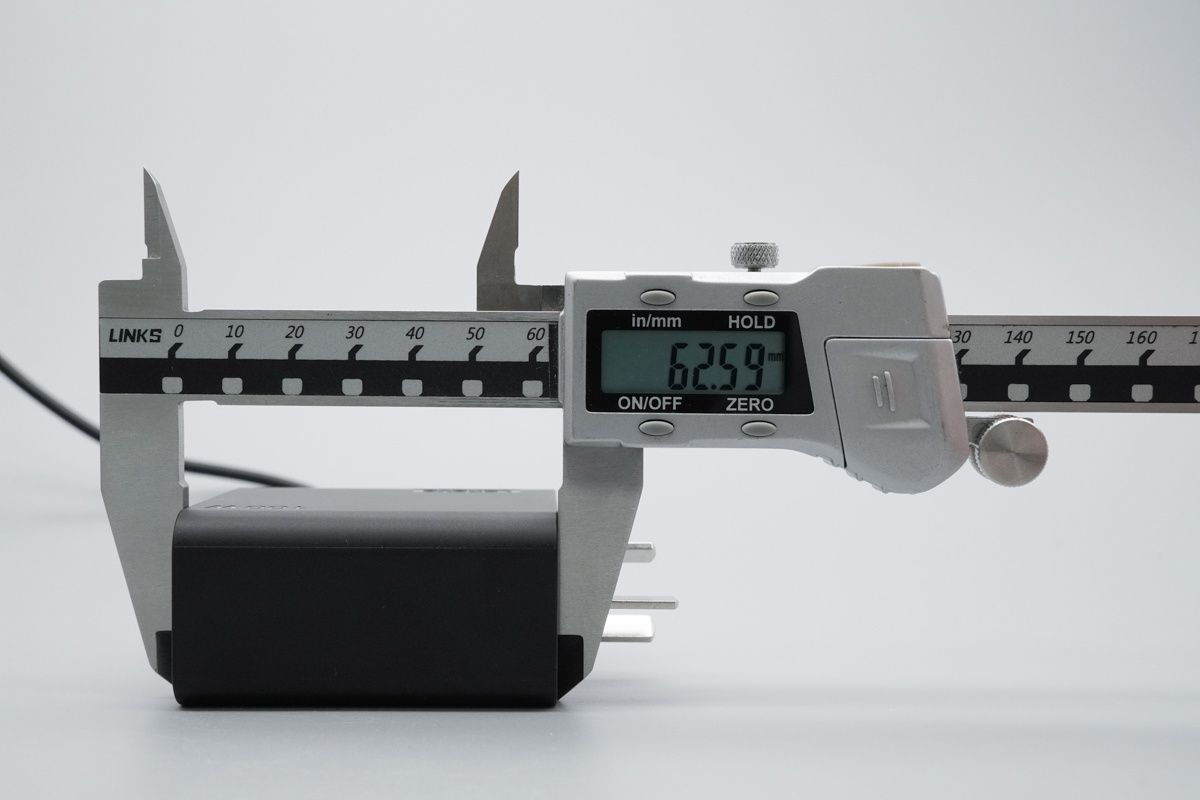
This makes it compact for a 100W laptop adapter, but heavier than many detachable GaN chargers when traveling. The three-prong plug adds grounding protection, which is especially useful for metal-bodied laptops and phones because it helps prevent leakage current and the tingling sensation some users notice with ungrounded chargers. The narrow body also avoids blocking adjacent outlets on a power strip, and the downward cable exit promotes natural cable routing.
Protocols and Output Specifications
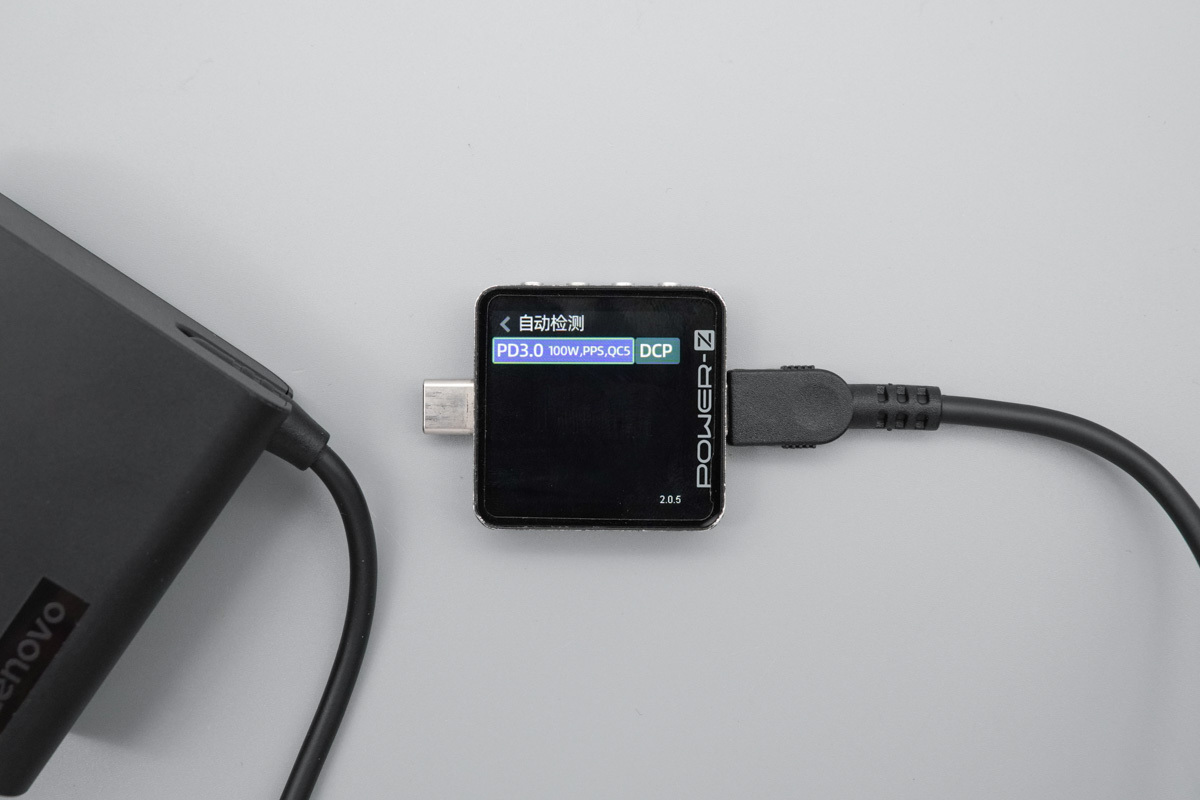
Using a POWER-Z tester, the adapter supports PD3.0 at 100W, PPS, QC5, and DCP. Its fixed PD voltage profiles include 5V/3A, 9V/3A, 15V/3A, and 20V/5A. It also offers two PPS ranges: 5.00–11.00V at 3.00A and 5.00–21.00V at 3.00A. This combination allows full-speed laptop charging and efficient PPS charging for compatible smartphones.
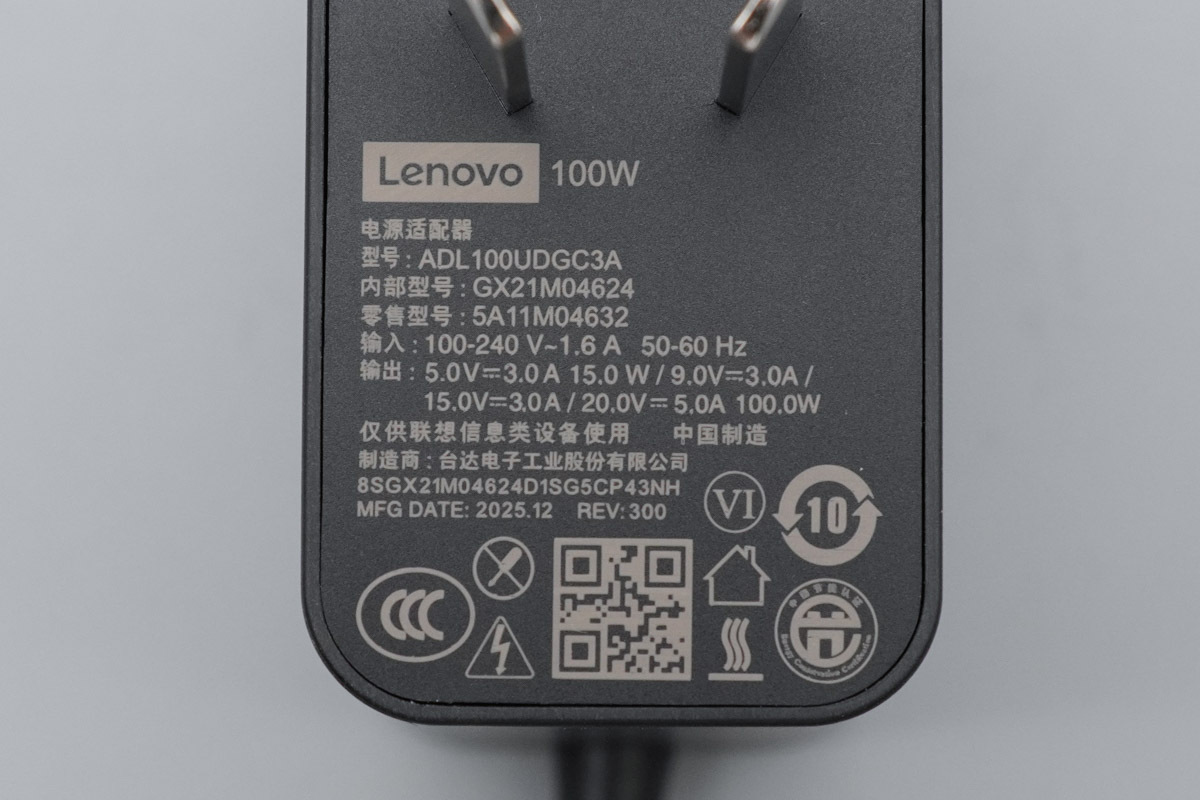
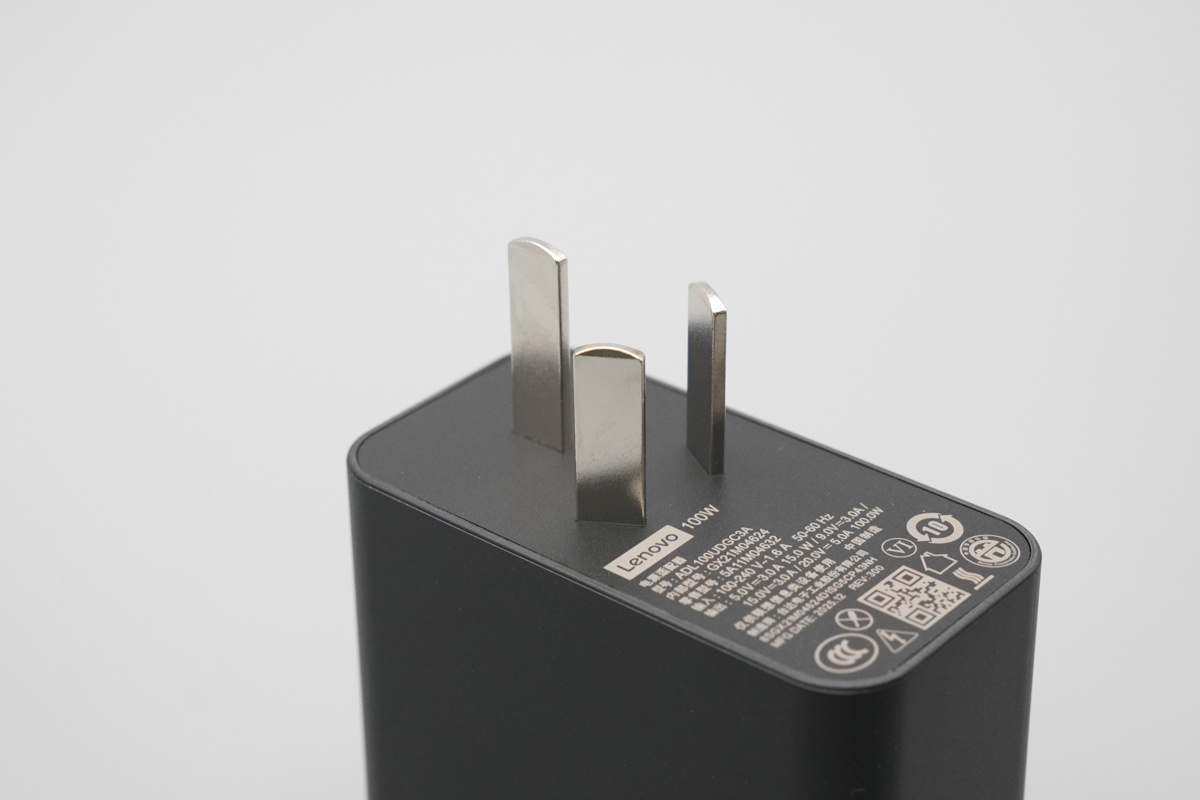
The printed specifications on the adapter are:
Model: ADL100UDGC3A
Internal model: GX21M04624
Retail model: 5A11M04632
Input: 100–240V~1.6A, 50–60Hz
Output: 5.0V⎓3.0A 15.0W / 9.0V⎓3.0A / 15.0V⎓3.0A / 20.0V⎓5.0A 100.0W
Manufacturer: Delta Electronics
Certifications: 3C and VI energy-efficiency marking
HFB Topology and Safety Engineering
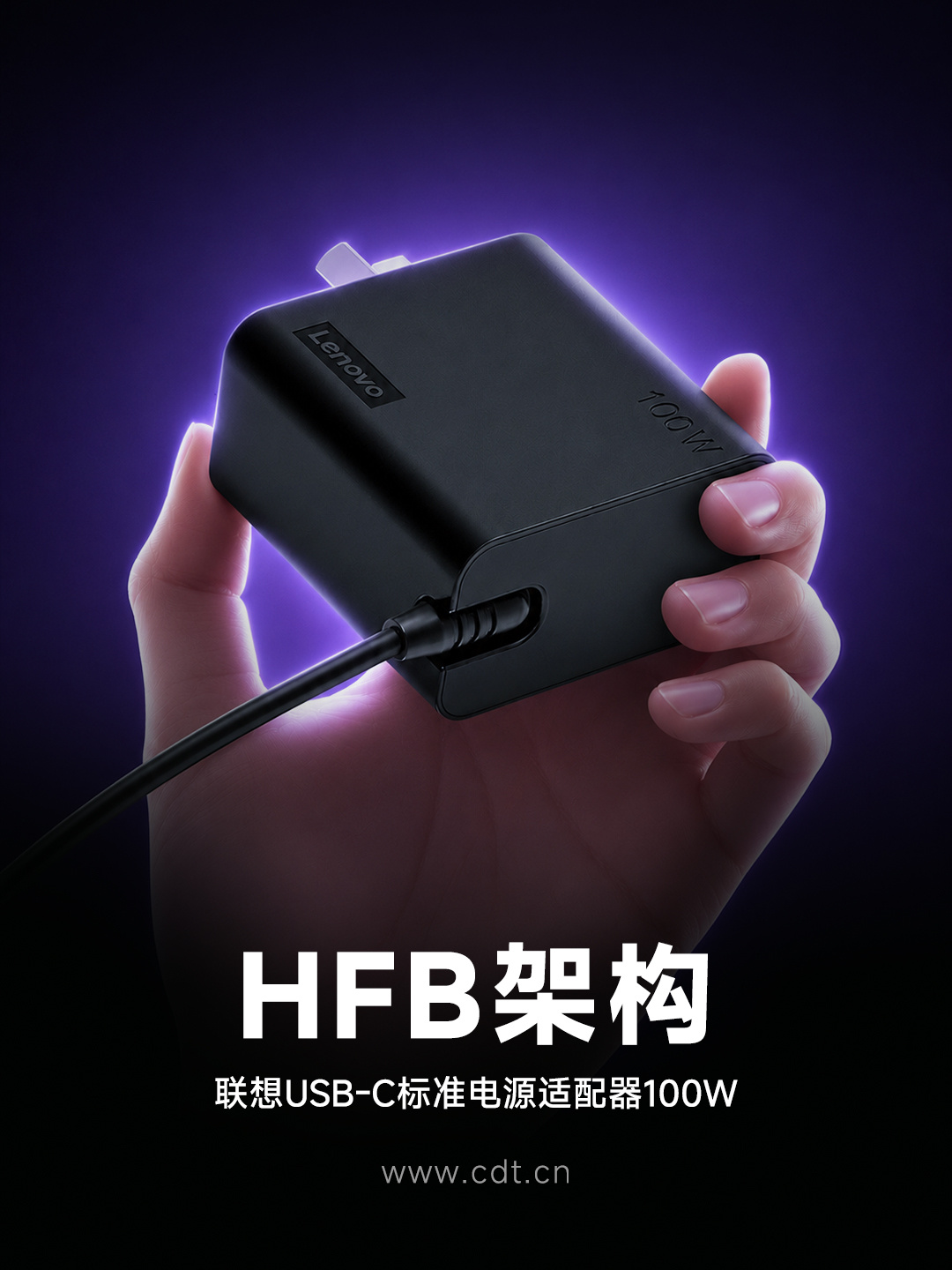
Inside, the adapter uses an HFB half-bridge flyback topology. Compared with a traditional QR flyback design, this architecture offers higher efficiency in the medium-to-high load range, lower full-load temperature rise, reduced voltage stress on switching devices, and easier electromagnetic interference suppression. It is well suited to the 65–140W range, helping combine stable power delivery with a relatively small body.
The three-prong plug provides grounding, which improves safety when charging metal-chassis laptops and phones. The plug fits securely into a standard wall socket, and normal cable movement is unlikely to loosen it. This helps reduce contact resistance and avoid heat caused by poor connections.
Real-World Charging Tests
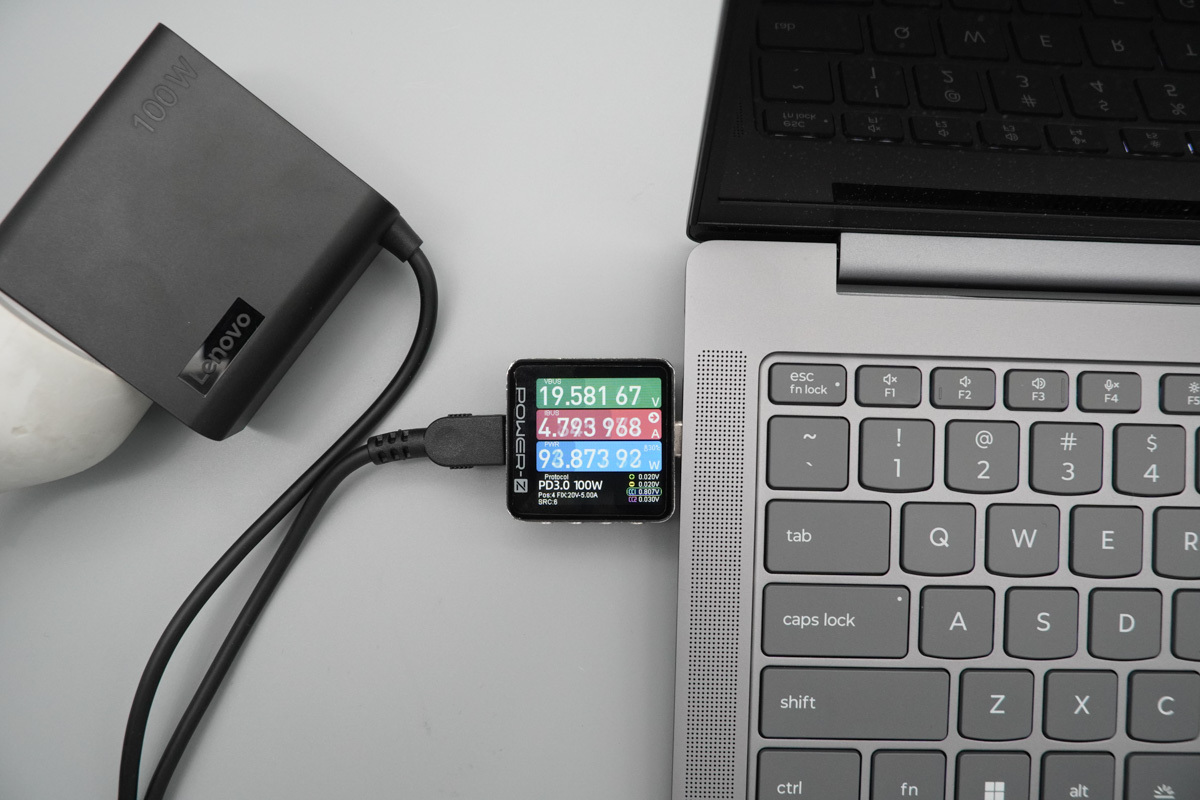
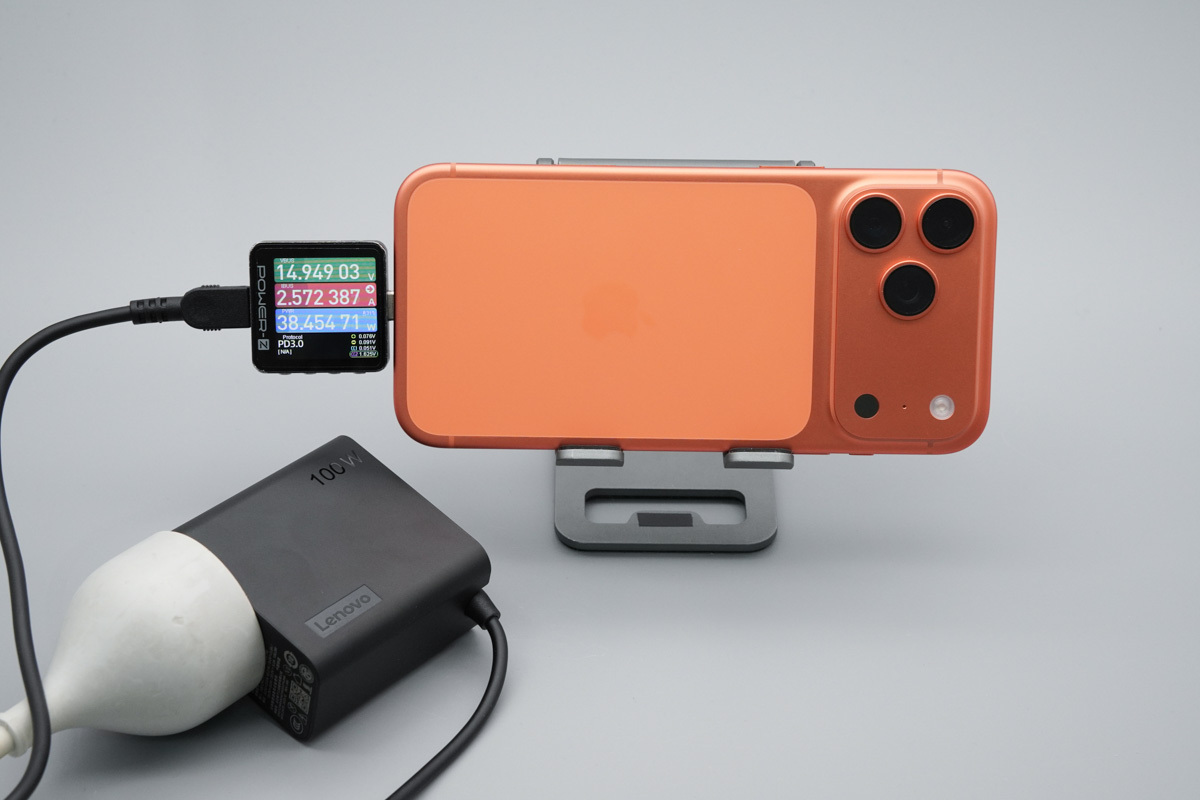
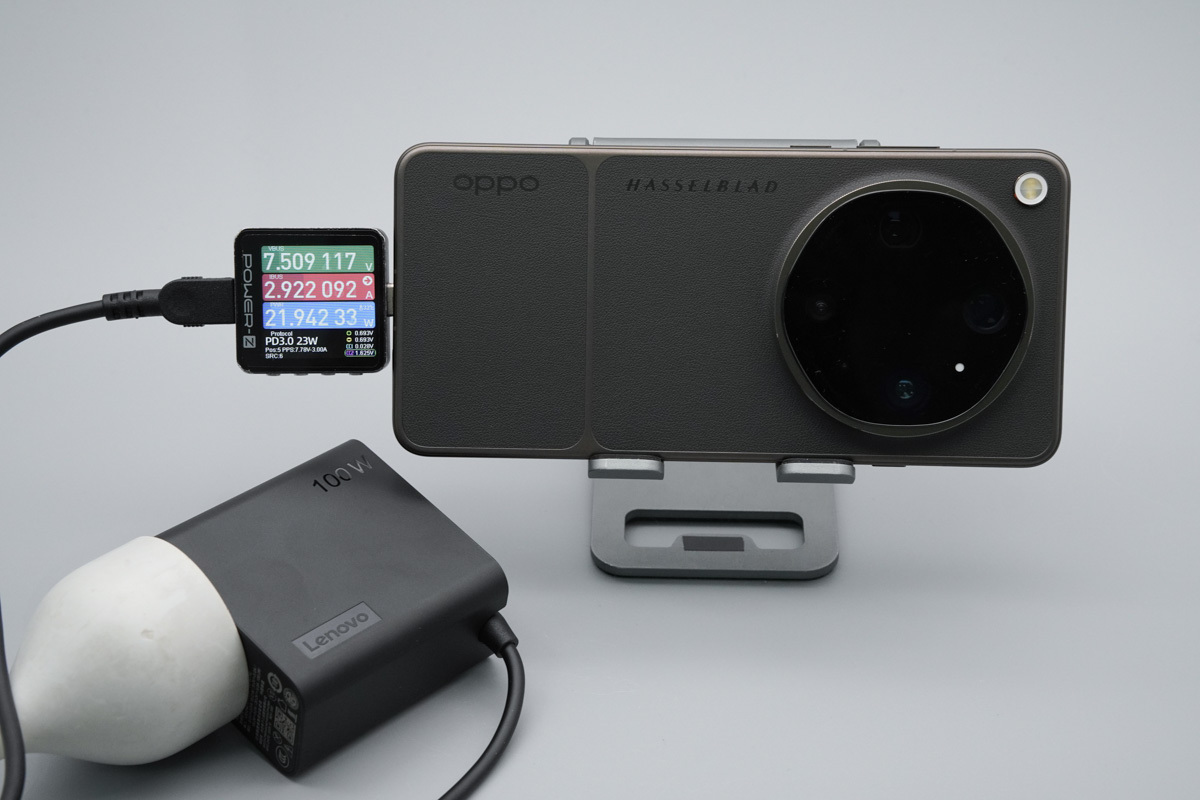
With a Lenovo Xiaoxin Pro 14, the adapter negotiated PD fast charging and delivered 19.58V, 4.79A, and 93.87W. For an iPhone 17 Pro Max, it also used PD and reached about 14.95V, 2.57A, and 38.45W. When charging an OPPO Find X9 Ultra, it negotiated PPS and delivered 7.51V, 2.92A, and 21.94W. These results show broad compatibility across laptops, iPhones, and PPS-capable Android phones.
Full Charging Sessions: Stable Curves, Predictable Power
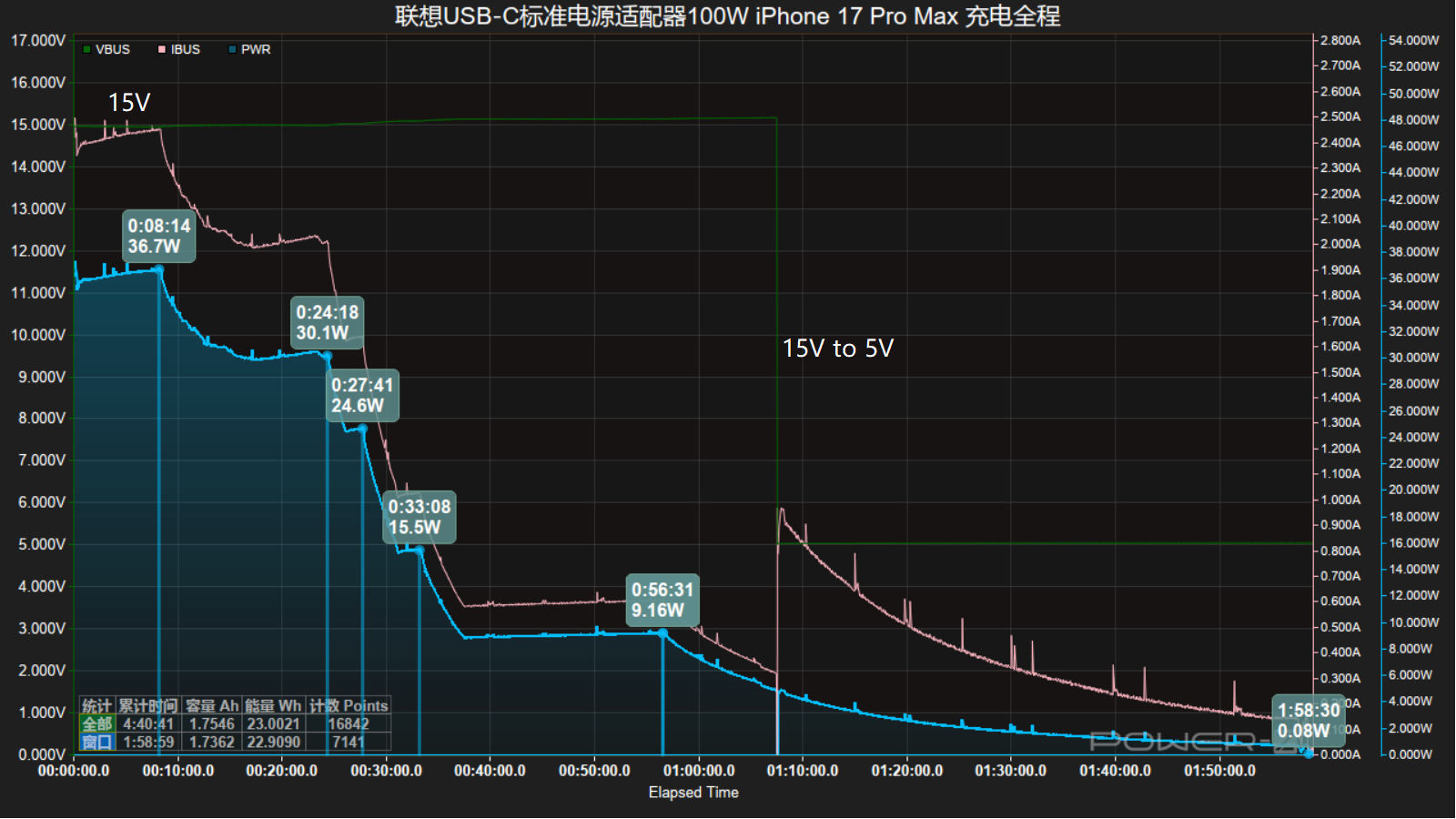
Charging the iPhone 17 Pro Max began at the 15V PD level. At 8 minutes, power peaked at 36.7W, then stepped down: 30.1W at 24 minutes, 24.6W at 27 minutes, 15.5W at 33 minutes, and 9.16W at 56 minutes. After about 1 hour, it switched to the 5V low-voltage stage. The full session took 1 hour 58 minutes and ended at 0.08W. It reached 50% in 21 minutes, 67.9% in 30 minutes, 80% in 45 minutes, and 90% in 1 hour 3 minutes. Total energy input was 22.9Wh.
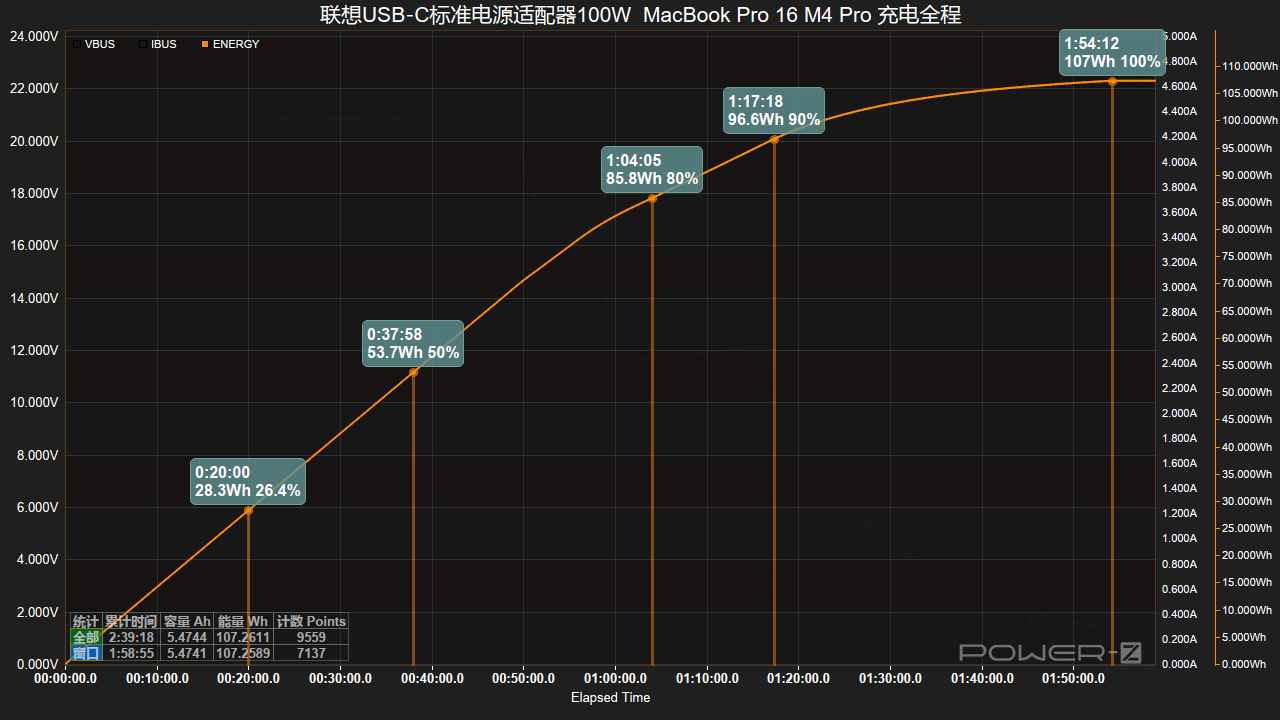
For a laptop, the adapter used the 20V PD profile. It maintained high power early, then dropped to 84.7W at 49 minutes, 76W at 55 minutes, and 49.9W at 1 hour 17 minutes. The full charge took 1 hour 54 minutes and ended at 0.01W. A MacBook Pro 16 M4 Pro reached 26.4% in 20 minutes, 50% in 38 minutes, 80% in 1 hour 4 minutes, and 90% in 1 hour 17 minutes. Its full charge took 1 hour 54 minutes 12 seconds with 107Wh input. The curves were smooth and consistent with expected laptop charging behavior.
2050 Fast-Charging Benchmark
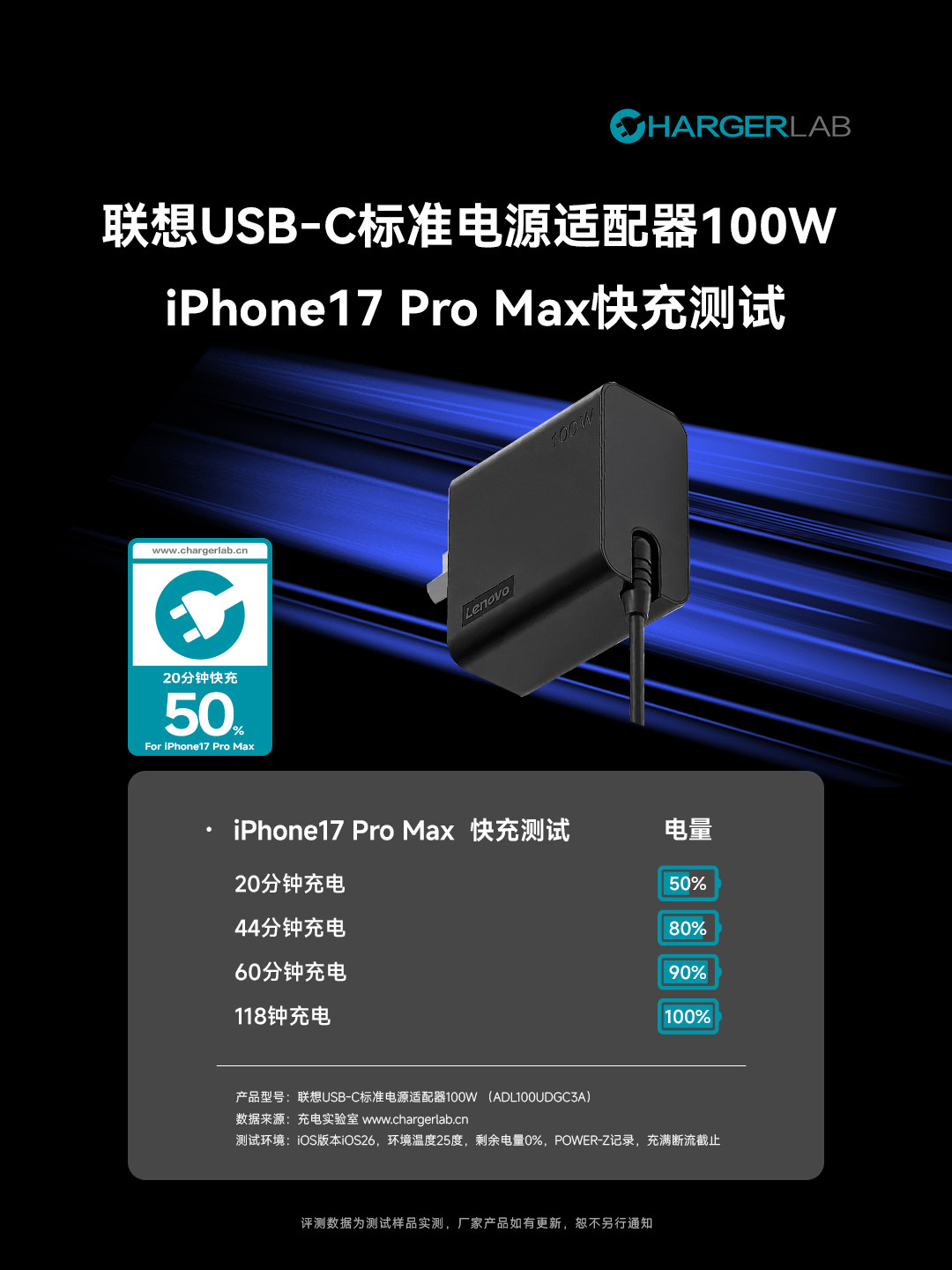
In the 2050 fast-charging benchmark, the Lenovo 100W adapter passed by charging an iPhone 17 Pro Max to 50% in 20 minutes. This confirms that it is not only suitable for laptops but also performs strongly as a high-power phone charger.
Standby Power and Conversion Efficiency
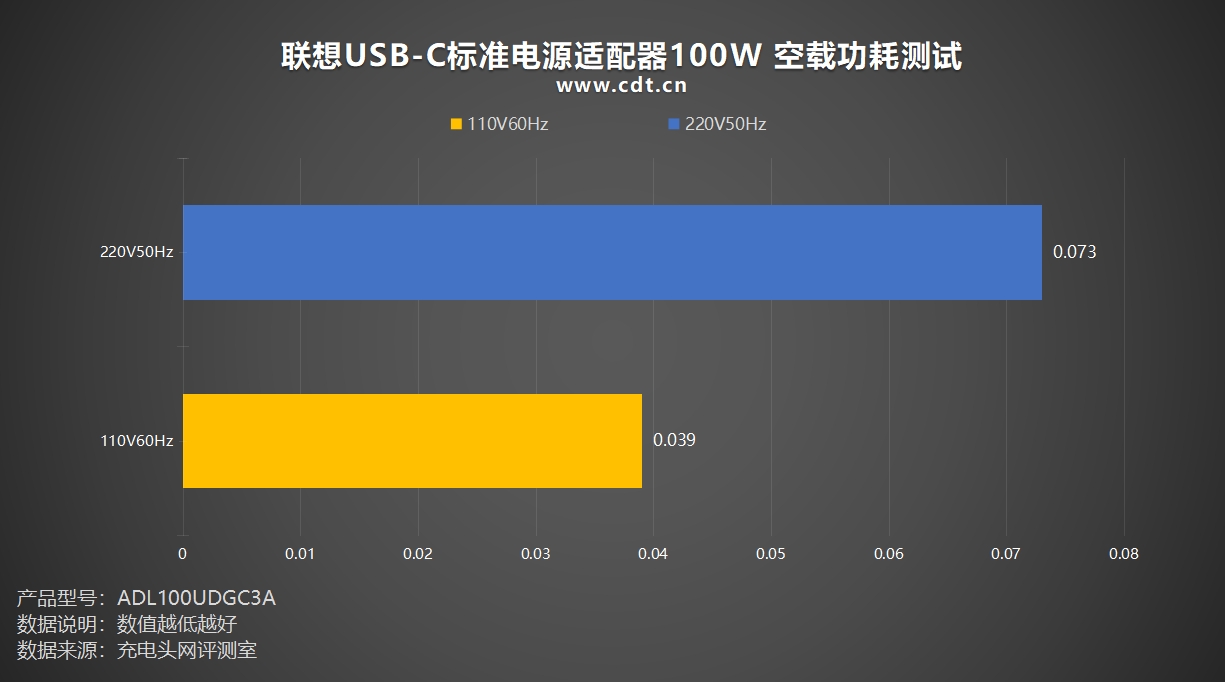
Standby power was measured with a Yokogawa WT310E digital power meter. The adapter’s no-load consumption is described as excellent, meaning it wastes very little energy when left plugged in without a device attached. This is important for users who keep chargers connected to wall outlets or power strips all day.
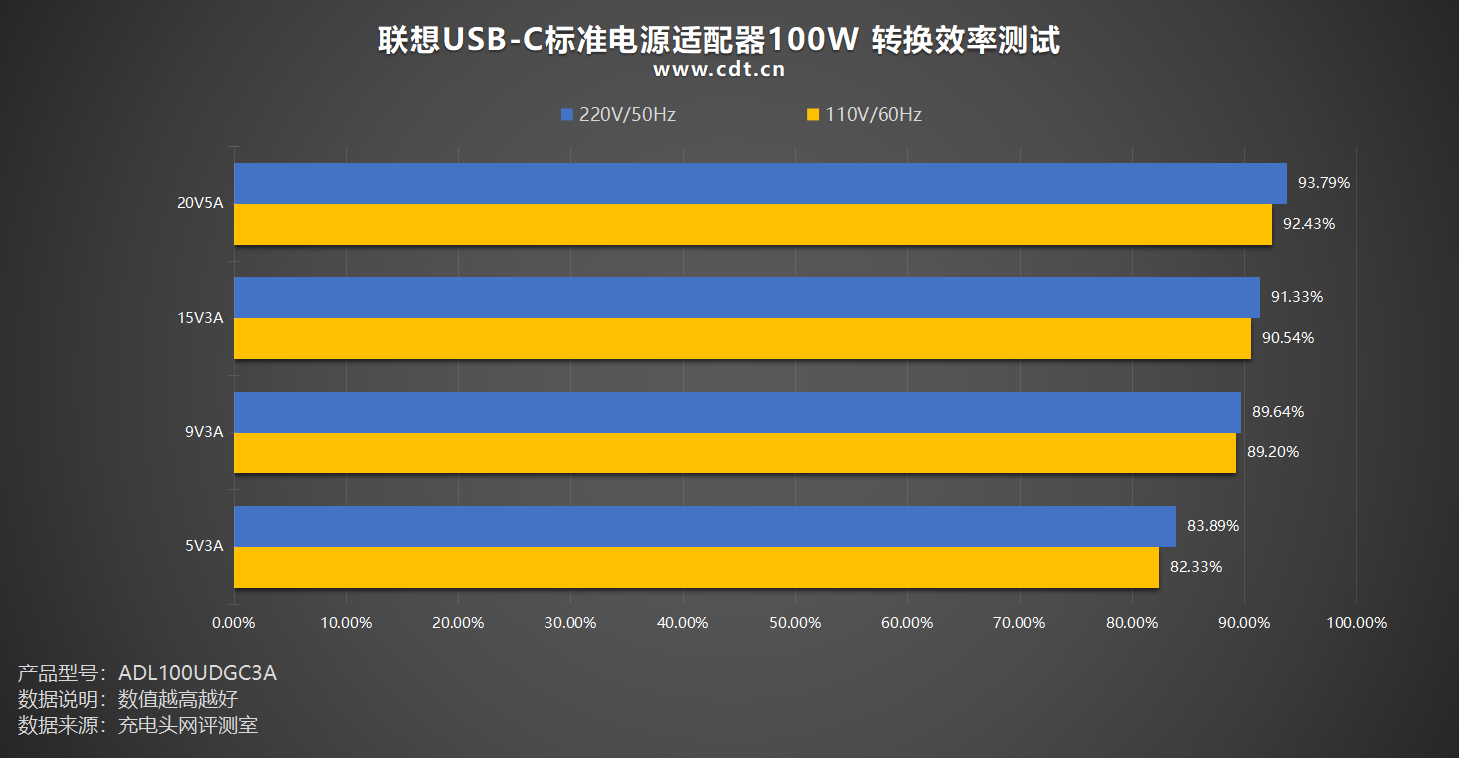
Efficiency is a strong point. At 220V/50Hz, the 20V/5A profile reached 93.79%, the 15V/3A profile reached 91.33%, the 9V/3A profile reached 89.64%, and the 5V/3A profile reached 83.09%. At 110V/60Hz, efficiency dropped only slightly: 92.43% at 20V/5A, 90.54% at 15V/3A, 89.20% at 9V/3A, and 82.33% at 5V/3A. The adapter therefore performs well across both high- and low-voltage regions.
Ripple Performance: Clean Output Across Loads
Ripple was measured with an oscilloscope and compared with industry standards. At 220V/50Hz with no load, the highest ripple was 78mVp-p at 5V/0A, while the lowest was 63.2mVp-p at 20V/0A. At 110V/60Hz with no load, the highest was 64mVp-p at 9V/0A, and the lowest was 56.8mVp-p at 20V/0A.
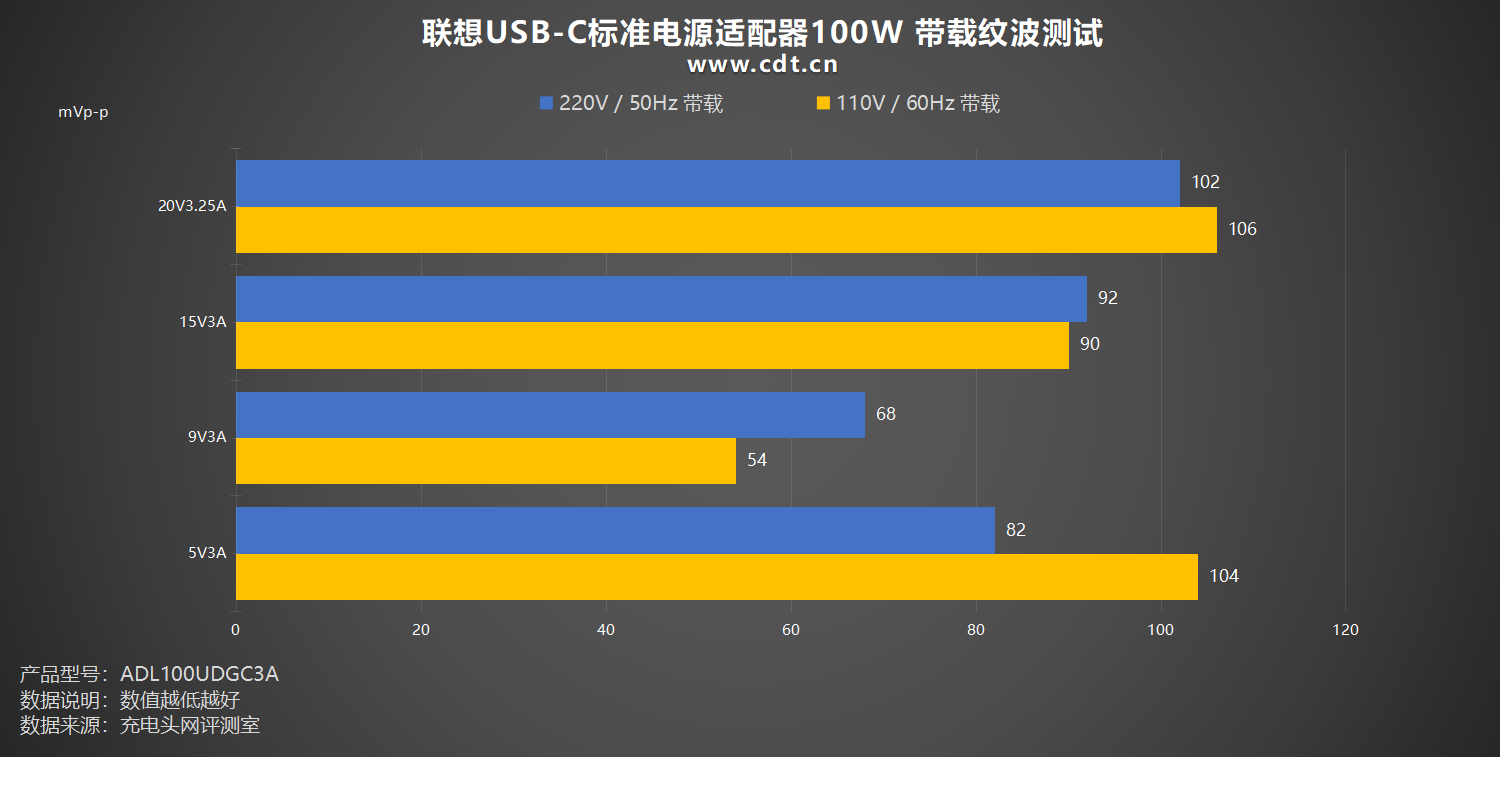
Under load at 220V/50Hz, the highest ripple was 102mVp-p at 20V/3.25A, and the lowest was 68mVp-p at 9V/3A. At 110V/60Hz under load, the highest was 106mVp-p at 20V/3.25A, and the lowest was 54mVp-p at 9V/3A. All values remain within a reasonable range, indicating stable, device-friendly output.
Thermal Testing: Controlled Heat Under Full Load
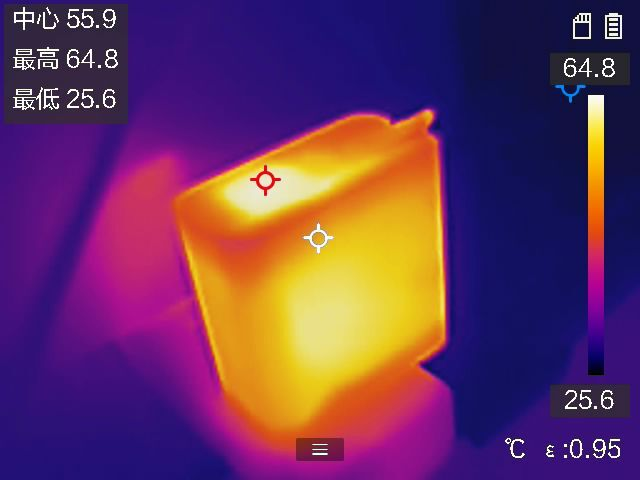
Thermal testing was conducted in a 25°C chamber with a 20V/5A load for one hour. At 220V/50Hz, the front housing reached a maximum of 64.8°C, with a center temperature of 55.9°C. The other side reached a maximum of 64°C, with a center temperature of 47.3°C. At 110V, the highest temperature was about 72.7°C near the top, while the other side reached about 73.6°C near the top.
Overall, heat is concentrated mainly on the top surface. The 220V platform runs cooler than 110V, and side heat distribution is fairly even. Peak temperatures remain reasonable for a compact 100W adapter during sustained full-load operation.
Lenovo’s Role in Power Efficiency Standards
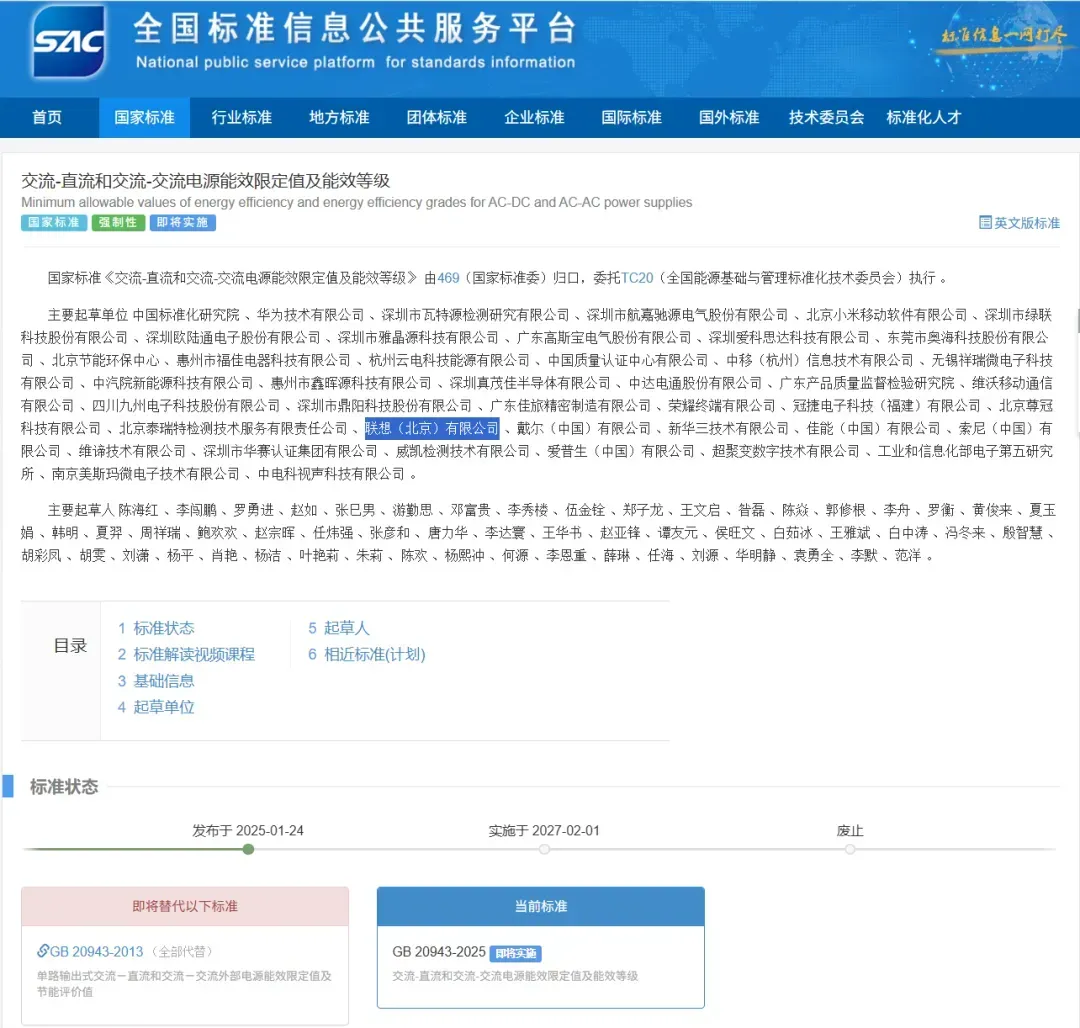
Lenovo is one of the drafting organizations for GB 20943-2025, China’s new charger energy-efficiency standard, and has also participated in USB PD fast-charging standard development. This background supports the adapter’s focus on efficiency, safety, and standards compliance.
Final Verdict: A Reliable Original 100W USB-C Adapter
The Lenovo 100W USB-C Standard Power Adapter is a genuine notebook accessory with a compact body and an integrated cable. It offers 5V/3A, 9V/3A, 15V/3A, and 20V/5A PD profiles, a 100W peak, and compatibility with Lenovo laptops, phones, tablets, and other USB-C devices.
It supports 110V–220V input, reaches up to 93.79% efficiency at high power, maintains low standby consumption, and keeps ripple within acceptable limits. Thermal performance is stable under a full 20V/5A load. For Lenovo USB-C laptop owners who want an official, convenient, and dependable charger, it is a strong choice. It is slightly heavier for travel than a separate GaN charger, but the built-in cable and reliable performance make it a practical all-in-one power solution.
 Honeycomb Cooling & Perfect Fit: UGREEN 160W Charger DIY Stand Review