



Xiaomi 140W 8-in-1 GaN Desktop Charging Station In-Depth Review: A System-Level Upgrade for Desktop Power Management
 29 Jan,2026
As multi-device work setups and high-power fast charging become everyday requirements, the traditional power strip is gradually reaching its functional limits. Xiaomi’s newly released 140W 8-in-1 GaN desktop charging station represents a clear shift in this category. Rather than being a simple combination of a power strip and a charger, it integrates AC power distribution with a high-performance GaN fast-charging module at a system level, redefining what a modern desktop power solution can be.
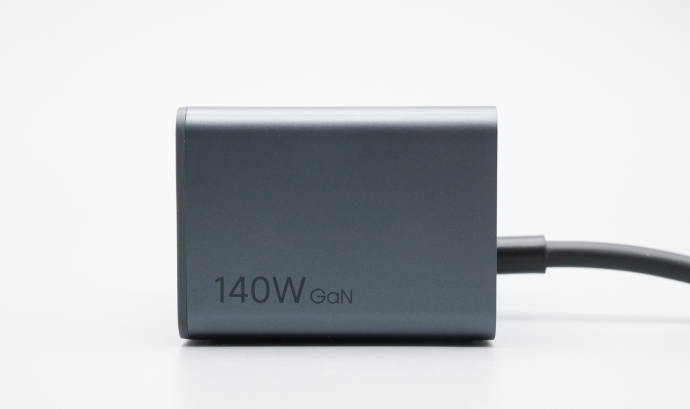
Integrated Design Concept: From Power Strip to Desktop Power Hub
The core value of this product lies in its high level of integration. Built on an AC power base capable of handling up to 2500W, Xiaomi embeds a 140W multi-port GaN fast charging module directly into the unit. As a result, laptops, smartphones, earbuds, smartwatches, and other devices can all be powered from a single centralized point on the desk. Compared with the traditional setup of a power strip paired with multiple adapters—often involving different types of charger scattered across the workspace—this approach significantly improves space efficiency, power management, and overall usability. It aligns well with modern office and home environments where cleanliness, order, and efficiency are increasingly valued.
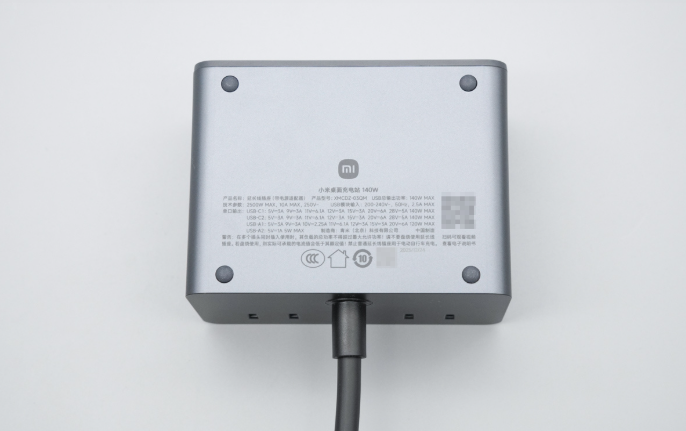
Design and Build: Moving Beyond a Tool-Like Appearance
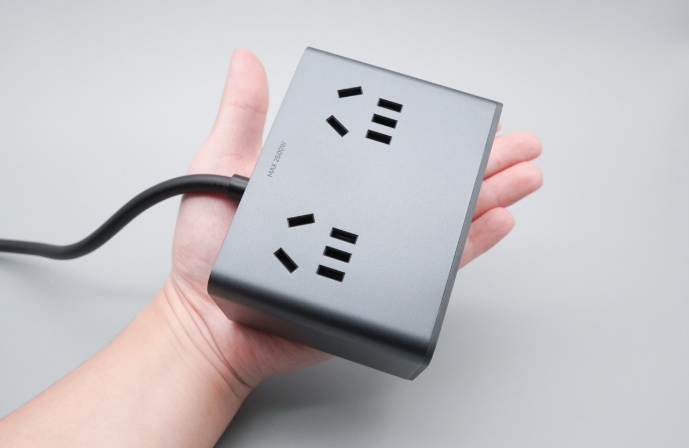
Visually, the charging station clearly distances itself from the industrial look of conventional power strips. The top panel features an AG-coated surface combined with optical coating technology, delivering a refined tactile feel while effectively resisting fingerprints and stains. The overall appearance is restrained and minimal, allowing it to blend naturally into desks, studies, or living spaces without drawing unnecessary attention. Despite integrating AC sockets, multiple USB outputs, and internal thermal structures, the unit remains compact and desk-friendly. Weighing around 500g, it also maintains good stability during daily use. Port Configuration and Power Output: Covering Both High and Low Power Scenarios
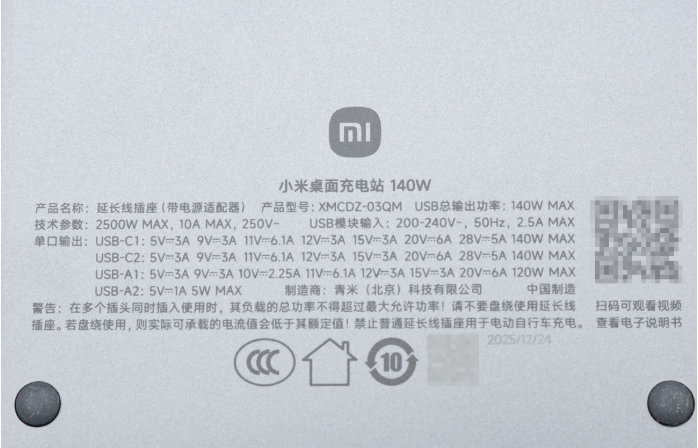
The USB section adopts a 2C2A layout, with each port clearly positioned for specific use cases.
Both USB-C ports support PD 3.1 EPR, delivering up to 140W (28V 5A) from a single port. This makes the device fully capable of powering high-performance laptops such as the MacBook Pro, positioning it as a powerful usb c wall charger for desktop environments. In addition, both USB-C ports and one USB-A port support Xiaomi’s proprietary 120W HyperCharge protocol, ensuring optimal fast-charging performance for Xiaomi and Redmi flagship smartphones. The USB-A1 port offers up to 100W PD output, providing broad compatibility with laptops and other high-power devices, while the USB-A2 port is designed specifically for low-current charging (5V 1A), making it suitable for sensitive devices like earbuds and wearables. This combination of high-output fast charging and carefully managed low-power delivery reflects a thoughtful balance between performance, safety, and device compatibility—qualities expected from a premium type c charger solution.
Internal Architecture: A Mature High-Power Fast-Charging Platform
A closer look inside reveals that this charging station is not merely impressive on paper. Internally, it adopts an active PFC + AHB (asymmetrical half-bridge) architecture, with the primary power stage built around controllers from Richtek and paired with high-voltage GaN devices from Innoscience. This configuration achieves an effective balance between efficiency, power density, and long-term stability. Synchronous rectification and multi-channel secondary buck conversion are implemented independently for each output path, ensuring that different ports operate without mutual interference even under mixed-load conditions.
Thermal management is also taken seriously. Large metal heat spreaders, combined with thermal pads and copper foil, help dissipate heat generated during high-power operation, supporting reliable performance during prolonged heavy loads. On the AC side, the socket module uses an integrated copper busbar design, providing both high current capacity and structural reliability—key factors behind its stable 2500W rating.
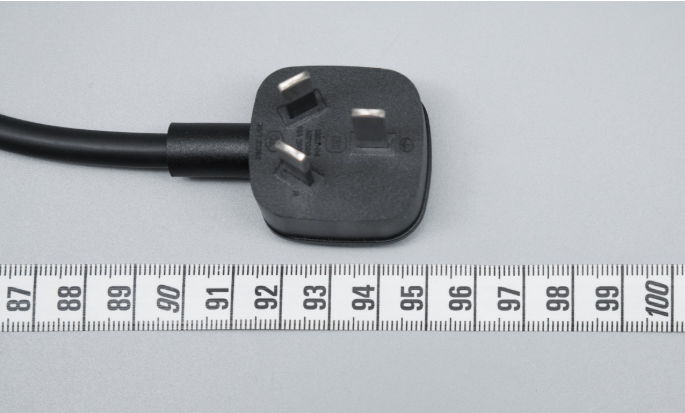
Charging Protocols and Compatibility: Private and Public Standards Combined
Charging protocol support is another strong point. In addition to mainstream public standards such as PD, PPS, QC, AFC, and FCP, Xiaomi fully integrates its 120W HyperCharge technology into a desktop-class product, effectively turning the unit into an official fast-charging hub for Xiaomi users. At the same time, compatibility with non-Xiaomi devices is not compromised. The inclusion of PD 3.1 EPR ensures that this charger remains relevant for future generations of high-power laptops and USB-C devices, making it a versatile option across different types of charger requirements.
Conclusion: More Than a Power Strip, a Desktop Power System
Taken as a whole, the Xiaomi 140W 8-in-1 GaN desktop charging station is not a product that simply chases specifications. Instead, it represents a systematic rethink of desktop power distribution—combining AC output, fast-charging technology, intelligent power allocation, safety considerations, and refined industrial design into a single platform.
For users managing multiple devices who value a clean workspace and demand high-performance fast charging, this product offers a more advanced and hassle-free solution. From an industry perspective, it also sets a high benchmark for the emerging category of integrated desktop power hubs built around GaN and USB-C technology.
 Deep Dive into the Belkin 112W GaN Charger: Unveiling the Secrets of a Multi-Port Flagship