



New Power Industry Trends: From High-Power Server Modules to Smart Consumer Charging Solutions
 27 Jan,2026
The power supply and charging industry is currently witnessing a significant surge in innovation, driven by stricter regulations and the relentless demand for higher efficiency. In particular, with the implementation of the New National Standard for portable power banks, major chip manufacturers and solution providers are racing to introduce compliant designs. These advancements are not limited to industrial applications; they are trickling down to consumer electronics, influencing the design of every usb plug in charger and portable battery on the market. From massive 600W server modules to compact, intelligent reference designs for a charger 30w, the industry is evolving to meet the needs of the AI era and the smart consumer.
1. Hynetek: Redefining High Power Density and Dynamic Allocation
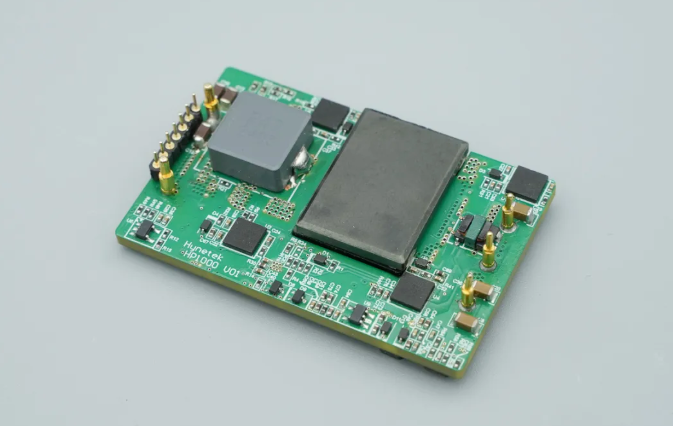
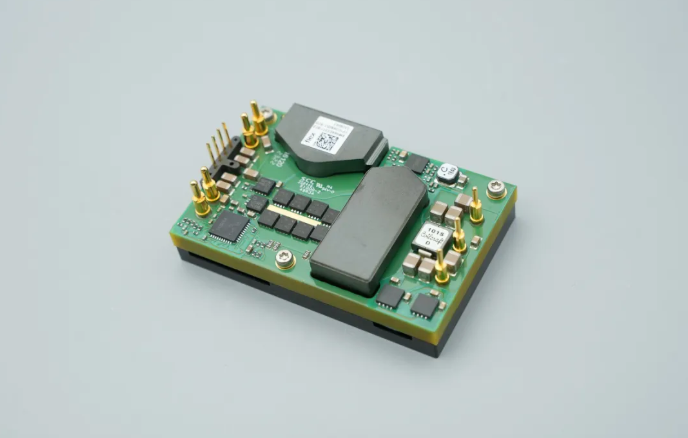
At the forefront of this technological wave is Hynetek, which has released a groundbreaking reference design for the HP1000 600W 1/4 brick module full-bridge converter. This solution exemplifies the concept of high power density in digital power supplies. By utilizing a planar transformer for high-frequency isolation and energy transmission, the design achieves a remarkable balance of size and performance. The layout is meticulously engineered: the primary side full-bridge MOS and secondary side synchronous rectification MOS are placed on opposite sides, while the input/output filtering networks are positioned near the edges. This integration allows for a peak efficiency of 96.3%, making it an ideal solution for data centers powering AI computations.
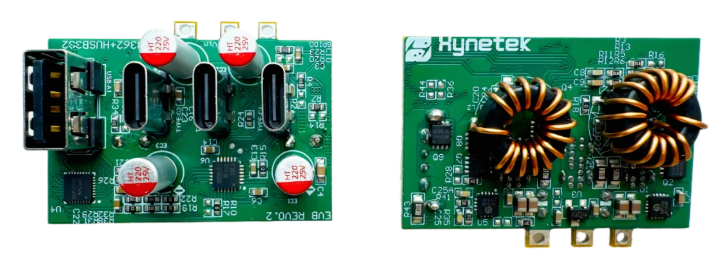
While this 600W beast serves industrial needs, Hynetek’s technology also scales down to consumer needs, such as a dual usb c charger. Their 100W 3C1A dynamic power distribution solution utilizes the HUSB362BF and HUSB392 chips. This system ensures that when a user plugs in multiple devices, the power is allocated intelligently. For instance, if you are using a powerful usb plug in charger to juice up a laptop and a phone simultaneously, the system initially sets a fixed limit. After a short period, it dynamically adjusts the voltage and current based on real-time needs. This ensures that even in a multi-port scenario, a specific port can still function effectively as a rapid charger 30w for a smartphone while the rest of the power goes to the laptop.
2. MODSEMI: Modular Intelligence for Safer Charging
Compliance with the New National Standard for mobile power banks is a significant challenge for many manufacturers. MODSEMI has addressed this with the IPB-M1 module, a solution designed for modularity and plug-and-play capability. This module allows manufacturers to upgrade existing non-smart power bank designs into intelligent systems without redesigning the entire main control board. By simply connecting this module, a standard battery pack gains capabilities like battery status monitoring, information interaction, OTA upgrades, and even anti-loss positioning.
This approach is revolutionary for the production of safer charging accessories, including the portable equivalent of a usb plug in charger. For the consumer, this means that the next generation of power banks will not only be compliant but also smarter and safer. The ability to monitor battery health and internal temperature is crucial, whether it is a large power station or a compact, wall-outlet style charger 30w. MODSEMI’s solution lowers the barrier to entry, ensuring that safety features previously reserved for high-end devices become standard across the industry.
3. Zienertech: The GaN Revolution in Power Topology
Zienertech is pushing the boundaries of material science with its ZN-600W single-stage topology DAB scheme. The core of this design is the ZN70B1R075L, a sapphire-substrate bidirectional Gallium Nitride (GaN) device. GaN technology is the magic behind the shrinking size of the modern usb plug in charger. This specific device supports 700V withstand voltage and bidirectional conduction while eliminating the back-gate effect common in silicon-substrate GaN.
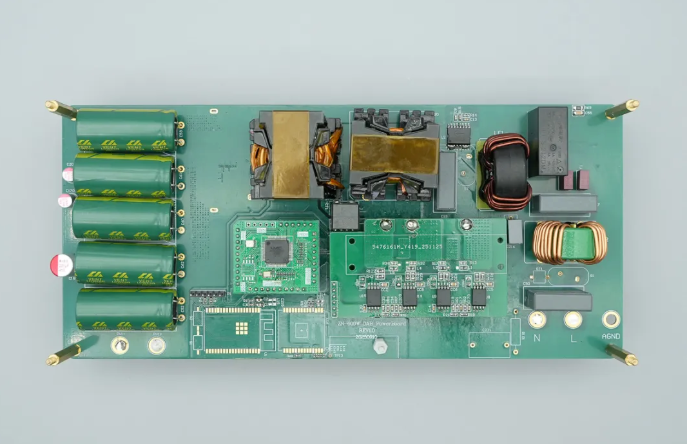
The implications of this technology are vast. By removing the need for extra substrate clamping designs, the system becomes more reliable and compact. While this specific reference design is aimed at bi-directional DC-DC and energy storage, the underlying GaN technology is what enables a high-performance dual usb c charger to fit in the palm of your hand. It is also the reason why a charger 30w today is half the size of a standard 5W charger from a decade ago. Zienertech’s robust design proves that GaN is ready for mass production in long-term high-load scenarios.
4. Flex and Huawei: Industrial Reliability Standards
In the realm of mission-critical power, Flex and Huawei set the bar for reliability. The Flex BMR490 series is a non-isolated DC-DC power module capable of delivering 1300W. Designed for data centers, it operates on a 7x24 basis, utilizing advanced controllers from Texas Instruments and MOSFETs from Infineon. Similarly, Huawei’s GDQ33S12B/P isolated DC-DC module focuses on high power density combined with rigorous protection mechanisms against over-current, short circuits, and over-temperature.
Why does this matter for a consumer looking for a usb plug in charger? Because the safety protocols developed for these industrial behemoths influence consumer safety standards. The engineering rigor required to keep a server running safely is translated into the protection circuits found in a high-quality dual usb c charger. When you buy a certified charger 30w, you are often benefiting from the trickle-down of these high-reliability engineering practices, ensuring your device doesn't overheat or short out during overnight charging.
5. Injoinic and Ismartware: Visualizing Power Delivery
The New National Standard emphasizes not just safety, but also the transparency of information. Injoinic and Ismartware have introduced solutions that make power delivery visible to the user. Injoinic’s low-cost PD VDM information interaction scheme allows battery data (voltage, current, temperature) to be read and displayed on external testers. This transparency is vital for diagnosing issues in complex charging setups.
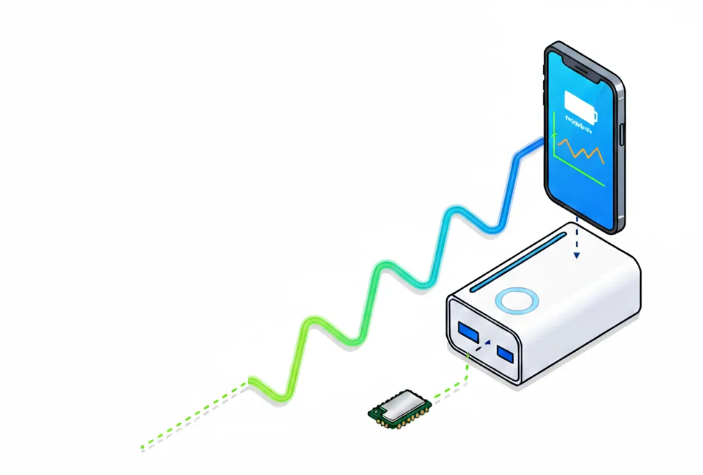
Ismartware takes this a step further with Bluetooth connectivity and built-in display drivers. Their 22.5W Bluetooth solution syncs data to a smartphone, allowing users to see exactly how fast their dual usb c charger or power bank is working. Furthermore, their SoC solutions that drive TFT screens directly mean that future power banks and possibly even a high-end usb plug in charger could feature built-in screens showing real-time charging curves. Imagine plugging in your charger 30w and seeing a small display confirm the exact wattage being delivered to your phone—this is the level of interactivity these chips are enabling.
6. Delta and the Trend Toward Miniaturization
Delta’s DC24S1215 isolated DC-DC power module is a masterpiece of miniaturization, weighing only 9.4g. It uses a high-efficiency current mode PWM controller and advanced optical coupling for isolation. This level of compactness is exactly what the market demands. Whether it is a server component or a travel-friendly usb plug in charger, the goal is to pack more power into less space without compromising safety.
Conclusion: The Future is Integrated and Intelligent
Reviewing these recent schemes, it is evident that integration and intelligence are driving the industry. From Hynetek’s density breakthroughs to Ismartware’s smart displays, the technology inside a dual usb c charger or a simple charger 30w is becoming increasingly sophisticated. These reference designs are paving the way for a future where charging is not only faster and smaller but also safer and more transparent for the user.
 High-Performance Wireless Charging: Honor SuperCharge Stand (Max 80W) Deep Dive Review