



Comprehensive Teardown and Review: Inside the Lenovo thinkplus 190W Power Bank
 02 Feb,2026
In the rapidly evolving world of mobile accessories, the demand for high-performance energy solutions is at an all-time high. Lenovo's thinkplus brand has recently introduced the Lingxun series 20000mAh power bank, a device that promises to redefine expectations for the modern portable laptop charger. With a staggering total output of 190W and a single-port capability of 140W, this device is built to handle the most demanding electronics. Today, we are conducting a comprehensive teardown and review to understand what makes this type c pd charger a top-tier choice for power users.
1. Introduction: A New Standard for Mobile Power
The Lenovo thinkplus 190W power bank is not just another battery pack; it is a high-performance energy station designed for professionals. As laptops become more powerful, the standard 100 watt charger often falls short of maintaining charge during intensive tasks. Lenovo addresses this by offering a 140W single-port output, making it an ideal portable laptop charger for devices like the MacBook Pro 16-inch and high-end Windows gaming laptops. The inclusion of a built-in TFT color screen sets it apart, offering real-time data on voltage, current, and temperature, ensuring users are always informed about their charging status.
2. Design and User Interface
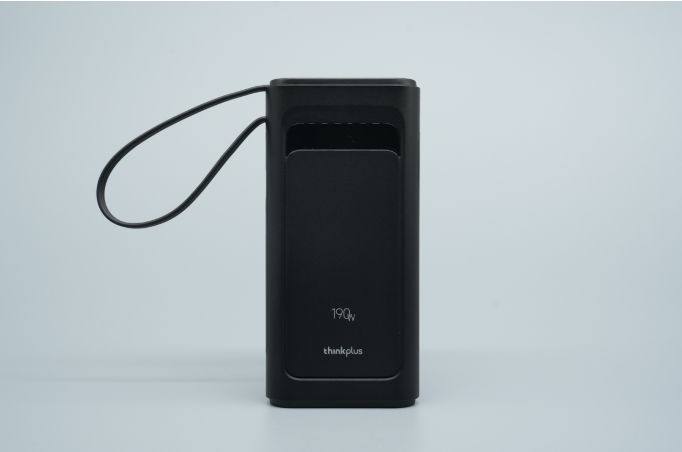
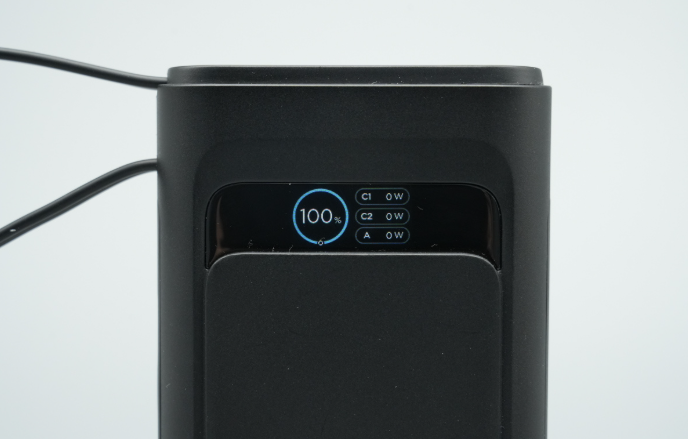
Upon unboxing, the device exudes a premium business aesthetic. The unit features a sleek, elongated pillar design with rounded edges that provide a comfortable grip. The chassis is finished in a matte black texture, while the front panel houses a glossy translucent section that covers the TFT display. Unlike a standard portable laptop charger that relies on simple LED dots, this screen provides a wealth of information, including battery percentage, real-time power input/output, and internal battery temperature. This level of transparency is crucial for tech enthusiasts who want to verify if their device is truly operating as a high-speed type c pd charger.
3. Integrated Cable and Connectivity
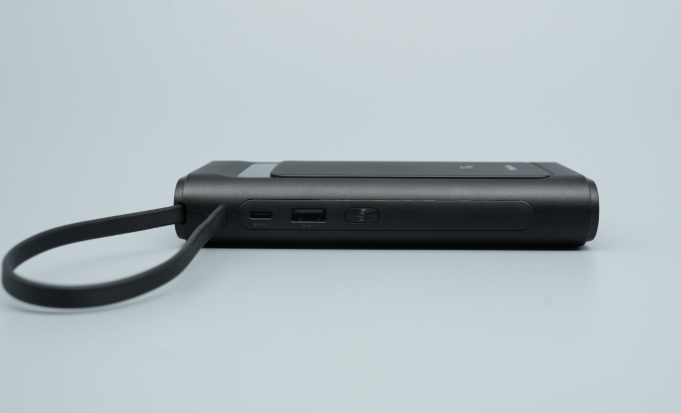
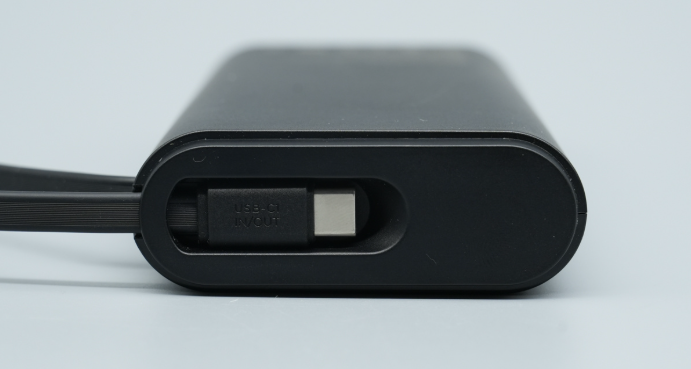
One of the standout features of this portable laptop charger is its built-in USB-C cable. The cable is neatly integrated into a magnetic groove on the top of the device, doubling as a lanyard when not in use. Our testing with the KM003C tester revealed that this integrated cable is equipped with an E-Marker chip capable of handling 50V 5A, supporting the latest PD3.1 standard up to 240W. This future-proofs the device, ensuring it outperforms the typical 100 watt charger found in the market. In addition to the built-in cable, the unit features a USB-C port and a USB-A port, allowing for simultaneous charging of up to three devices with a total combined output of 190W.
4. Protocol Compatibility and Performance
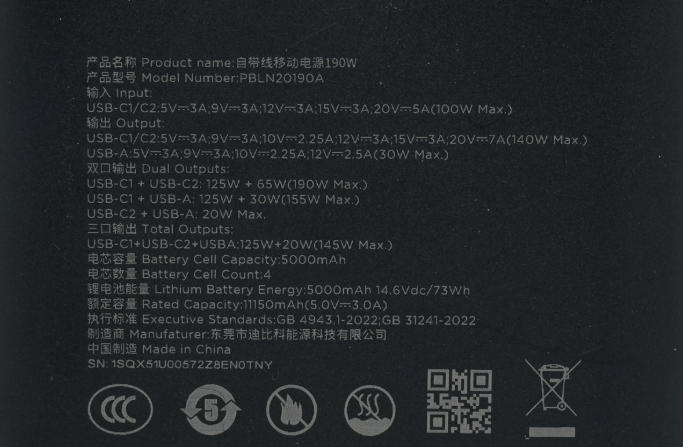
A versatile type c pd charger must support a wide array of charging protocols to be truly useful. The Lenovo thinkplus excels here, supporting PD3.0, QC5, PPS, SCP, and FCP protocols. During our specific testing of the USB-C2 port and the built-in cable, we confirmed support for five fixed voltage PDOs (5V, 9V, 12V, 15V, 20V) and robust PPS ranges. The ability to deliver 20V at 7A (140W) means it significantly outpaces a standard 100 watt charger, providing rapid energy replenishment for power-hungry devices. Even the input capabilities are impressive, supporting up to 100W recharge speeds, meaning the power bank itself can be fully topped up in a very short time.
5. Internal Layout and Thermal Management
Disassembling the unit reveals a sophisticated internal structure designed for safety and efficiency. The device utilizes a stacked PCB design, separating the control logic for different ports. Given that this is a high-power portable laptop charger, thermal management is critical. Lenovo engineers have applied a large area of thickened thermal pads between the PCB modules and the bottom shell. Additionally, graphite copper foil is pasted inside the battery contact area. This multi-layered cooling system ensures that even when the device is pushing output levels far beyond a standard 100 watt charger, it remains cool and stable, preventing overheating during sustained loads.
6. Battery Cell Architecture
At the heart of any portable laptop charger is its battery cells. This unit employs four 21700 series battery cells from EVE Energy (Model INR21700/50E), connected in series. Each cell has a capacity of 5000mAh. EVE Energy is a renowned manufacturer, and these specific cells are automotive-grade, ensuring high energy density and longevity. The battery pack is secured with robust insulation and protection. Two NTC thermistors are strategically placed on the cells to monitor temperature changes in real-time. This redundancy is vital for a high-capacity type c pd charger, providing users with peace of mind regarding safety.
7. Circuit Design and Chipset Analysis
The electronic architecture is driven by the Injoinic IP2366, a cutting-edge power management SoC. The teardown revealed two independent IP2366 chips, each controlling a separate buck-boost circuit. This independence allows the built-in cable and the external USB-C port to operate without throttling each other significantly, a feature rarely seen in a standard 100 watt charger. The IP2366 integrates PD3.1 support and synchronous buck-boost control, allowing for the massive 140W throughput. The use of such advanced silicon confirms its status as a premium type c pd charger capable of complex power negotiation and high-efficiency conversion.
8. Protection Systems and Component Quality
Surrounding the main controllers are high-quality components from reputable suppliers. The protection circuit features a Cellwise CW1244 and CW1051ALJM combination, offering comprehensive safeguards against over-charge, over-discharge, and over-current. For power switching, Hynetek NMOS transistors (AER3041AE and AET3061AP) are utilized for their low resistance and high efficiency. Solid-state capacitors from Koas provide stable filtering. These components work in harmony to deliver a clean, stable power output, which is essential when acting as a portable laptop charger for sensitive and expensive electronics.
9. Conclusion
The Lenovo thinkplus 190W power bank represents a significant leap forward in mobile charging technology. By combining automotive-grade battery cells, a dual-independent circuit design, and the advanced Injoinic IP2366 chipset, it delivers performance that far exceeds the average 100 watt charger. Its ability to sustain 140W output makes it an essential portable laptop charger for power users, while the integrated cable and broad protocol support cement its utility as a universal type c pd charger. Whether for business travel or daily commuting, the robust build quality and thoughtful engineering make it a standout choice in the crowded market of mobile power accessories.
 Comprehensive Guide to GaN Technology and the Future of Cport Charger Efficiency