



Apple’s New 140W Charger Tested: Efficiency Breaks 95%
 03 Nov,2026
A Five-Year Update With a Clear Focus
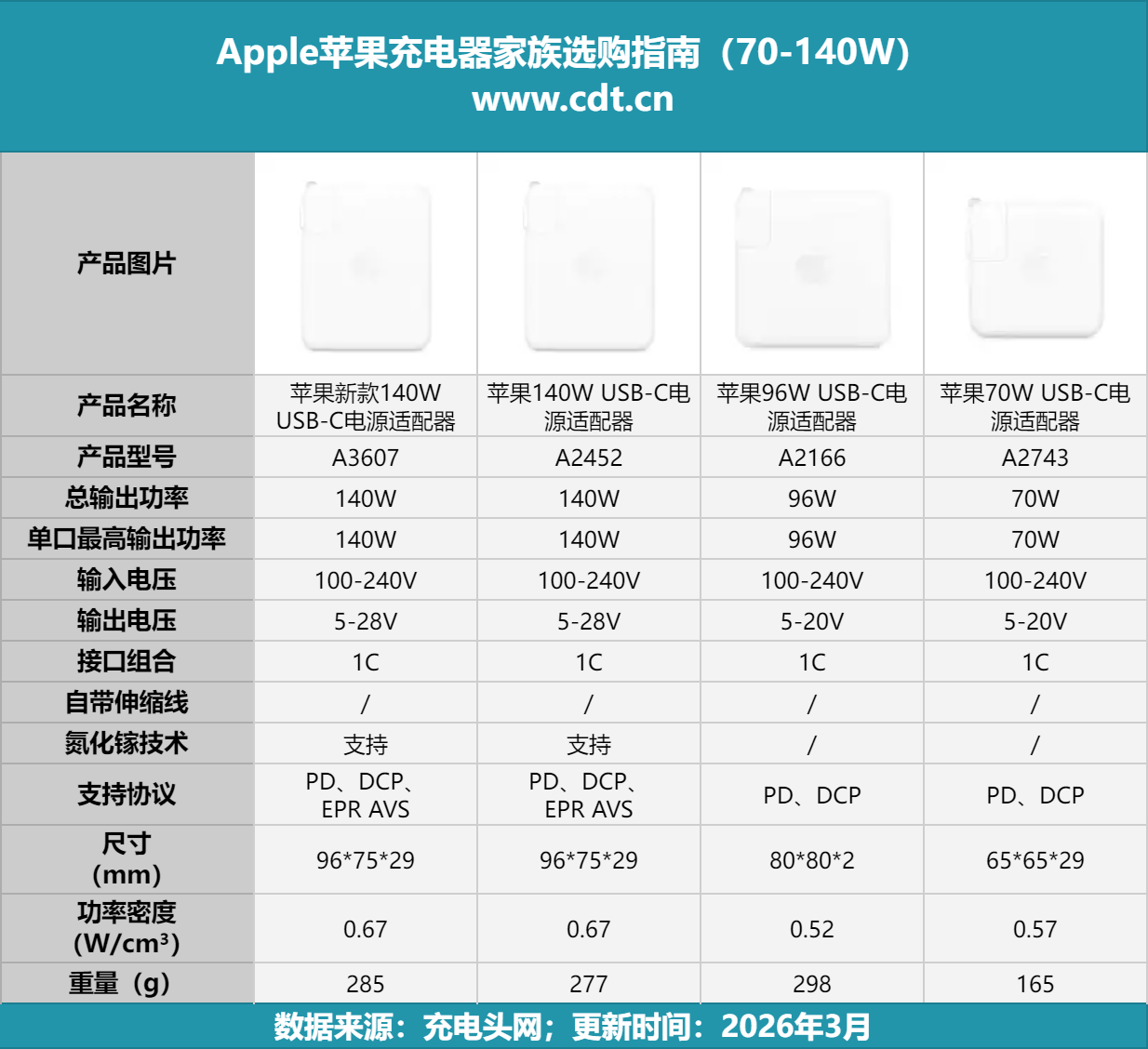
Five years after Apple introduced the A2452, the industry’s first 140W PD3.1 GaN charger, the company has updated the model to the A3607.
The original A2452 helped open the high-power USB-C fast-charging market and pushed the ecosystem toward higher voltage and higher wattage.
The new A3607 arrives with almost no visible change in design or rated specifications, so the real question is whether compatibility, conversion efficiency, and charging speed have improved.
The answer is that the A3607 is not a feature-driven redesign, but a carefully refined internal update focused on efficiency, output quality, and long-term stability.
Packaging and External Design
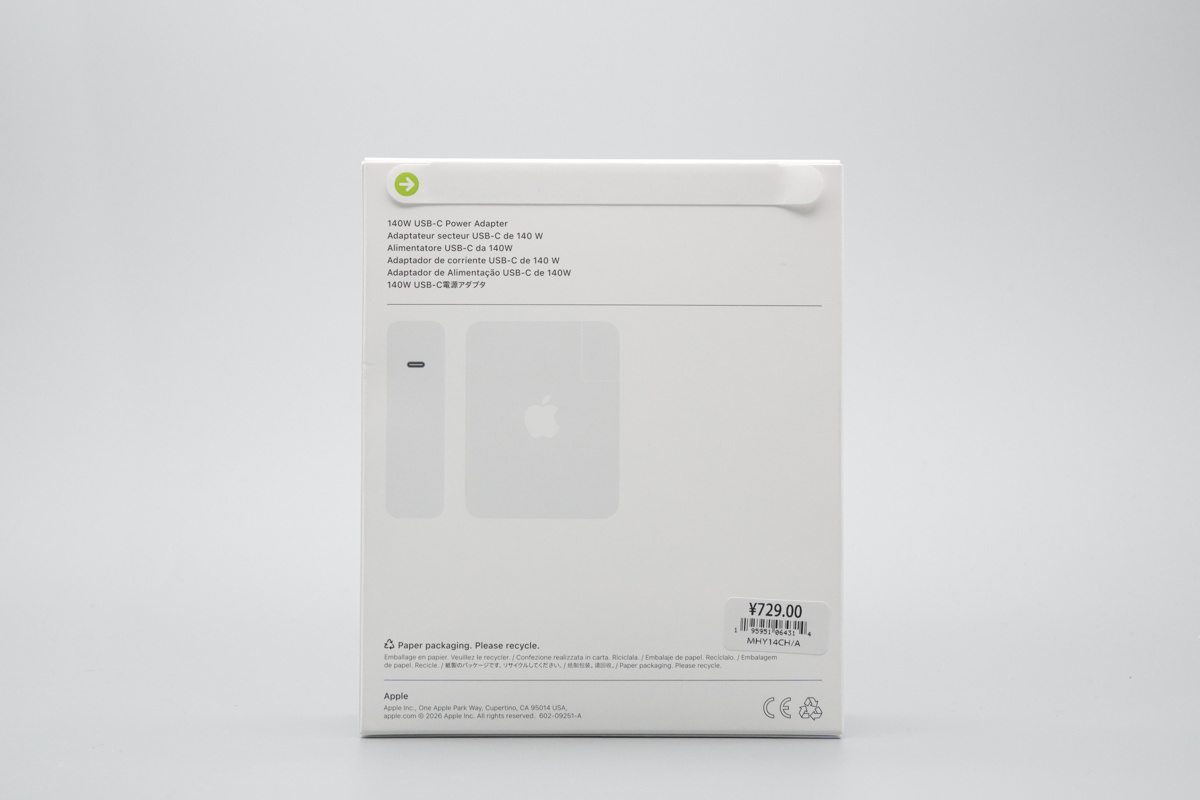
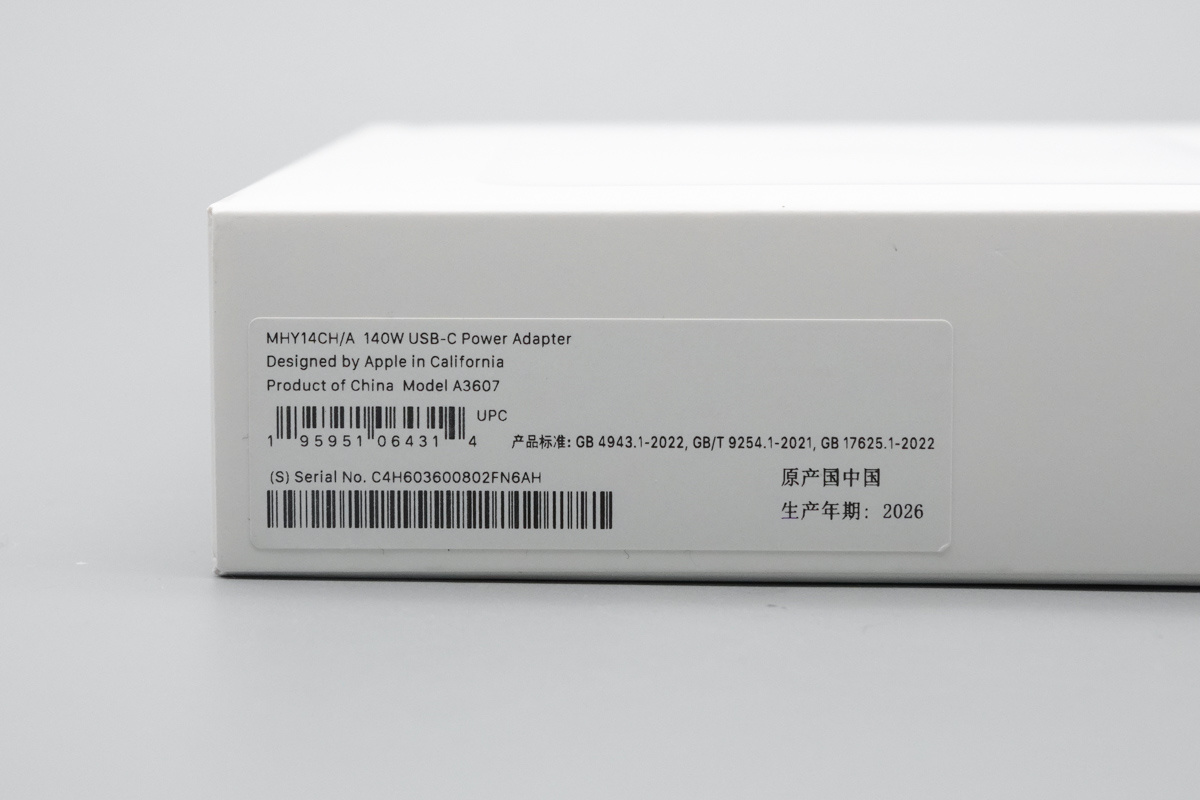
The retail package remains a simple white box with a pull-tab closure on the back, a CE mark, and a price label. A side sticker lists the charger’s parameters.
Inside are the A3607 charger and documentation. The charger keeps the glossy, rounded shell with an Apple logo on the side, making old and new versions difficult to distinguish at a glance.
It has a single USB-C port rated for 140W output, an independent receptacle, and a shell seam that can still collect dust.
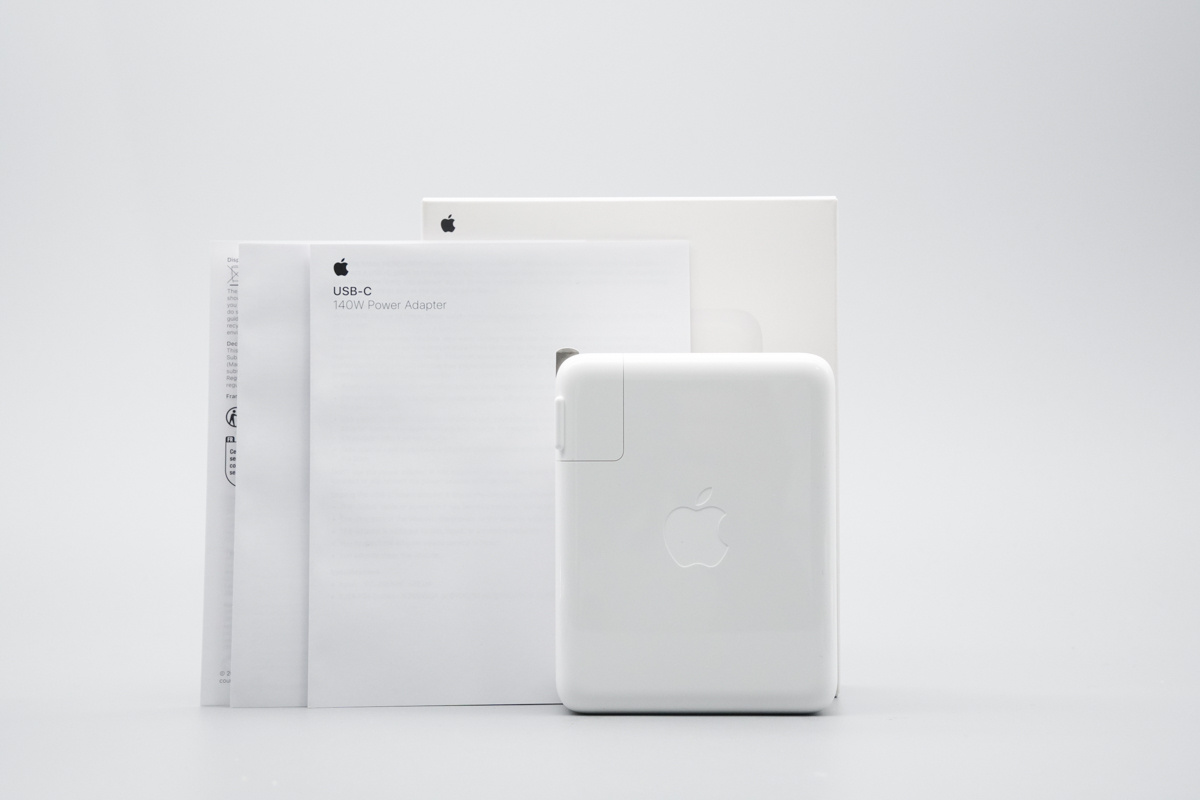
The folding-pin design improves portability, while the two side wings make the charger sit more firmly in a wall outlet.
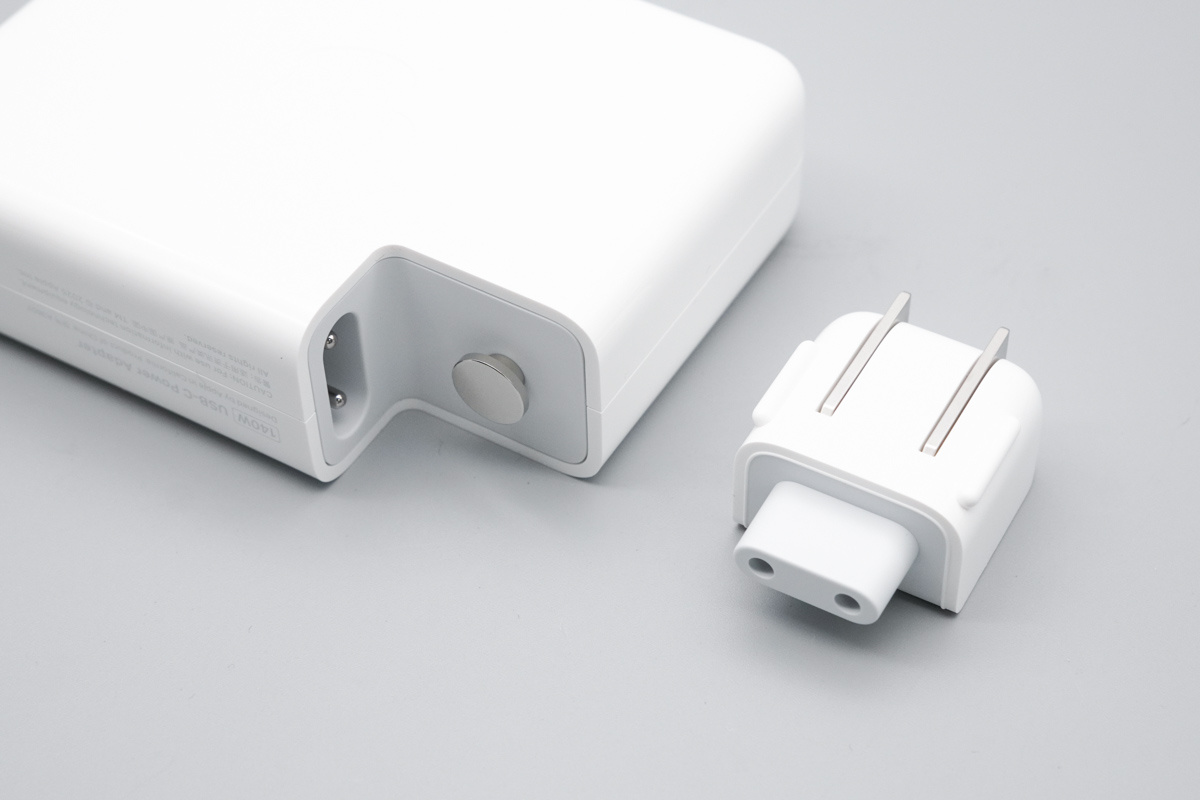
The pin assembly is a classic detachable module and can be replaced; the fixed base can also serve as a ground contact.
Rated Parameters and Physical Specifications
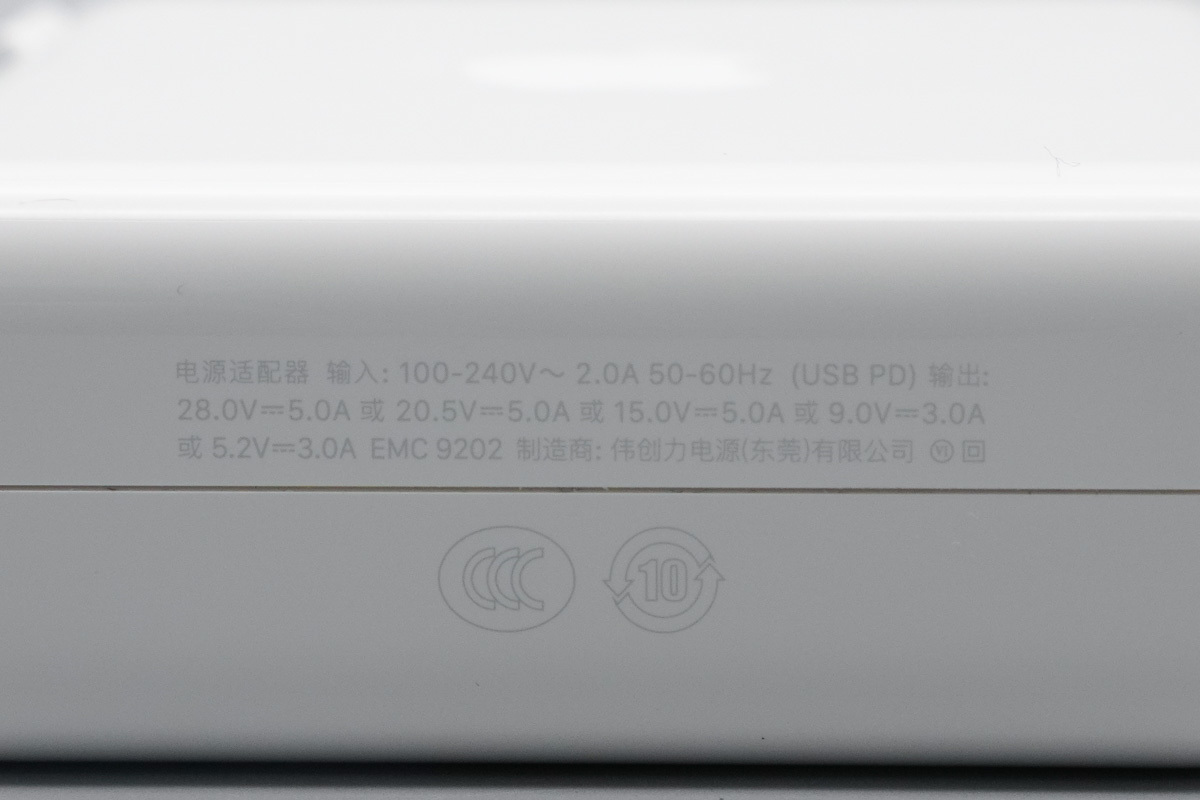
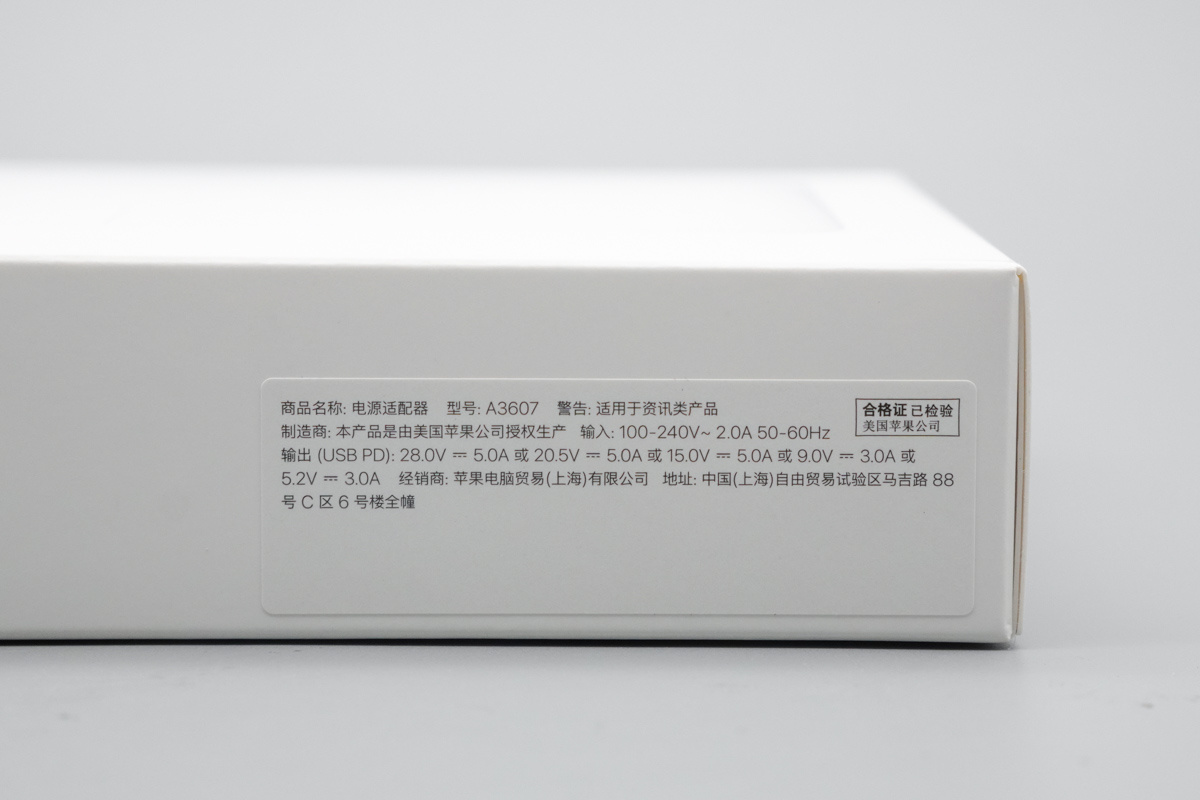
The opposite side prints the input and output ratings, and the product carries China’s 3C compulsory certification. Input is 100–240V~2.0A, 50–60Hz. USB PD output is listed as 28V5A, 20.5V5A, 15V5A, 9V3A, and 5.2V3A. The manufacturer is Flex Power (Dongguan) Co., Ltd. Measured dimensions are about 96.06mm long, 75.06mm wide, and 28.43mm thick.
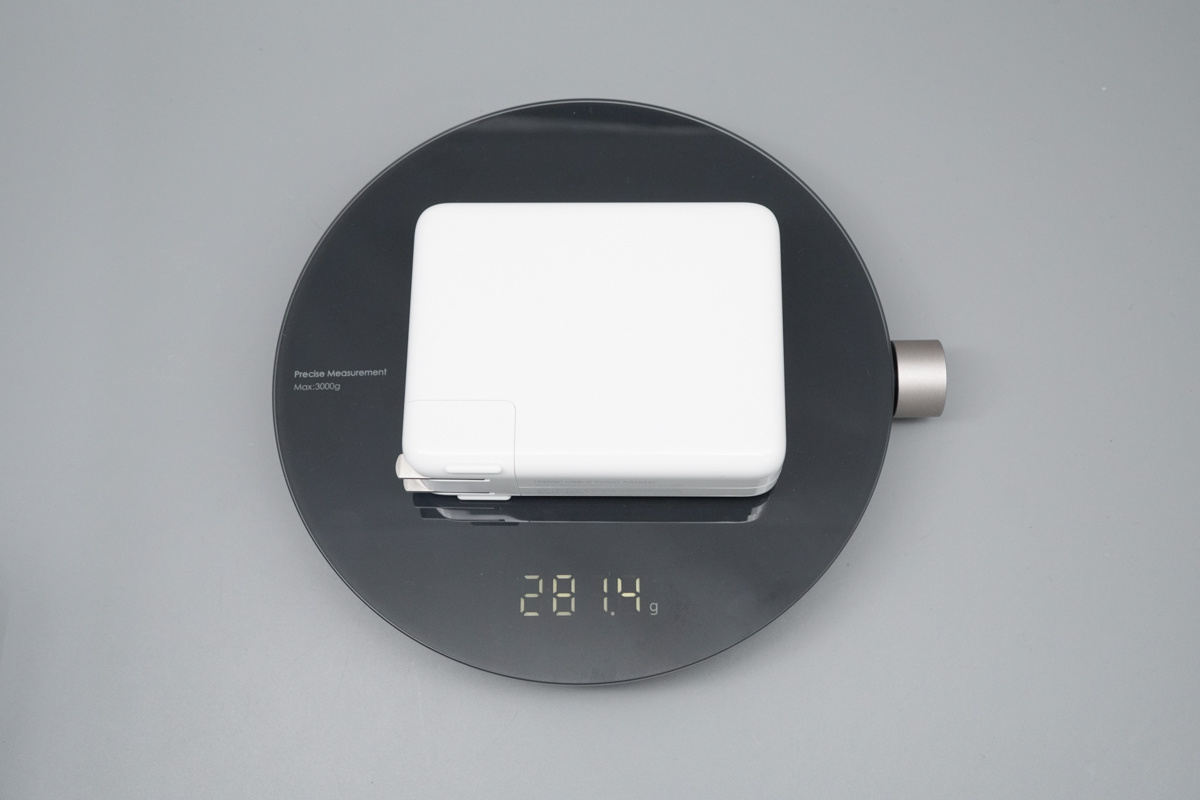
Volume is about 204.99cm³, power density is about 0.68W/cm³, and weight is about 281.4g.
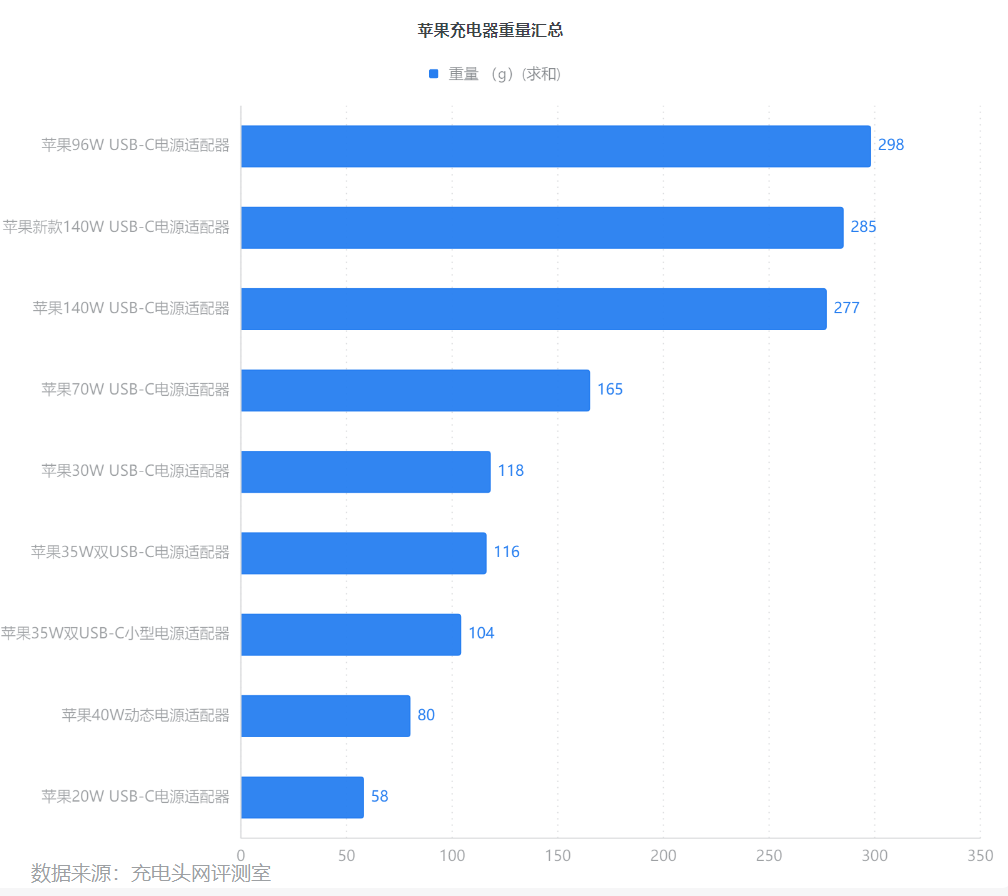
These figures confirm that the A3607 is essentially the same size class as the previous generation, with only minor weight and structural changes.
Protocols and Output Profile
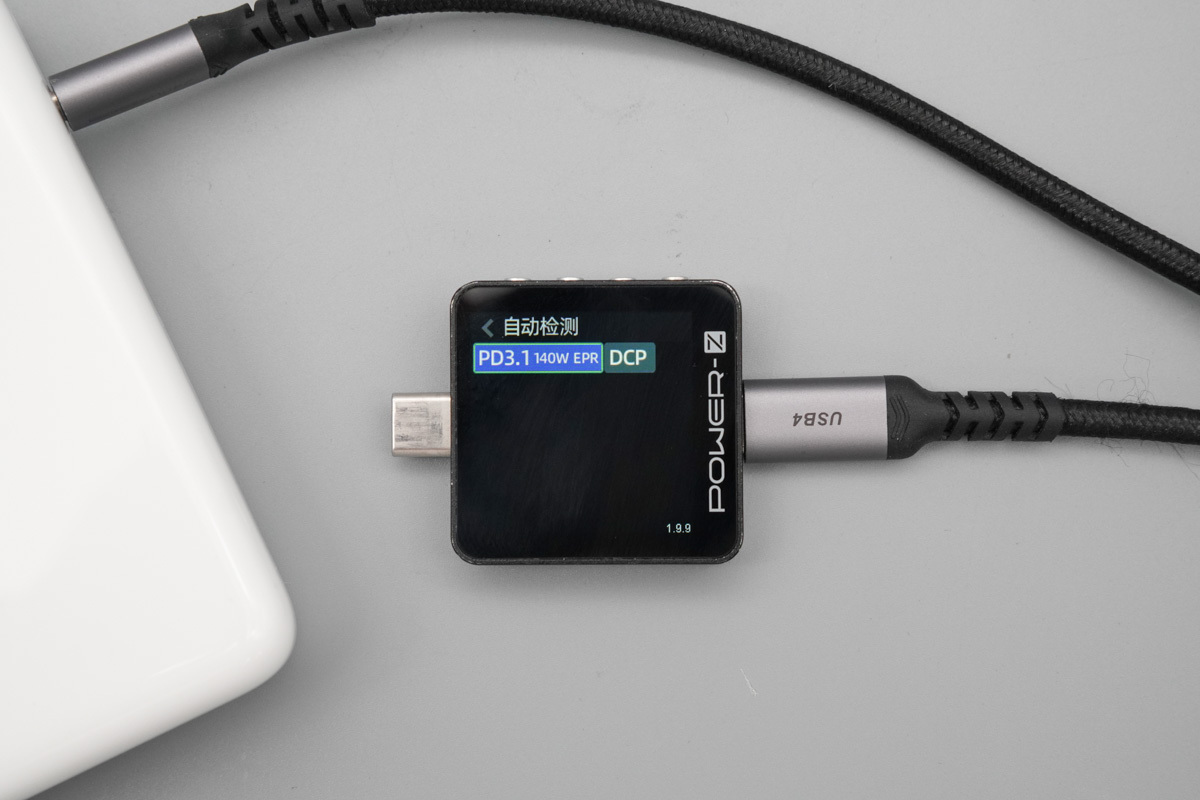
Testing with a POWER-Z KM003C shows that the USB-C port supports PD3.1 and DCP charging protocols.
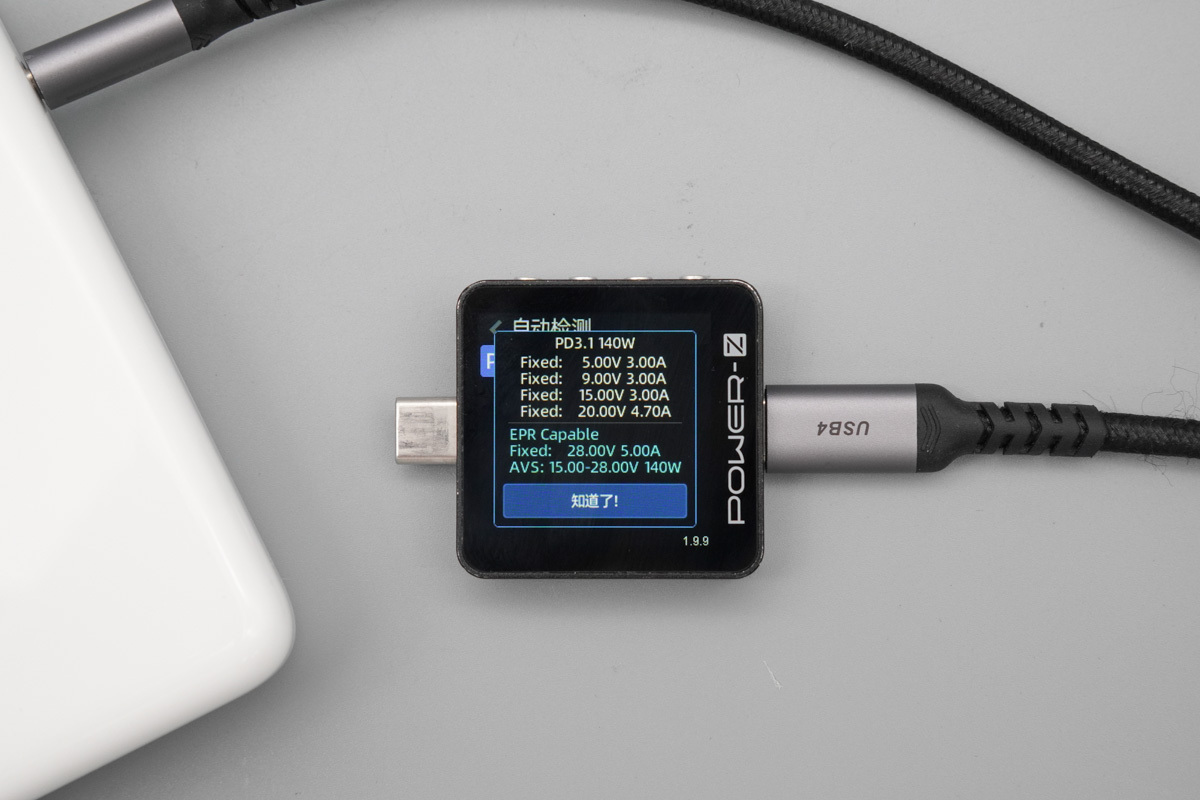
The PDO report lists five fixed voltage steps: 5V3A, 9V3A, 15V3A, 20V4.7A, and 28V5A, plus a 15–28V AVS voltage range rated for 140W. This profile is broad enough to cover phones, tablets, laptops, and high-power MacBook Pro models. The presence of the 28V fixed step and the AVS range is the key reason the A3607 can deliver near-full 140W charging to compatible PD3.1 devices.
Compatibility Across Devices
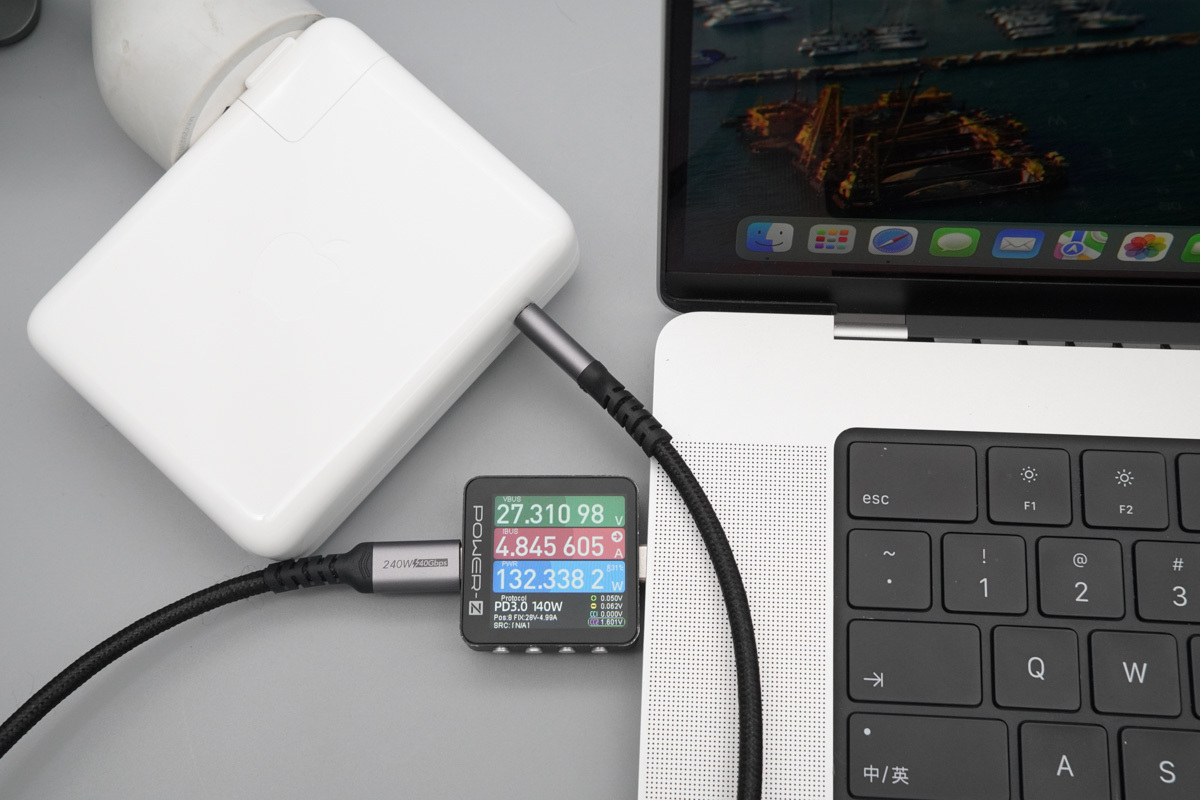
Compatibility testing covered dozens of devices. When charging a MacBook Pro 16 M4 Pro, the charger negotiated PD3.1 and delivered 27.31V at 4.85A, or 132.34W.
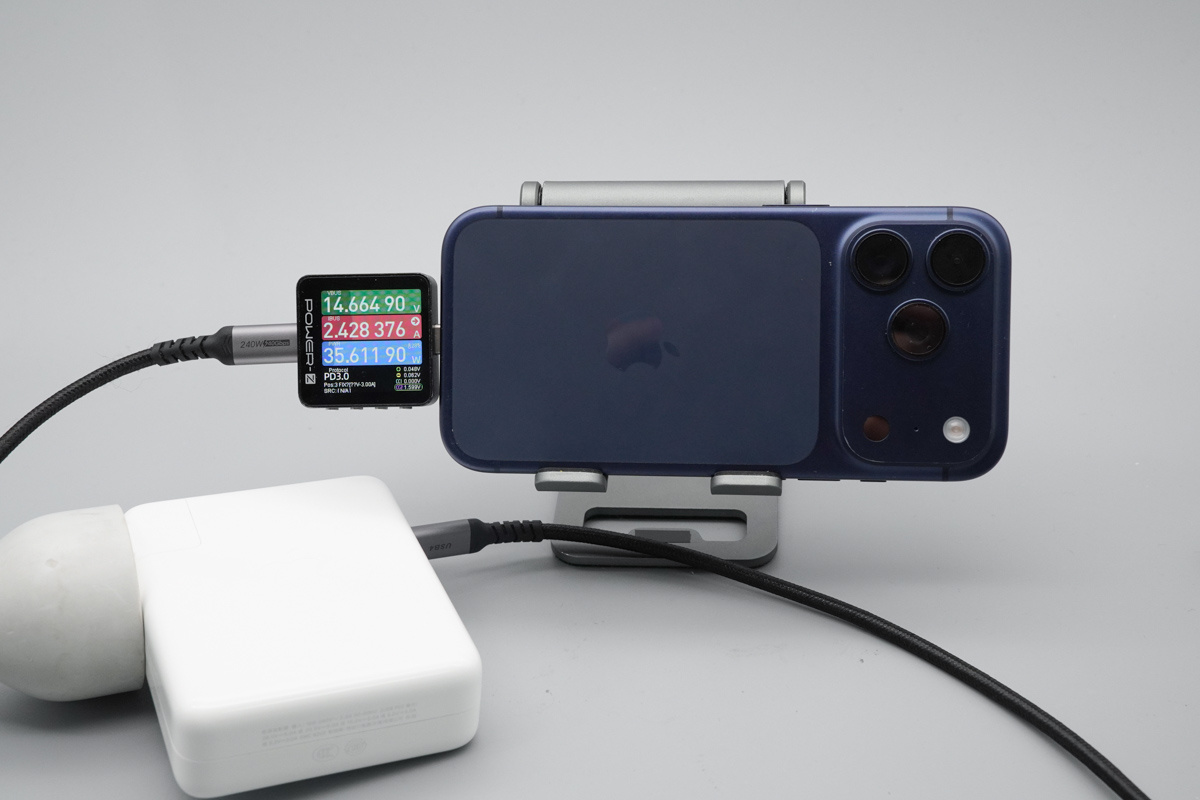
When charging an iPhone 17 Pro, it delivered 14.66V at 2.43A, or 35.61W.
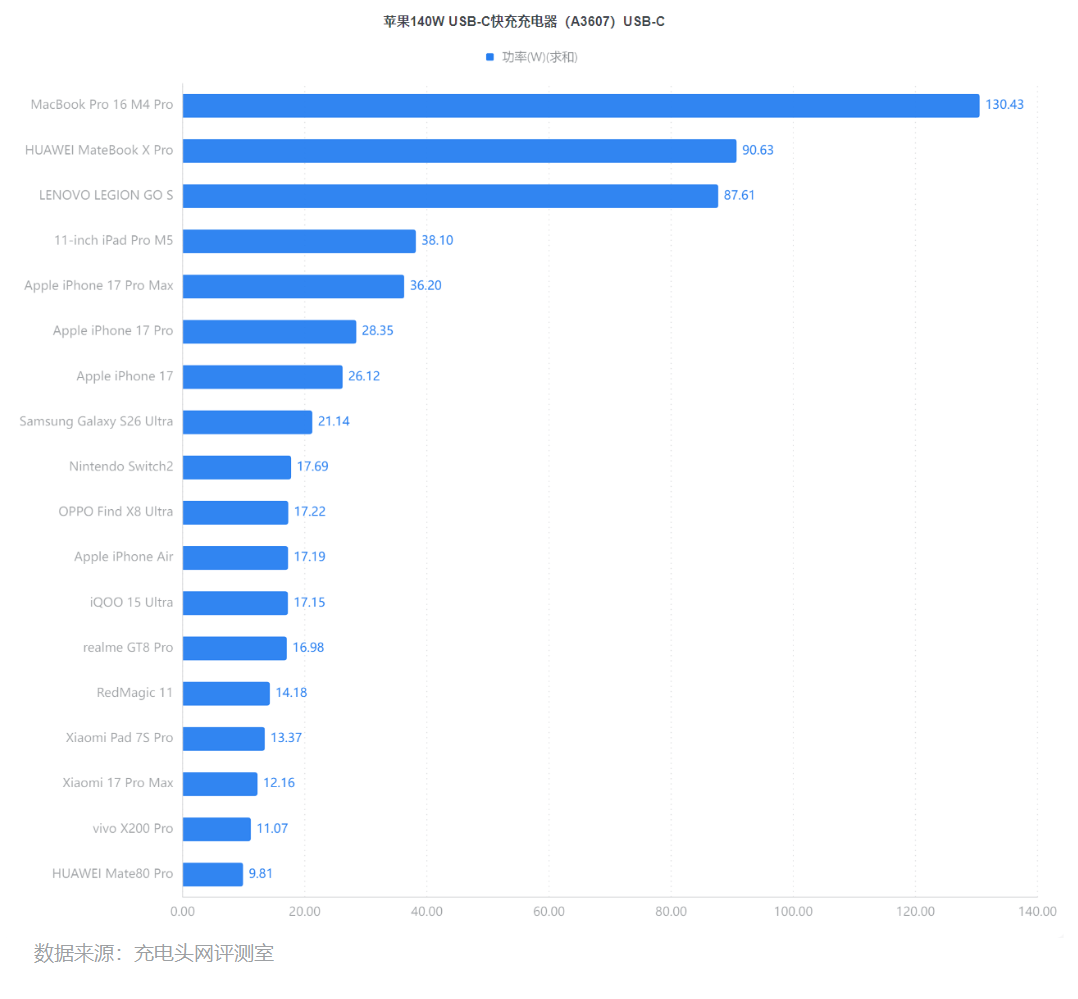
The summary data shows that all tested devices negotiated the PD protocol. The highest recorded power was 130.43W for the MacBook Pro 16 M4 Pro, while high-power PD laptops also performed well: Huawei MateBook X Pro reached 90.63W, and Lenovo Legion Go S reached 87.61W. Apple devices reached their expected fast-charging levels, while most Android phones drew between 9W and 21W. This confirms broad compatibility rather than device-specific optimization.
Charging the iPhone 17 Pro Max
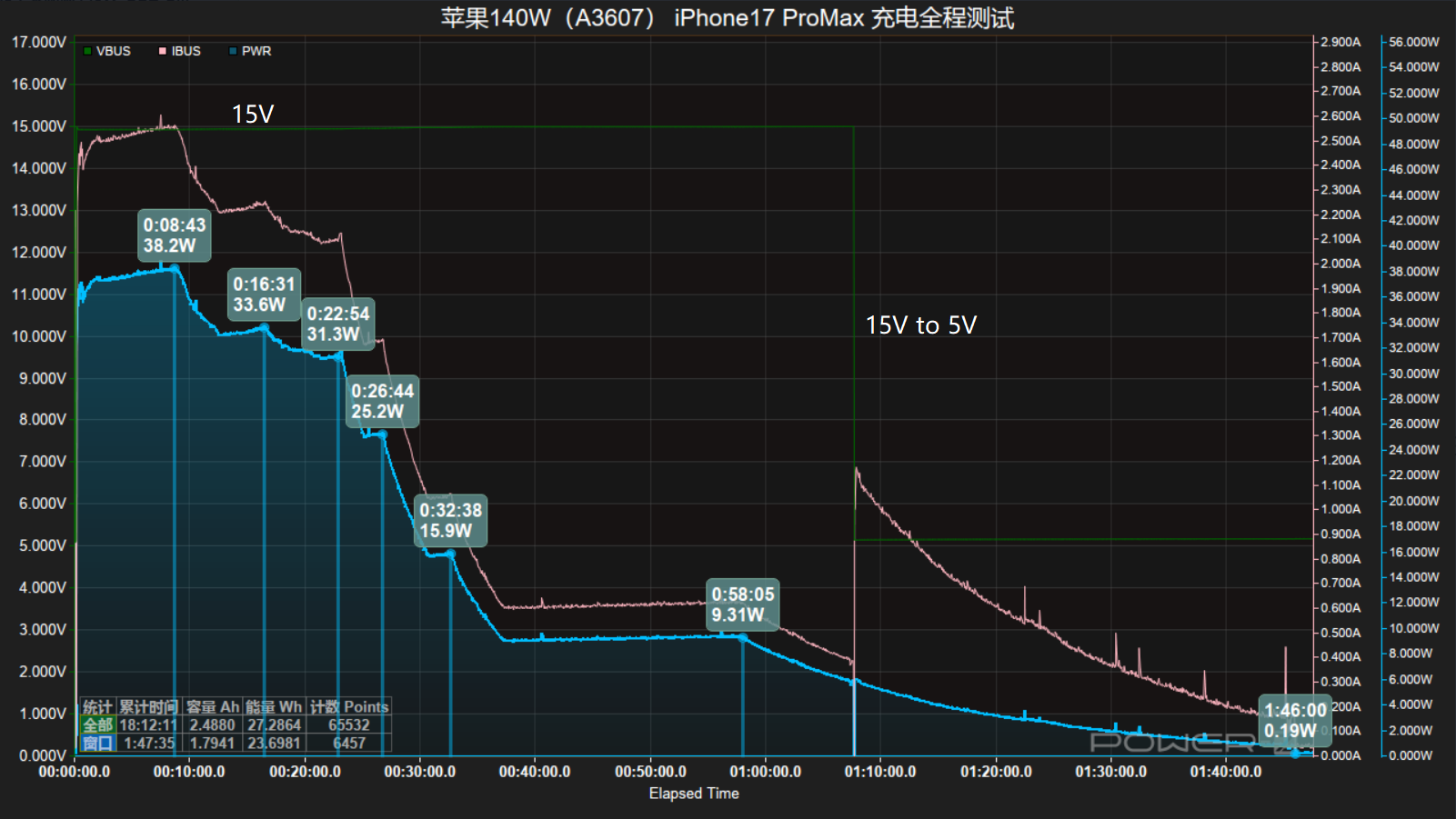
For a full charging test, an iPhone 17 Pro Max was placed in a 25°C constant-temperature chamber and connected to the A3607.
After connection, the phone negotiated 15V and reached 38.2W for the first 8 minutes. Power then stepped down several times, from 33.6W to 31.3W, 25.2W, and 15.9W, before stabilizing at 9.31W until the 58-minute mark. At 1 hour 8 minutes, voltage dropped to 5V and power continued to fall, with charging ending at 1 hour 46 minutes.
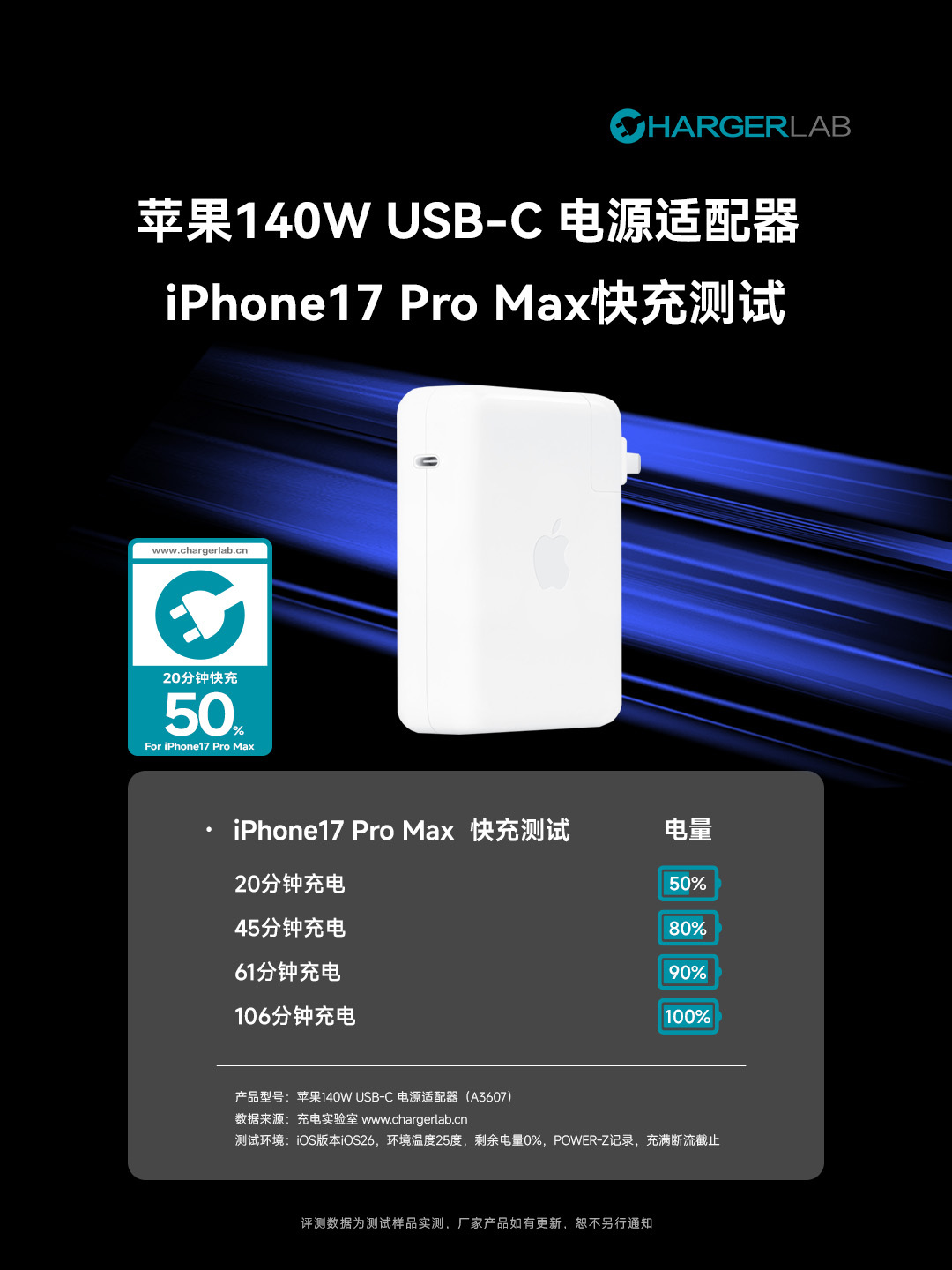
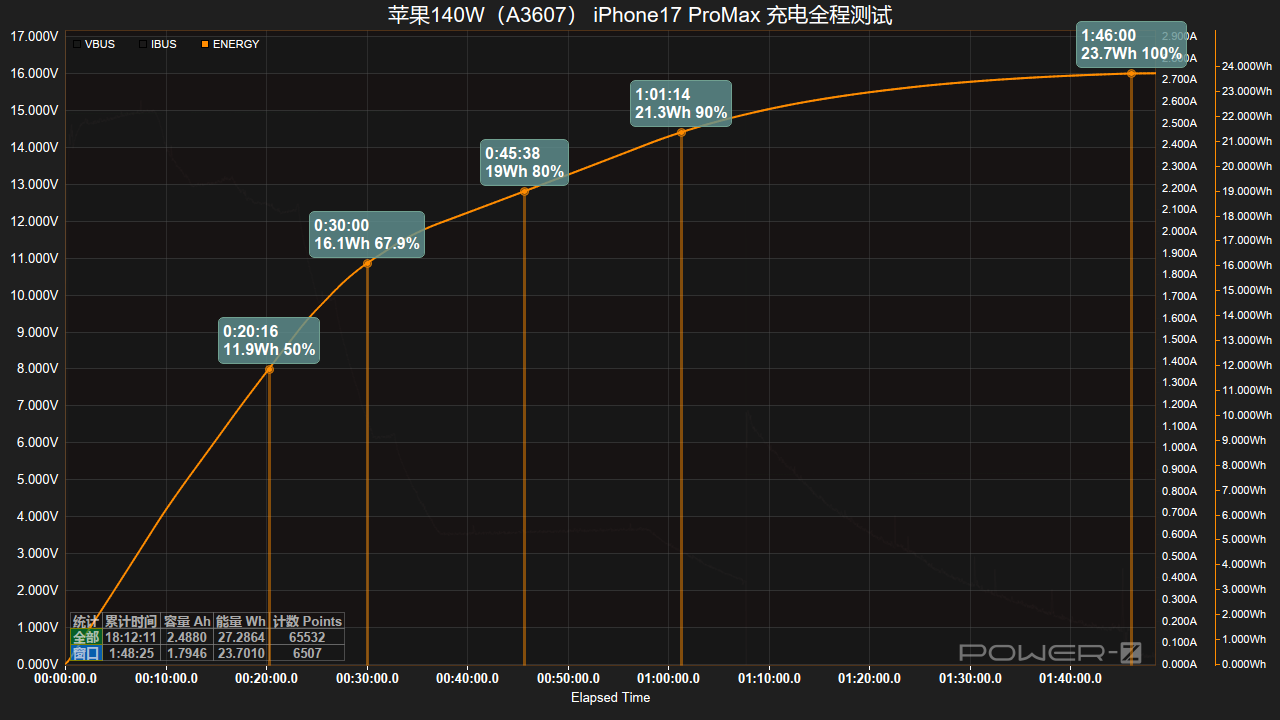
In terms of speed, the charger reached 50% in 20 minutes, 67.9% in 30 minutes, 80% in 45 minutes, 90% in 1 hour 1 minute, and 100% in 1 hour 46 minutes. The result is a strong fast-charge curve for a 140W charger paired with a phone.
Charging the MacBook Pro 16 M4 Pro
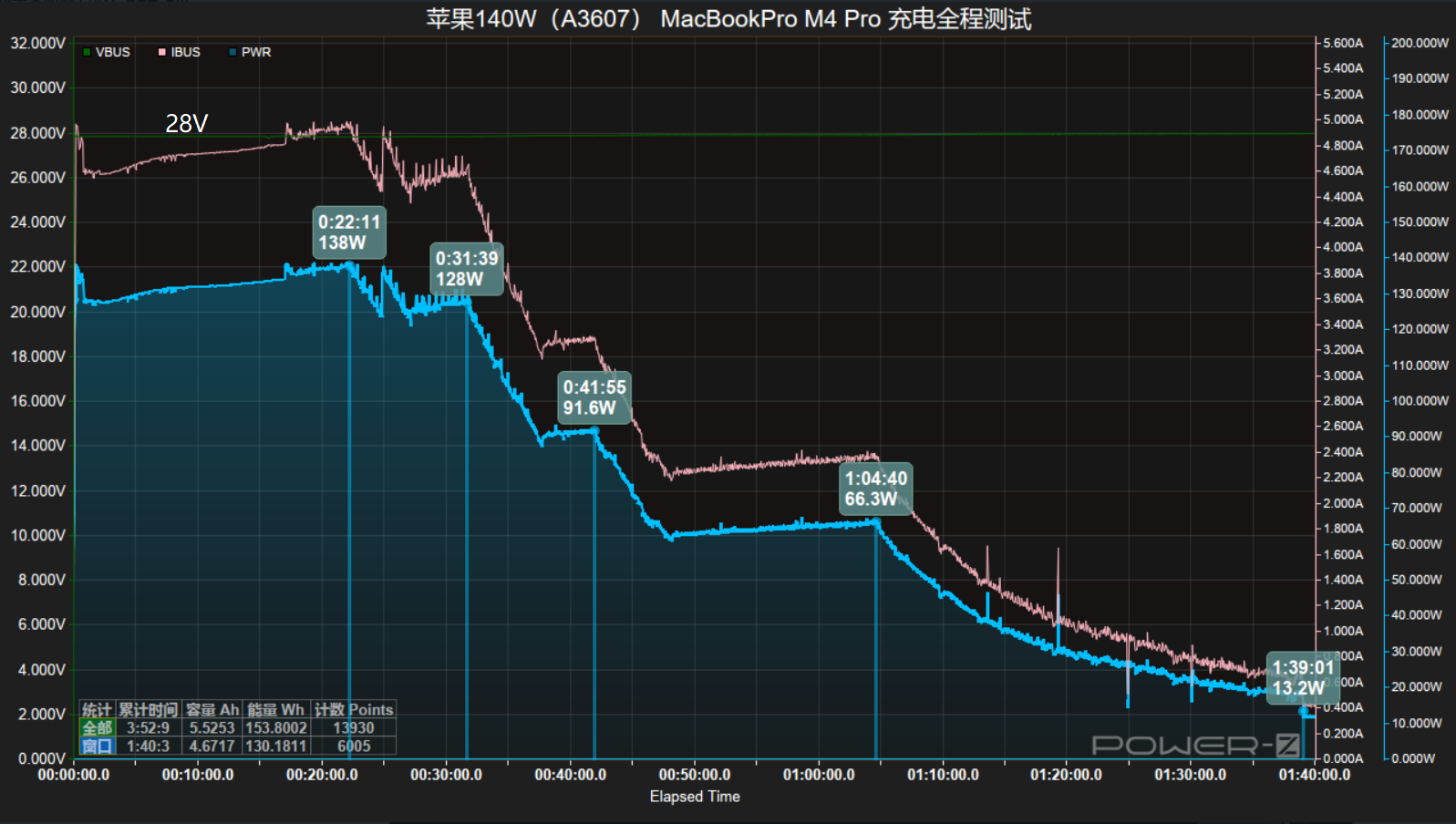
For the notebook test, an original MagSafe 3 magnetic cable connected the A3607 to a MacBook Pro 16 M4 Pro, with a POWER-Z KM003C recording the session. The charger negotiated 28V and delivered 138W until 22 minutes, then 128W until 31 minutes. Power then dropped to 91.6W until 41 minutes and to 66.3W until 1 hour 4 minutes, after which it gradually declined.
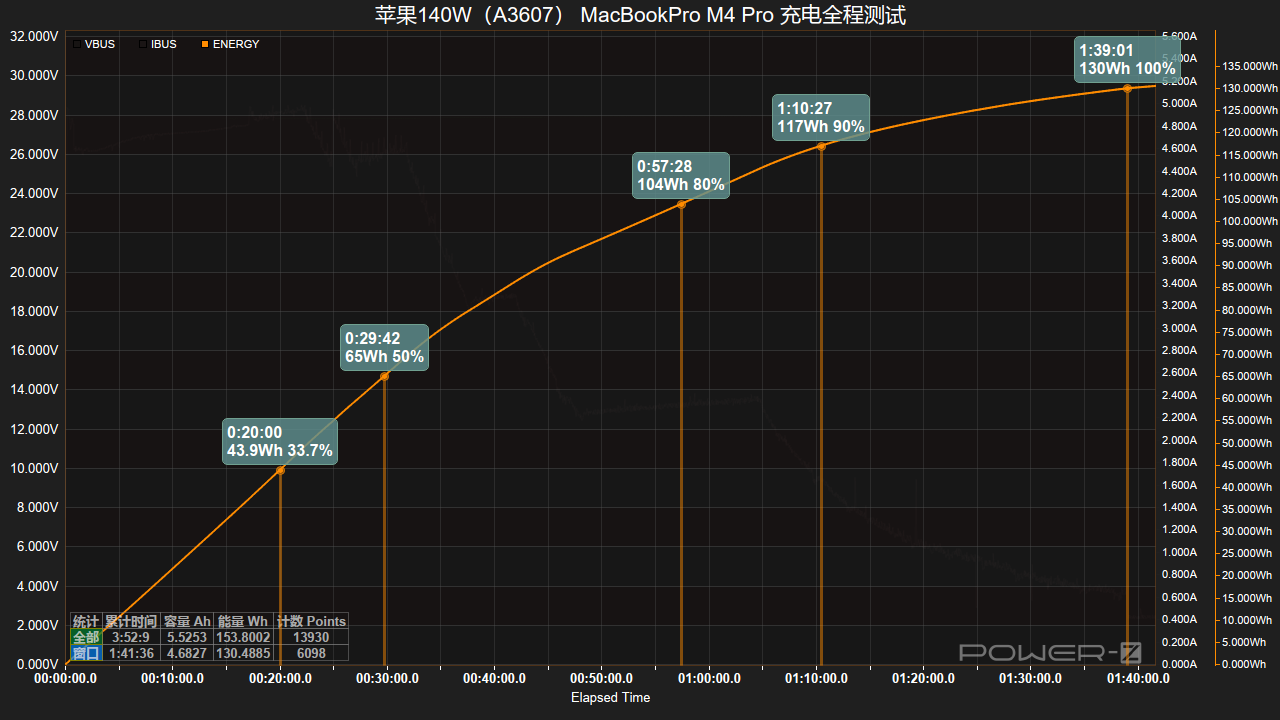
Charging ended at 1 hour 39 minutes 1 second. The charger reached 33.7% in 20 minutes, 50% in 29 minutes, 80% in 57 minutes, 90% in 1 hour 10 minutes, and 100% in 1 hour 39 minutes 1 second. This shows that the A3607 can sustain near-140W output early in the charge and then follow a controlled taper.
Standby Power Consumption
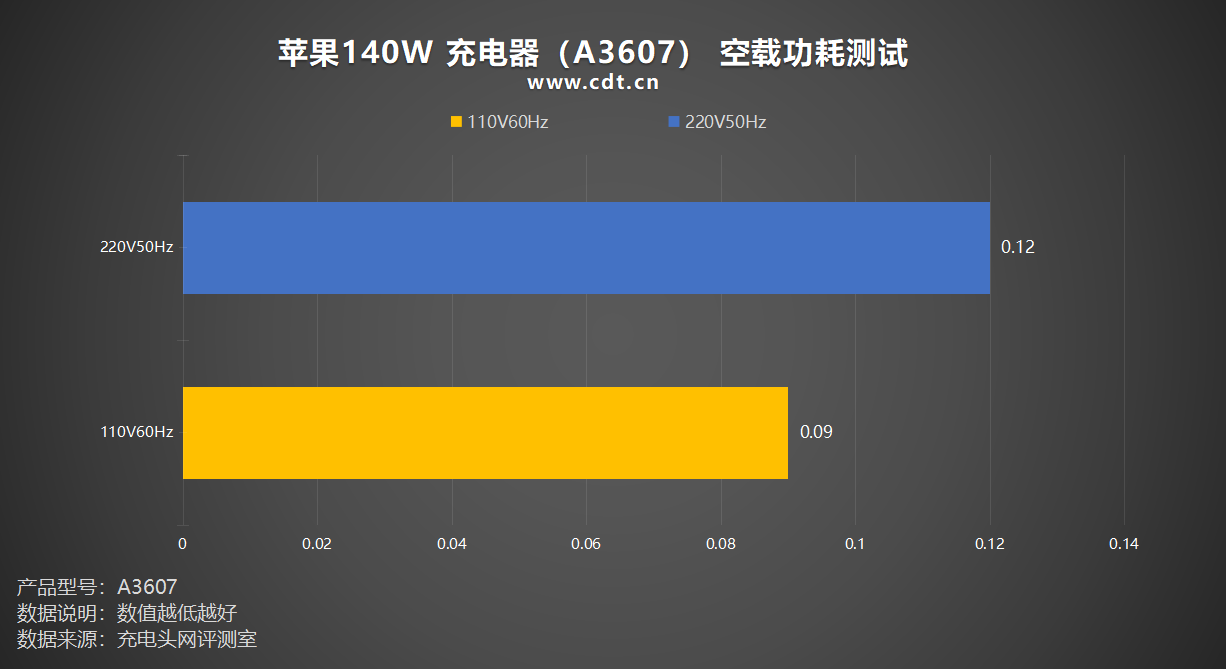
Standby power was measured with the charger plugged in but not charging a device. At 220V 50Hz, no-load consumption was 0.12W, equivalent to about 1.0512kWh per year.
At a electricity price of 0.6 CNY/kWh, the annual cost is about 0.63 CNY. At 110V 60Hz, no-load consumption was 0.09W, or about 0.7884kWh per year, costing about 0.47 CNY annually. These figures are low for a 140W charger and show that long-term idle losses are well controlled.
Conversion Efficiency Above 95%
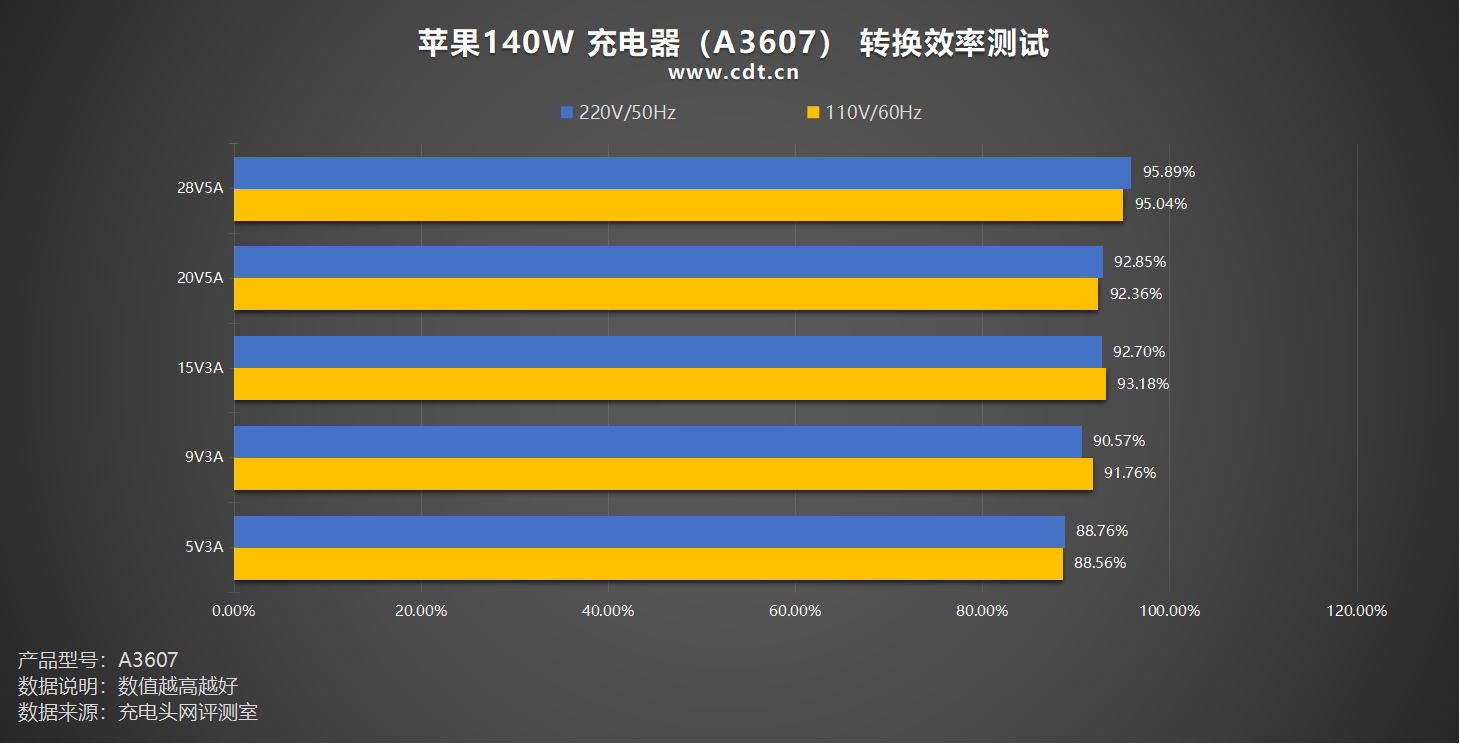
Conversion efficiency was tested at both 220V 50Hz and 110V 60Hz. At 220V, overall efficiency ranged from 88.76% to 95.89%.
The best result was 95.89% at 28V5A, while the lowest was 88.76% at 5V3A. At 110V, efficiency ranged from 88.56% to 95.04%, with the best result again at 28V5A and the lowest at 5V3A.
The key takeaway is that the A3607 exceeds 95% efficiency at its highest power step under both voltage environments. This places it in the first tier of comparable 140W chargers and explains why thermal performance remains controlled at full load.
Output Quality and Thermal Control

The summary data notes that output ripple is far below the communications-industry standard, indicating clean and stable power delivery.
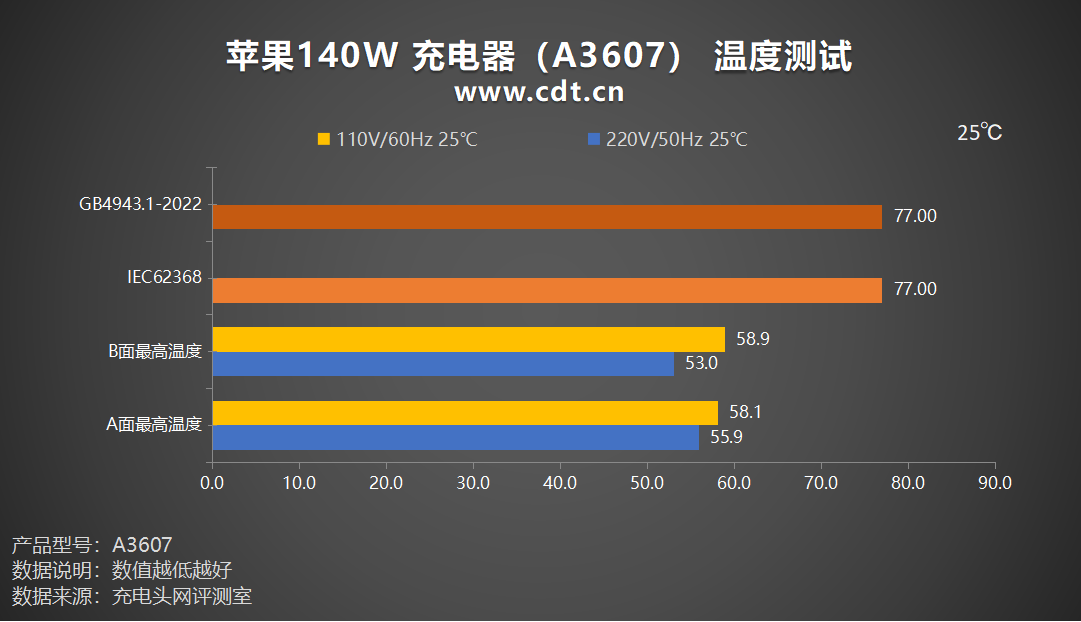
Thermal testing at 28V5A full load for one hour showed maximum surface temperatures below 60°C under both 220V and 110V environments. The charger maintained stable output without power-dropping fluctuations.
For a compact 140W adapter, this combination of low ripple and controlled heat is important for long charging sessions, especially when powering a high-performance notebook.
Final Verdict: A Refined Internal Update
The Apple A3607 is not a consumer-facing “feature upgrade” over the A2452. Its exterior dimensions, power rating, port configuration, and power density remain essentially unchanged, with only a slight weight increase and minor pin-structure adjustment.
The real improvements are internal: higher full-load efficiency, low standby consumption, clean output, and stable thermal behavior. For users with a MacBook Pro 16 or other high-power PD3.1 devices, the A3607 is a safe, stable, and efficient original-equipment choice.
For existing A2452 owners, the upgrade is not urgent, because the everyday experience is nearly identical. The A3607’s value lies in refined engineering rather than new features, making it a mature benchmark for high-end PD3.1 fast charging.
 UGREEN 300W 8-Port Desktop Charger Review: 6C + 1A + DC Smart Power Hub