



The GaN Revolution: Redefining Efficiency in Low-Voltage Power Electronics and Desktop Charging
 14 Jan,2026
1. The Rise of Low-Voltage GaN in Power Electronics
As the demand for higher energy efficiency and power density accelerates, the power semiconductor industry is rapidly transitioning from silicon to Gallium Nitride (GaN). While 650V high-voltage GaN has already become mainstream in primary-side fast chargers, low-voltage GaN is emerging as the next disruptive force, reshaping secondary-side power conversion from 20W to 300W.
With its superior breakdown electric field and ultra-low gate charge, low-voltage GaN enables significantly higher switching frequencies than silicon MOSFETs. This capability allows designers to dramatically reduce the size of transformers, inductors, and filtering components. In modern desktop charging systems, low-voltage GaN provides the foundation for compact, high-power, multi-port designs without compromising efficiency or thermal performance. As consumer expectations continue to rise, the desktop charge market is rapidly shifting toward high-density GaN-based architectures.

2. High-Frequency PD Fast Charging and Desktop Charge Stations
Power Delivery (PD) fast charging spans a wide voltage range from 5V to 48V, placing strict demands on secondary-side rectification and DC-DC conversion. Traditional silicon MOSFETs struggle at high frequencies due to high input capacitance and reverse recovery losses, making further frequency scaling impractical.
Low-voltage GaN eliminates this bottleneck. By replacing silicon rectifiers with GaN devices, desktop charge systems can operate in the hundreds of kilohertz to multi-megahertz range. The result is smaller inductors, reduced EMI filtering requirements, and higher overall efficiency. Although GaN devices currently carry a cost premium, the rapid expansion of 8-inch GaN-on-silicon wafer production is closing this gap. For premium desktop charge stations, all-GaN architectures are becoming the new benchmark, directly linking port efficiency and power density to GaN adoption.
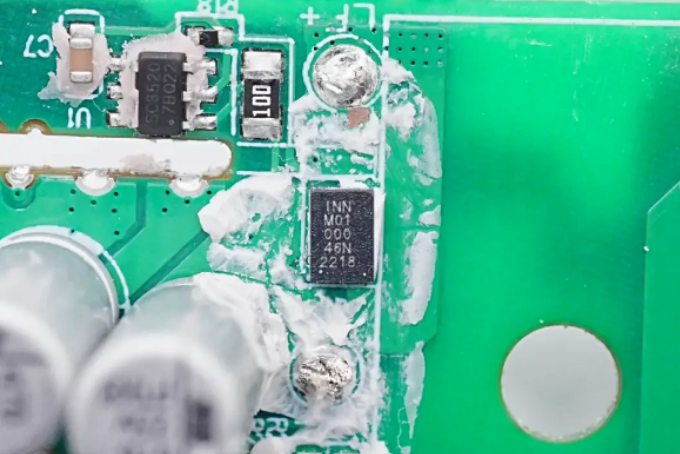
3. Automotive Chargers and Vehicle Docking Systemsw
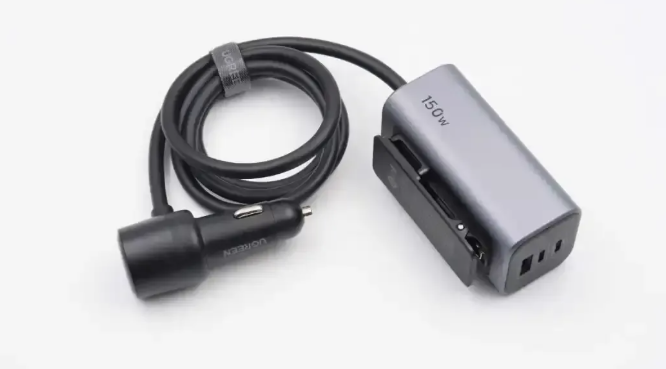
Automotive charging environments present unique challenges, including limited space, wide input voltage ranges, and strict thermal constraints. Car chargers typically rely on buck-boost topologies to convert 12V or 24V battery power into stable PD outputs. As PD3.1 adoption increases, multi-port desktop charge solutions for vehicles are becoming essential accessories.
Integrating low-voltage GaN into automotive desktop charge designs significantly improves conversion efficiency and reduces heat generation—critical advantages in enclosed vehicle cabins. GaN also enables thinner, lighter car chargers and docking stations by reducing inductor size and component count. Furthermore, higher efficiency minimizes parasitic battery drain, which is especially valuable for electric vehicles. As a result, vehicle desktop charge capabilities are rapidly approaching the performance level of home and office desktop charge systems.
4. GaN Expansion into Consumer and Personal Electronics
Low-voltage GaN is now extending beyond traditional chargers into personal care and handheld consumer devices. Ultrasound beauty devices represent one of the first commercial uses of GaN in this segment. By leveraging GaN’s high-frequency switching, designers can achieve precise energy control while significantly reducing PCB area.
In these compact systems, GaN functions as a miniature desktop charge engine, minimizing peripheral components and improving battery-to-load efficiency. The result is longer usage time, improved thermal behavior, and greater design freedom. As desktop charge design principles migrate into personal electronics, GaN is becoming a key enabler of premium, portable, and thermally stable consumer products.
5. Ultra-Slim Power Banks and Laptop Power Architectures
Power banks and laptops are major battlegrounds for low-voltage GaN adoption. Advanced GaN-based power banks now use E-mode GaN in bi-directional buck-boost circuits to support 5V–28V desktop charge performance with exceptional efficiency. This allows portable power banks to deliver power densities once reserved for stationary desktop charge stations.
Inside laptops, low-voltage GaN is increasingly used in DC-DC stages that convert 19V–20V adapter input into CPU and GPU supply rails. GaN’s low losses reduce heat and free valuable board space, enabling thinner chassis and higher sustained performance. The synergy between external GaN desktop charge adapters and internal GaN power stages is becoming essential for next-generation high-performance laptops.
6. BMS and Industrial DC-DC Power Systems
Battery Management Systems (BMS) demand high reliability, fast transient response, and minimal parasitic effects. Low-voltage GaN helps meet these requirements by reducing switching losses and component size while improving system responsiveness. Compared with traditional desktop charge components, GaN-based BMS designs offer higher safety margins and lower failure rates.
In industrial and data center applications, 48V-to-12V DC-DC brick power modules are rapidly adopting low-voltage GaN to push switching frequencies into the MHz range. These high-density desktop charge-inspired architectures simplify system design while achieving peak efficiency. For data centers, this translates directly into lower energy consumption and improved thermal management under massive computing loads.
7. Precision Control in LiDAR and Robotics
Beyond power conversion, low-voltage GaN plays a critical role in precision control systems. LiDAR requires nanosecond-scale pulse transitions to achieve centimeter-level distance resolution. GaN devices, with sub-nanosecond switching capability, are ideal for driving laser diodes with extreme accuracy.
Similarly, robotic servo drives benefit from GaN’s ability to operate at higher PWM frequencies, reducing motor losses and thermal stress in compact joints. The same power-density philosophy that defines premium desktop charge products now enables more agile, efficient, and durable robotic systems. GaN ensures that every robotic power cycle is optimized for performance and endurance.
8. Smartphone Power Paths and the Future of Low-Voltage GaN
In smartphones and tablets, low-voltage GaN is already reshaping fast-charging path management. By replacing multiple silicon MOSFETs with a single GaN device, manufacturers achieve lower resistance, bi-directional cutoff, and significantly reduced heat during desktop charge sessions.
As mobile charging power exceeds 100W, silicon struggles to handle high current without thermal throttling. GaN’s superior thermal stability allows devices to sustain peak charging speeds for longer periods. With global supply chains shifting toward mature 8-inch GaN processes, low-voltage GaN is set to become the foundational technology behind future desktop charge systems—from mobile devices to industrial infrastructure.
 TORRAS 67W Retractable GaN Charger Review: The Ultimate Ultra Thin Charger and Slim Charger for Multi-Device Fast Charging